|
 |
 |
 |
 |
 |
 |
 |
 |

 |
UAB Researchers Discover HIV-1 Originated in Wild Chimpanzees
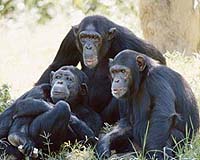
Birmingham AL (SPX) May 30, 2006 An international team of scientists, led by researchers at the University of Alabama at Birmingham (UAB), has discovered a crucial missing link in the search for the origin of HIV-1, the virus responsible for human AIDS. That missing link is the natural reservoir of the virus, which the team has found in wild-living chimpanzees in southern Cameroon. The findings provide important clues to how the disease migrated from non-human to human primates and will be published in an upcoming issue of Science magazine. Although researchers have long suspected that HIV-1's origins lie in some way with chimpanzee infection through a closely related virus SIVcpz (simian immunodeficiency virus from chimpanzees), only a few captive apes had been found to harbor SIVcpz. In the study, UAB Professor of Medicine Beatrice H. Hahn, M.D., and her team conducted the first-ever molecular epidemiological survey of SIVcpz infection in wild-living chimpanzees in west-central Africa. By analyzing ape fecal samples collected by trackers from the forest floor in remote jungle regions of Cameroon, Hahn and her colleagues were able to detect SIVcpz-specific antibodies and nucleic acids (viral genetic information) in as many as 35 percent of chimpanzees in some ape communities. The UAB investigators went on to molecularly clone and sequence the complete viral genomes from four individual chimpanzees. According to UAB post-doctoral researcher Brandon Keele, Ph.D., lead author of the report, "this allowed for unprecedented genetic comparisons to be done between HIV-1 and its closest simian virus counterpart." He went on to say that "finding this cluster of naturally infected chimpanzees will allow us to explore the natural history and behavior of SIVcpz in its natural host and help us begin to unravel how and why SIVcpz made the jump to humans." Hahn, who for more than a decade has led an international effort to elucidate the origins of HIV-1, emphasized that the current study could not have succeeded without a close working partnership with Cameroonian government officials and with other collaborating scientists, including George M. Shaw, M.D., Ying Ying Li, Jun Takehisa, Mario Santiago, Frederic Bibollet-Ruche, and Yalu Chen from UAB; Fran Van Heuverswyn, Florian Liegeois, Eric Delaporte and Martine Peters from the University of Montpellier, France; Elizabeth Bailes, Louise Wain, John Brookfield and Paul Sharp from the University of Nottingham, England; and Severin Loul, Eitel Mpoudi Ngole and Yanga Bienvenue from the Project Pr�vention du Sida au Cameroun (PRESICA). Community Email This Article Comment On This Article Related Links University of Alabama at Birmingham ScienceExpress Epidemics on Earth - Bird Flu, HIV/AIDS, Ebola
 UN conference to assess HIV-AIDS programs worldwide
 United Nations (AFP) May 29, 2006
 A United Nations conference opening this week will assess AIDS and HIV programs on the world level, 25 years after the scourge appeared and went on to take 25 million lives. |
|
|

| The content herein, unless otherwise known to be public domain, are Copyright 1995-2006 - SpaceDaily.AFP and UPI Wire Stories are copyright Agence France-Presse and United Press International. ESA PortalReports are copyright European Space Agency. All NASA sourced material is public domain. Additionalcopyrights may apply in whole or part to other bona fide parties. Advertising does not imply endorsement,agreement or approval of any opinions, statements or information provided by SpaceDaily on any Web page published or hosted by SpaceDaily. Privacy Statement |