|
 |
 |
 |
 |
 |
 |
 |
 |

 |
Tyrannosaur Survivorship -- Tough Times For Teens
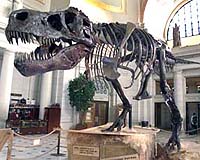
Edmonton, Canada (SPX) Jul 19, 2006 A massive dinosaur death bed in Alberta has helped map out the animal's life span and thrown doubt on long-held theories about how one species lived, says new research conducted in part at the University of Alberta. "One of the surprises to me was that the overall pattern of survivorship fits closer to an attritional model rather than the catastrophic model we were expecting," said world-renowned paleontologist Dr. Phillip Currie and professor in the U of A's Department of Biological Sciences. "Hopefully this will help us to unravel the cause of death of so many carnivores at one location. "It's also surprising that something like this study has never been done before." For decades, scientists believed dinosaurs were bigger versions of living reptiles but this new research, published in the current issue of Science, shows that the life pattern of the Albertosaurus is closer to that of living large mammals. The pattern also shows that if the Albertosaurus lived until the age of two, he enjoyed a low death rate until the teenage years when mortality increased. In 1910, a collecting party from the American Museum of Natural History floated down Alberta's Red Deer River. Led by Barnum Brown, they excavated skeletons of nine individuals of Albertosaurus sarcophagus from a single quarry. It is the best evidence that exists to suggest that tyrannosaurids may have been gregarious, or pack, animals. The almost complete lack of herbivore bones from the excavation suggests that this was probably not a predator trap. Recognizing the importance of the site, Currie led an expedition in 1997 to try to find Brown's original quarry and returned annually with a group from the Royal Tyrrell Museum of Palaeontology to excavate the site. The number of Albertosaurus individuals is now known to be at least 22, which range from two to almost 10 metres in total length. For this latest paper, Currie collaborated with Dr. Gregory Erickson from Florida State University to produce the first age-standardized ecological life table for a non-avian dinosaur population. They selected fibulae or metatarsals from individuals and used growth line counts to estimate ages at death. They found that the complex survivorship pattern is remarkably similar to that seen in living large mammals. High newborn mortality rates due to predation alone subside once a threshold size is reached and it appears that such a threshold was reached by age two in Albertosaurus sarcophagus, say the research team. The mortality rates remained low until about the 13th year of life, at which point they reached total lengths of six metres or 60 per cent of their maximum recorded size. At that point, mortality rates escalated to more than 23 per cent a year. 70% of the animals surviving to two years of age were still alive at age 13, which would help explain why so few bones of young adults have been found. "One implication of these findings is that the previously mysterious rarity of sub-adult tyrannosaur specimens is due to their exceptionally low mortality rates," said Currie. Some people have speculated that tyrannosaurs must have rocketed to adult size in a few years or less, leaving only a small fraction of development that juveniles could have contributed to the fossil record. "However, this notion is inconsistent with our growth curve," say the researchers in the paper. "Instead, we suggest that these young animals simply had low mortality, just like older juveniles and subadults of most large terrestrial mammals today." The estimated survivorship curve also provides a possible explanation for the rarity of individual giants--just two per cent of the population lived long enough to attain maximal size and age for the species. Community Email This Article Comment On This Article Related Links University of Alberta Darwin Today At TerraDaily.com
 Evolution Can Occur Quickly Change Population Interaction
 Los Angeles CA (SPX) Jul 17, 2006
Biologists generally accept that evolutionary change can take from decades to millennia, while ecological change can occur over mere days or seasons. However, a new Cornell study shows that evolution and ecology can operate on the same time scale. |
|
|

| The content herein, unless otherwise known to be public domain, are Copyright 1995-2006 - SpaceDaily.AFP and UPI Wire Stories are copyright Agence France-Presse and United Press International. ESA PortalReports are copyright European Space Agency. All NASA sourced material is public domain. Additionalcopyrights may apply in whole or part to other bona fide parties. Advertising does not imply endorsement,agreement or approval of any opinions, statements or information provided by SpaceDaily on any Web page published or hosted by SpaceDaily. Privacy Statement |