|
 |
 |
 |
 |
 |
 |
 |
 |

 |
Two Comets To Glow In The Spring Sky
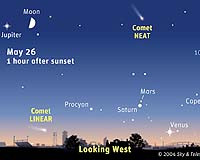
Los Angeles - Apr 28, 2004 Seven years have passed since Comet Hale-Bopp graced the evening sky in the spring of 1997. Now not just one but two new comets are heading into springtime view -- though they won't come near Hale-Bopp for brightness and grandeur. In fact, no one yet knows whether they'll reach naked-eye visibility for most people in North America and Europe. But even if they don't, anyone should be able to catch them with binoculars. But you'll have to know when and where to look. Sky & Telescope magazine provides complete instructions. Sky & Telescope's editors are tracking the comets' brightnesses and will post updates on the magazine's Web site, SkyandTelescope.com, in the coming weeks so that no one need miss this spring's comet show.
Here is an overview of what to expect. The two arriving visitors are named Comet Linear and Comet Neat, after the search programs that found them (Lincoln Near-Earth Asteroid Research, which uses a pair of telescopes in New Mexico, and the Near-Earth Asteroid Tracking program, which uses telescopes in California and Hawaii). Right now, Comet Linear is hard find to in the bright glow of dawn just above the eastern horizon before sunrise, and Comet Neat is visible only from the Southern Hemisphere. But that will soon change. For now, in the final week of April and the first few days of May, North American and European skywatchers do have a shot at spotting Comet Linear before dawn on clear mornings. Scan with binoculars just above the horizon due east about 60 minutes before your local time of sunrise. (There's a chance that observers may detect another comet, Comet Bradfield, somewhat to the left of Linear on April 24th and for the next few mornings. But the chances for this one are slimmer.) In subsequent weeks both Linear and Neat will come into in the evening sky, where they'll be in more convenient view. Starting around May 5th or 6th, scan for Comet Neat just above the southwest horizon as evening twilight fades. You're looking for a small, fuzzy "star" with a small tail pointing to the upper left. [The much brighter star Sirius will also be low in the southwest; on May 5th the comet will be not far to its left, and on May 6th the comet will be to Sirius's upper left.] In the next two weeks Comet Neat will get much higher in the southwest at nightfall, though it will also fade. Binocular users may be able to follow it through the end of May. Around May 26th or 28th, Comet Linear could steal the show when it too enters the evening sky. Look for it just above the west-southwest horizon as twilight fades. It will get only a little higher in the following week or two, while fading rapidly. Full details, including charts showing when and where to look for both comets (from the Southern Hemisphere too!) Appear in the May 2004 issue of Sky & Telescope and in the article "The Double Comet Show of 2004". Community Email This Article Comment On This Article Related Links Sky and Telescope SpaceDaily Search SpaceDaily Subscribe To SpaceDaily Express Astronomy News from Skynightly.com
 Venus Express Completes LEOP Activities
 Paris (ESA) Nov 15, 2005
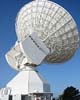
The Venus Express Launch and Early Orbit Phase (LEOP) activities again continued to run very smoothly. All foreseen activities were completed and it was also possible to bring forward some platform commissioning activities, which were planned for last weekend. |
|
|

| The content herein, unless otherwise known to be public domain, are Copyright 1995-2006 - SpaceDaily.AFP and UPI Wire Stories are copyright Agence France-Presse and United Press International. ESA PortalReports are copyright European Space Agency. All NASA sourced material is public domain. Additionalcopyrights may apply in whole or part to other bona fide parties. Advertising does not imply endorsement,agreement or approval of any opinions, statements or information provided by SpaceDaily on any Web page published or hosted by SpaceDaily. Privacy Statement |