|
 |
 |
 |
 |
 |
 |
 |
 |

 |
Two-Billion-Year-Old Surprise Found Beneath The Azores
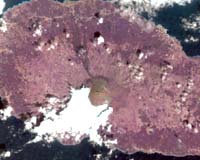
Bristol - Nov 26, 2002 Geologists may have to revise their ideas about what goes on in the Earth's interior, following the publication today of new research in the journal Nature. It appears that contrary to previous belief, part of the interior has remained undisturbed for at least two-and-a-half billion years, in spite of the massive forces at work inside the planet. Like a saucepan of thick syrup being heated on the stove, huge convection currents within the Earth, generated by heat from the core, have stirred up the interior for most of its four-and-a-half billion year history. This has led geologists to believe that the interior is now well mixed. But Dr Simon Turner and Professor Chris Hawkesworth from the Earth Sciences Department at Bristol University, with colleagues at the Open University, have new data that suggest the presence of extremely ancient material beneath the Azores. The islands of the Azores are volcanoes that sit either side of the Mid-Atlantic Ridge, a huge mountain chain beneath the ocean that formed as hot material from the Earth's interior rose to the surface. In some places, such as the Azores, the tops of these mountains form islands. The lavas from the Azores volcanoes appear to have been derived from some of the oldest material yet discovered within the convecting and well stirred part of the Earth. One of the few ways to obtain information about the processes that go on in the Earth's interior is to analyse material that is brought up from these depths. The researchers therefore analysed the ratios of certain elements in the lavas that specifically characterise the source material they were derived from. Dr Turner said: "The osmium ratios obtained in some of the Azores rocks are among the lowest ever seen in oceanic lavas. This indicates that the region from which the lavas were derived contained material that was left behind when continents were formed about two-and-a-half billion years ago. "This depleted material was subsequently recycled back into the interior beneath the volcanic islands, where it has remained ever since." The fact that such old material could reside in the Earth's interior for so long without being recycled will help inform new models about processes that go on inside the Earth. Community Email This Article Comment On This Article Related Links University of Bristol SpaceDaily Search SpaceDaily Subscribe To SpaceDaily Express Explore The Early Earth at TerraDaily.com
 Oxygen in Ancient Atmosphere Rose Gradually To Modern Levels
 College Park MD (SPX) Dec 03, 2005
The history of life on Earth is closely linked to the appearance of oxygen in the atmosphere. The current scientific consensus holds that significant amounts of oxygen first appeared in Earth's atmosphere some 2.4 billion years ago, with a second large increase in atmospheric oxygen occurring much later, perhaps around 600 million years ago. |
|
|

| The content herein, unless otherwise known to be public domain, are Copyright 1995-2006 - SpaceDaily.AFP and UPI Wire Stories are copyright Agence France-Presse and United Press International. ESA PortalReports are copyright European Space Agency. All NASA sourced material is public domain. Additionalcopyrights may apply in whole or part to other bona fide parties. Advertising does not imply endorsement,agreement or approval of any opinions, statements or information provided by SpaceDaily on any Web page published or hosted by SpaceDaily. Privacy Statement |