|
 |
 |
 |
 |
 |
 |
 |
 |

 |
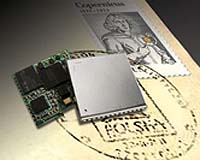
Trimble's Tiny Surface Mount GPS Receiver Adds WAAS And EGNOS Capability
Hannover, Germany (SPX) Mar 17, 2007 Trimble has introduced a new firmware for its Copernicus GPS receiver -- Wide Area Augmentation System (WAAS) and European Geostationary Navigation Overlay Service (EGNOS) capability. The new firmware allows users to take advantage of satellite-based augmentation systems for improved positioning accuracy. The announcement was made today at CeBIT, the world's largest trade fair showcasing digital IT and telecommunications solutions for home and work environments. The Copernicus GPS receiver is a thumbnail-sized, surface-mount, low power Global Positioning System (GPS) module for mobile devices. With major advancements in performance, sensitivity and startup times, the Copernicus GPS module enables system integrators to easily add GPS capability to a mobile device with minimal impact on its size or battery life at a very economical price. It is ideal for adding GPS to Bluetooth appliances, sport accessories, personal navigators or cameras, computer and communication peripherals as well as vehicle tracking, navigation, and security products. The Copernicus GPS module is a complete drop-in, ready-to-go receiver that provides position, velocity and time data. The receiver features the new Trimble TrimCore patented software technology that provides extremely fast startup times and high performance in foliage and urban canyon environments. Compatible with active or passive antennas, the Copernicus GPS receiver can be used in next-generation portable handheld, battery-powered applications. Designed for the demands of automated high-volume production processes, Copernicus is a complete 12-channel GPS receiver in a 19mm x 19mm x 2.5mm shielded module. The small, thin, single-sided receiver is packaged in tape and reel for pick and place manufacturing processes. It features a 28 reflow-solderable edge castellation interface so the module can be incorporated in a product design without costly I/O and RF connectors. Each module is manufactured and factory tested to Trimble's highest quality standards. In addition, the Copernicus GPS receiver has been designed to meet restrictions on the use of hazardous substances under the RoHS European Directive. The ultra-sensitive Copernicus GPS receiver can acquire satellite signals and generate position fixes with high accuracy in extremely challenging environments and under poor signal conditions. The receiver consumes typically 93.9 milliwatts (31.3 milliamps) at full power with continuous tracking. The Copernicus GPS module is available in three protocols. Trimble's powerful TSIP protocol offers complete control over receiver operation and provides detailed satellite information. The TAIP protocol is an easy-to-use ASCII protocol designed specifically for track and trace applications. The bi-directional NMEA 0183 v3.0 protocol offers industry standard data messages and a command set for easy interface to mapping software. The Copernicus Starter Kit provides everything a designer needs to begin adding state-of-the-art GPS capability into their application. The kit includes the reference interface board, which provides a visual layout of the Copernicus module on a PCB including the RF signal trace and RF connector, as well as the I/O and power connections of the 28 signal pins. Also included are a power converter, power adapter, GPS antennas, and the software to readily check out how easy it is to add Copernicus GPS to the application. The new Copernicus GPS receiver with WAAS/EGNOS firmware is expected to be available in the third quarter of 2007 through Trimble's distribution network. Both WAAS and EGNOS are Satellite-Based Augmentation Systems (SBAS) used to improve both the accuracy and integrity monitoring of GPS. WAAS was developed by The Federal Aviation Administration (FAA) and the Department of Transportation (DOT) for use in North America. EGNOS is a joint project of the European Space Agency, the European Commission and Eurocontrol. The regional augmentation systems consist of geostationary satellites and ground stations that provide GPS signal corrections, giving users with WAAS and EGNOS capable GPS receivers' even better position accuracy-typically better than 3 meters. The systems correct for GPS signal errors caused by ionospheric disturbances, timing and satellite orbit errors. Community Email This Article Comment On This Article Related Links Trimble GPS Applications, Technology and Suppliers GPS Applications, Technology and Suppliers
 GPS Sneakers Soon To Hit Retail Stores
 Washington (AFP) March 16, 2007
Isaac Daniel hopes the next time someone wears his sneakers, the footwear may prove to be life saving. The 38-year-old engineer and one-time United Nations scientific analyst has developed a line of running shoes with a tiny Global Positioning System (GPS) chip that can locate the wearer anywhere in the world with the press of a button. |
|
|

| The content herein, unless otherwise known to be public domain, are Copyright 1995-2006 - SpaceDaily.AFP and UPI Wire Stories are copyright Agence France-Presse and United Press International. ESA PortalReports are copyright European Space Agency. All NASA sourced material is public domain. Additionalcopyrights may apply in whole or part to other bona fide parties. Advertising does not imply endorsement,agreement or approval of any opinions, statements or information provided by SpaceDaily on any Web page published or hosted by SpaceDaily. Privacy Statement |