
 |
 |
 |
 |
 |
 |
 |
 |
 |

 |
Tree Branching Key To Efficient Flow In Nature And Novel Materials
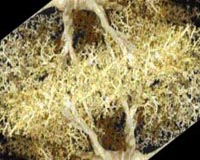
Durham NC (SPX) Jul 22, 2008 Nature, in the simple form of a tree canopy, appears to provide keen insights into the best way to design complex systems to move substances from one place to another, an essential ingredient in the development of novel "smart" materials. Duke University engineers believe that an image of two tree canopies touching top-to-top can guide their efforts to most efficiently control the flow of liquids in new materials, including the next generation of aircraft and rocket "skins" that can self-repair when damaged, or self-cool when overheated. "Examples of this branching design tendency are everywhere in nature, from the channels making up river deltas to the architecture of the human lung, where cascading pathways of air tubes deliver oxygen to tissues," said Adrian Bejan, J.A. Jones Professor of Mechanical Engineering at Duke's Pratt School of Engineering. Developing the most efficient and effective manner of controlling flow is becoming increasingly important, as engineers strive to create the next generation of nanodevices and "smart" materials. The goal of this research is to create materials that act like human skin by delivering liquid healing agents through a network much like blood vessels. Materials such as these will need efficient delivery systems, Bejan said. Working with Sylvie Lorente, professor of civil engineering at the University of Toulouse, France, Bejan found that the laws of constructal theory (http://www.constructal.org/), which he first described in 1996, could guide the creation of these novel "smart" materials. The constructal theory is based on the principle that flow systems evolve to minimize imperfections, reducing friction or other forms of resistance, so that the least amount of useful energy is lost. The theory applies to virtually everything that moves, Bejan said. "We examined a flow system that looks more like the canopy-to-canopy model and found it to be more efficient than models in use now that are made up of parallel flow channels," said Bejan, whose analysis was published early online in the Journal of Applied Physics. The research was supported by the Air Force Office of Scientific Research and Lawrence Livermore National Laboratory. "We believe that this strategy will allow for the design of progressively more complex vascular flow systems." In addition to finding that flow is maximized by these branching larger-to-smaller-to-larger systems, the researchers discovered that to maintain this gain in efficiency, the tree vasculature needs to become more complex as the flow increases. This is an important insight, Bejan said, because as new "smart" components become smaller, the efficiency of the flow systems will need to increase. "Constructal design concepts serve the vascularization needs of these new 'smart' structures ideally, because trees have evolved a natural architecture for maximally delivering water throughout the tree volume," Bejan said. "If a single stream is to touch a structure at every point, then that stream must serve that structure much like a tree, or much in way the bronchial tree supplies air to the total lung volume." Earlier, the constructal law was used to explain traffic flows, the cooling of small-scale electronics and river currents. Bejan recently reported that the theory can explain basic characteristics of locomotion for every creature, whether they run, swim or fly. The physics principle also explains many essential features of global circulation and climate, including the boundaries between different climate zones, average wind speed and the average temperature difference between night and day. Most recently, Bejan demonstrated that the constructal theory also helps explain why annual college rankings tend not to undergo major changes year-to-year. Community Email This Article Comment On This Article Share This Article With Planet Earth
Related Links Duke University Space Technology News - Applications and Research
 Valley Forge Composite Delivers Specialized Space Components To NASA
 Covington, KY (SPX) Jul 09, 2008
Valley Forge Aerospace has delivered to NASA its state-of-the-art components for project evaluation. Valley Forge provided to NASA specialized, prototype Attitude Control Instruments produced to NASA's precise engineering specifications. |
|
|

| The content herein, unless otherwise known to be public domain, are Copyright 1995-2007 - SpaceDaily.AFP and UPI Wire Stories are copyright Agence France-Presse and United Press International. ESA Portal Reports are copyright European Space Agency. All NASA sourced material is public domain. Additional copyrights may apply in whole or part to other bona fide parties. Advertising does not imply endorsement,agreement or approval of any opinions, statements or information provided by SpaceDaily on any Web page published or hosted by SpaceDaily. Privacy Statement |
 del.icio.us
 Digg
Digg Reddit
 YahooMyWeb
 Google
 Facebook