
 |
 |
 |
 |
 |
 |
 |
 |
 |

 |
Traveling Faster Than the Speed of Light
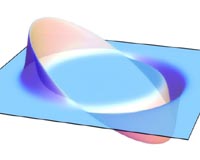
Waco TX (SPX) Aug 13, 2008 Two Baylor University scientists have come up with a new method to cause a spaceship to effectively travel faster than the speed of light, without breaking the laws of physics. Dr. Gerald Cleaver, associate professor of physics at Baylor, and Richard Obousy, a Baylor graduate student, theorize that by manipulating the extra spatial dimensions of string theory around a spaceship with an extremely large amount of energy, it would create a "bubble" that could cause the ship to travel faster than the speed of light. To create this bubble, the Baylor physicists believe manipulating the 10th spatial dimension would alter the dark energy in three large spatial dimensions: height, width and length. Cleaver said positive dark energy is currently responsible for speeding up the expansion rate of our universe as time moves on, just like it did after the Big Bang, when the universe expanded much faster than the speed of light for a very brief time. "Think of it like a surfer riding a wave," said Cleaver, who co-authored the paper with Obousy about the new method. "The ship would be pushed by the spatial bubble and the bubble would be traveling faster than the speed of light." The method is based on the Alcubierre drive, which proposes expanding the fabric of space behind a ship and shrinking space-time in front of the ship. The ship would not actually move, rather the ship would sit in a bubble between the expanding and shrinking space-time dimensions. Since space would move around the ship, the theory does not violate Einstein's Theory of Relativity, which states that it would take an infinite amount of energy to accelerate a massive object to the speed of light. String theory suggests the universe is made up of multiple dimensions. Height, width and length are three dimensions, and time is the fourth dimension. String theorists use to believe that there were a total of 10 dimensions, with six other dimensions that we can not yet identify because of their incredibly small size. A new theory, called M-theory, takes string theory one step farther and states that the "strings" that all things are made of actually vibrate in an additional spatial dimensional, which is called the 10th dimension. It is by changing the size of this 10th spatial dimension that Baylor researchers believe could alter the strength of the dark energy in such a manner to propel a ship faster than the speed of light. The Baylor physicists estimate that the amount of energy needed to influence the extra dimension is equivalent to the entire mass of Jupiter being converted into pure energy for a ship measuring roughly 10 meters by 10 meters by 10 meters. "That is an enormous amount of energy," Cleaver said. "We are still a very long ways off before we could create something to harness that type of energy." Community Email This Article Comment On This Article Share This Article With Planet Earth
Related Links Baylor University Understanding Time and Space
 Quantum Chaos Unveiled
 Salt Lake City UT (SPX) Aug 11, 2008
A University of Utah study is shedding light on an important, unsolved physics problem: the relationship between chaos theory - which is based on 300-year-old Newtonian physics - and the modern theory of quantum mechanics. |
|
|

| The content herein, unless otherwise known to be public domain, are Copyright 1995-2007 - SpaceDaily.AFP and UPI Wire Stories are copyright Agence France-Presse and United Press International. ESA Portal Reports are copyright European Space Agency. All NASA sourced material is public domain. Additional copyrights may apply in whole or part to other bona fide parties. Advertising does not imply endorsement,agreement or approval of any opinions, statements or information provided by SpaceDaily on any Web page published or hosted by SpaceDaily. Privacy Statement |
 del.icio.us
 Digg
Digg Reddit
 YahooMyWeb
 Google
 Facebook