|
 |
 |
 |
 |
 |
 |
 |
 |

 |
Transported Black Carbon A Significant Player In Pacific Ocean Climate
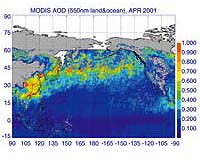
San Diego CA (SPX) Mar 15, 2007 Soot and other particulate pollution from Asian sources make up more than 75 percent of black carbon transported at high altitudes, according to a Scripps Institution of Oceanography, UC San Diego-led study More than three-quarters of the particulate pollution known as black carbon transported at high altitudes over the West Coast during spring is from Asian sources, according to a research team led by Professor V. Ramanathan at Scripps Institution of Oceanography, UC San Diego. Aerosol optical depth (AOD) measurements from 2001 and 2004 reflect springtime transport of black carbon and other pollutants across the Pacific Ocean. AOD is used as an indicator of how much solar radiation is prevented from reaching Earth's surface by particles in the atmosphere. Though the transported black carbon, most of which is soot, is an extremely small component of air pollution at land surface levels, the phenomenon has a significant heating effect on the atmosphere at altitudes above two kilometers (6,562 feet). As the soot heats the atmosphere, however, it also dims the surface of the ocean by absorbing solar radiation, said Ramanathan, a climate scientist at Scripps, and Odelle Hadley, a graduate student at the Center for Atmospheric Sciences at Scripps. The two are lead authors of a research paper appearing in the March 14 issue of the Journal of Geophysical Research. The dual effect carries consequences for the Pacific Ocean region that drives much of Earth's climate. "That's the primary concern we have with these aerosols," said Hadley. "They can really affect global climate." "The soot heating of the atmosphere exceeds the surface dimming and as a result the long range transported soot amplifies the global warming due to increase in carbon dioxide," said Ramanathan. "We have to find out if this amplification is just restricted to spring time or is happening throughout the year." The researchers found that transported black carbon from Asian sources is equal to 77 percent of North American black carbon emissions in the troposphere during the spring. In a follow-on study funded by the California Energy Commission (CEC), Hadley, Ramanathan and fellow Scripps climate scientist Craig Corrigan are now studying how much carbon might be incorporated into precipitation and what the effects on melt rates of Sierra Nevada snow pack could be. The measure of high black carbon concentration from Asian sources "is a startling finding by itself, but its potential importance is magnified by the fact that black carbon is believed to have a disproportional impact on regional climate," said Guido Franco, technical lead for climate change research at the CEC's Public Interest Energy Research (PIER) program. "Fortunately, we have already started to address this issue with Scripps and more studies are being planned." The researchers compared rarely available in-flight data collected during the spring 2004 Cloud Indirect Effects Experiment (CIFEX), a component of which was a series of atmospheric meteorological measurements made during flights originating in Eureka, Calif. The team combined that information with data from 30 West Coast meteorological stations and compared it with computer predictions made by the Chemical Weather Forecast System (CFORS). Transport of Asian black carbon, particulate pollution generated by automobile exhaust, agricultural burning and other sources, is heaviest in spring when cold Arctic fronts dip to lower latitudes and loft warmer air to higher levels in the atmosphere. It is part of a worldwide transport of aerosols that sees them remain aloft at high altitudes for up to two weeks. Black carbon concentrations diminish as they move farther away from their sources in cities and farmlands in countries such as China and India. However, over the Pacific Ocean, the particles are in sufficient concentration to have a heating effect on the upper atmosphere, a prediction based on output from other computer models besides CFORS. At the same time, the radiation-absorbing particles dim skies at the surface. On a regional level, that amount of heating, or positive radiative forcing, the black carbon causes in the skies over the Pacific is about 40 percent of the forcing that has been attributed to the carbon dioxide increase of the last century, said Ramanathan. It likely has measurable effects on a variety of other physical and biological conditions in the areas of the Pacific over which the particulate pollution passes. "It was a major surprise," said Ramanathan, Hadley's adviser at Scripps. "When we came up with the preliminary results, we had to check it and recheck it." Results from Hadley's study of black carbon's snow pack effects are expected by the end of this year. Authors of the Journal of Geophysical Research article besides Hadley and Ramanathan include Corrigan, Greg Roberts and Guillaume Mauger at Scripps Oceanography and Gregory Carmichael and Youhua Tang of the University of Iowa. The National Science Foundation, the National Oceanic and Atmospheric Administration (NOAA) and the California Energy Commission funded the study. Community Email This Article Comment On This Article Related Links Scripps Institution of Oceanography Learn about Climate Science at TerraDaily.com Climate Science News - Modeling, Mitigation Adaptation
 Climate Change Will Heat Switzerland Swiftly
 Geneva (AFP) March 14, 2007
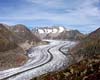
Switzerland will suffer regular heatwaves and drought by 2050 as average temperatures rise swiftly and disrupt living patterns in the heart of Europe, a report predicted Wednesday. The report commissioned by the interior and environment ministries forecast that average temperatures in the Alpine country would rise by at least 2.0 degrees Celsius (35.6 F) in summer and 3.0 degrees C in winter by 2050. |
|
|

| The content herein, unless otherwise known to be public domain, are Copyright 1995-2006 - SpaceDaily.AFP and UPI Wire Stories are copyright Agence France-Presse and United Press International. ESA PortalReports are copyright European Space Agency. All NASA sourced material is public domain. Additionalcopyrights may apply in whole or part to other bona fide parties. Advertising does not imply endorsement,agreement or approval of any opinions, statements or information provided by SpaceDaily on any Web page published or hosted by SpaceDaily. Privacy Statement |