|
 |
 |
 |
 |
 |
 |
 |
 |

 |
Tracking The Elusive Shipping Container Out Beyond The Horizon
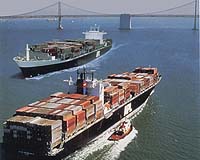
Washington DC (SPX) Aug 27, 2007 The world is a very different place out beyond the horizon. Even as you read this, there are some 40,000 large cargo ships plying the world's waterways and oceans, not to mention innumerable smaller merchant craft, all pulling in and out of ports, loading, unloading, changing out crews and cargos, and steaming from one location to the next. In what can be a very murky world of shadowy ship registry offices, lengthy manifests, and dockhands who change out faster than Barbosa's crew, how all these ships come by their cargo, how that cargo is loaded, by what polyglot seamen and in what untamed ports, can be an amazingly scrambled and trackless story rivaling the Pirates of the Caribbean. Scenario: A single ship starts out in Singapore with containers filled with electronics, passes through Indonesia where it picks up spices, sails to Calcutta to load cotton, Port Said where it boards an Egyptian crew, Piraeus where it stops for fuel, Tangier where it picks up leathers, Scotland where it packs in woolen sweaters, and finally sets sail for Newark, New Jersey. Eleven million containers packed with such goods reach U.S. ports every year. At any point in a merchant ship's journey, pry open container XYZ mid-ocean, and what might you find" When you can't be sure, that spells danger. The possibility that a single container has gone purposefully astray and might now be packed with explosives, or loaded with a virulent biologic destined for our shores, is not a fictional scenario. (In 1988, it was an Al Qaeda merchant ship that delivered the materials needed to bomb U.S. embassies in Tanzania and Kenya. That same ship was never seen again.) Given lots of time, customs agents could find all contraband. But, in the world of maritime shipping, time is the enemy. Try delaying a delivery, and you may face some rough characters down at the docks (think On the Waterfront). What's more, anything that hinders the swift transit of goods around the world can have a rippling effect on the world's economy. MATTS - DHS S and T's Marine Asset Tag Tracking System - is a miniature sensor, data logging computer, radio transceiver, and GPS tracking system integrated into a compact and inexpensive black box, about the size of a deck of cards. Affixed to a shipping container, MATTS can use its on-board GPS chip to estimate its location if the GPS signal is lost. And, in the final version of the system, containers outfitted with MATTS tags will be able to transmit through shipboard communications systems, even if they are placed deep below deck. The tag's signal will "jump" from container to container until it finds a path it can use. Better yet, this black box stores its location history and reports it back when in range (up to 1 km) of an Internet equipped ship, container terminal, or a cell phone tower. At any point in a container's journey, its history can be examined, and if anything has gone amiss, authorities know instantly to scrutinize that particular container. Ultimately, MATTS will be integrated with S and T's Advanced Container Security Device. The ACSD sends an alert through MATTS when a container has been opened or tampered with on any side, providing even more security. "MATTS will globally communicate in-transit alerts to Customs and Border Protection, and this capability satisfies a high-priority CBP requirement," says Bob Knetl, Program Manager for the MATTS research within S and T's Borders and Maritime Division. In late April 2007, one hundred MATTS-equipped containers started out in the Port of Yokohama, Japan, and are now making their trans-Pacific crossing to the Port of Los Angeles/Long Beach, where they will then continue by rail to the Rochelle, Illinois, Rail Terminal and be unloaded and trucked to their final destination. This test, ending in August, will demonstrate that the communications can be used internationally (in this case, by Japan's Ministry of Land, Infrastructure and Transportation) and that transitioning to domestic drayage once portside in Long Beach also runs smoothly. MATTS was developed under a DHS S and T Small Business Innovation Research (SBIR) contract by iControl Incorporated, a small Santa Clara, CA-based company. "A serious threat is posed by the cargo that containers may hold," says Vinny Schaper, SBIR Program manager. "We have to view the ocean with grave concern, and realize that a maritime attack is not beyond the realm of possibility and if it comes, it will probably involve the use of merchant ships. Eleven million containers a year are brought onto our docks. Interrupt this with a terrorist attack, and the backup would reach around the world." Community Email This Article Comment On This Article Related Links US Department of Homeland Security GPS Applications, Technology and Suppliers
 Russia Starts Serial Production Of New Navigation Systems
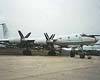 Zhukovsky, Russia (RIA Novosti) Aug 27, 2007
Russian manufacturers are starting serial production of new navigation systems on the basis of the Glonass technology for strategic aviation, the first deputy general director of a design bureau said Saturday. |
|
|

| The content herein, unless otherwise known to be public domain, are Copyright 1995-2007 - SpaceDaily.AFP and UPI Wire Stories are copyright Agence France-Presse and United Press International. ESA Portal Reports are copyright European Space Agency. All NASA sourced material is public domain. Additional copyrights may apply in whole or part to other bona fide parties. Advertising does not imply endorsement,agreement or approval of any opinions, statements or information provided by SpaceDaily on any Web page published or hosted by SpaceDaily. Privacy Statement |