|
 |
 |
 |
 |
 |
 |
 |
 |

 |
Touch the Universe
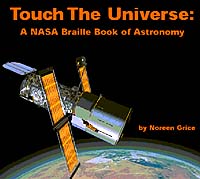
Pasadena - June 4, 2001 How does a person who can't comprehend the concept of "sky" begin to understand that planets, stars and galaxies are real and can be studied? Noreen Grice is answering that question by converting Hubble Space Telescope images into plastic sheets embossed with bumps, lines and other tactile representations. These plastic sheets are designed to render the colors and shapes of familiar space objects as bumps, textures, lines and patterns which can be felt rather than seen. Grice and her two collaborators previewed the results of their work on Monday at the American Astronomical Society meeting being held here this week. The product of Grice's work is a new book, "Touch the Universe: A NASA Braille Book of Astronomy". Two photos of HST in orbit, plus 12 photographs of planets, stars, galaxies and the Hubble Deep Field are presented in both color and the tactile overlays. Descriptive captions rendered both in large print and in Braille allow those with limited vision and no sight to understand the image. Grice, who is the operations manager for the Hayden Planetarium in Boston, has worked for 17 years to bring astronomical images to those with visual impairments. In 1984, a group of visually impaired students from the Perkins School arrived at the Planetarium. After the show it was clear to her that the students were bored. The visually intensive show had not reached them. Grice went home and started working on a way to bring the images to those who could not see them. From that experience, Grice created her first book, "Touch the Stars". Grice converted sketches of familiar sky objects, such as stars and comets, into a metal template. From those templates she made heavy paper pages with text in large print and Braille. The book proved to be so popular, so unique and so valuable that it is now entering its fourth edition. Enter Dr. Bernhard Beck-Winchatz, from Chicago's DePaul University. After receiving a grant to use HST to research quasars, he applied for, and received, an additional $10,000 for educational outreach as part of his science work. He had seen Grice's book and wanted to make the stunning HST photos available to those who could not see them. He contacted Grice and she was eager to take up the challenge. As she did with "Touch the Stars", she created metal masters of the images to be represented. This time, though, she turned to a different technology for the end product. Converting the masters into clear plastic overlays allowed her to bring the images, again with text in large print and Braille, to both the totally blind and those with visual impairments. Grice refers to this overlay technique as "twin vision". Only a handful of such books exist and none in astronomy. This new representation needed testing, though. Last fall she sent a set of prototypes to Benning Wentworth, a teacher at the Colorado School for the Deaf and Blind in Colorado Springs, a school with an existing program for teaching astronomy to those who cannot see the night sky. "The cognitive processes [of the blind] are very different than those of the sighted," Wentworth commented. "The eye takes in the picture as a whole, then the brain examines the various pieces." Using touch, the process is reversed. The details must be assembled into a whole by the person's brain. Students experiencing the prototypes gave honest feedback on Grice's prototypes. Some needed changes, some just were too complicated to be used. A tactile representation of the Ring Nebula needed more than just lines to show the various colors shown in the HST images. Adding textures, bumps, lines, cross-hatching, etc., with text explaining what each represented, gave the students a way to understand exactly what was being represented. Wentworth recounted the student's deep appreciation for Grice's extensive efforts in creating these tactile images. "These books are very labor intensive to produce," stated Grice. "We had to do all the work. We couldn't just send it to a publisher to handle." The captions had to include not only a description of the image, the science it represented, but had to instruct the blind reader on what they would feel in the picture. The book will be released late this summer. The team expects to sell them for under $40 per copy, a price only slightly above cost. The "profit" will be used for updates and enhancements to future editions. Grice envisions a whole series of books, "Touch the Planets", "Touch the Galaxies" and more. "There are lots of possibilities," she eagerly states. Mark Perew is a freelance writer living in Southern California. Community Email This Article Comment On This Article Related Links Touch the Universe - ordering details SpaceDaily Search SpaceDaily Subscribe To SpaceDaily Express Space
 Satellite Launch To Boost DTH In India
 Calcutta, India (SPX) Dec 28, 2005
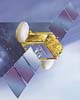
The successful launch Thursday of India's heaviest satellite from spaceport of Kourou in French Guyana may have boosted the country's space research efforts to yet another level, but it has also lifted the spirits of at least three Direct-To-Home televisions broadcasters, one of which has been waiting for years to launch its services in India.
--------------------------------------------------------- It's new. And it's downright terrific! Celestron's CPC Schmidt-Cassegrain telescope is the scope you've been waiting for! It offers new alignment technology, advanced engineering, and bold new design at a new, low price! In fact, Celestron's Professional Computerized (CPC) scope with revolutionary SkyAlign Alignment Technology redefines everything that amateur astronomers are looking for. It offers quick and simple alignment, GPS technology, unsurpassed optical quality, ease of use, advanced ergonomics, enhanced computerization and, most important, affordability. Want to view M-31 tonight? One button takes you there!
Shop for telescopes online at Telescopes.com! today!
|
|
|

|
|
|
|
|
|
|
|
|
|
|
|
| The content herein, unless otherwise known to be public domain, are Copyright 1995-2006 - SpaceDaily.AFP and UPI Wire Stories are copyright Agence France-Presse and United Press International. ESA PortalReports are copyright European Space Agency. All NASA sourced material is public domain. Additionalcopyrights may apply in whole or part to other bona fide parties. Advertising does not imply endorsement,agreement or approval of any opinions, statements or information provided by SpaceDaily on any Web page published or hosted by SpaceDaily. Privacy Statement |