|
 |
 |
 |
 |
 |
 |
 |
 |

 |
Too Good Eyes For Living Below Ground
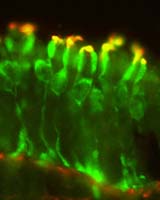
Frankfurt - Apr 07, 2004 Scientists at the Max Planck Institute for Brain Research in Frankfurt, at the University of Duisburg-Essen, and at the Charles University in Prague have now discovered that in contrast to previous assumptions, the eyes of subterranean African mole-rats have a rather well-structured retina with an unusually high proportion of cone photoreceptors. Cones are the photoreceptors for daylight vision, hence their usefulness in the lightless world of mole-rats is puzzling. As a further peculiarity, most mole-rat cones contain a blue-sensitive visual pigment, whereas in other mammals most cones have a green-sensitive pigment. The density of rods, the photoreceptors for low-light night vision, is much lower in the mole-rats than in nocturnal surface-dwelling rodents. These findings, published in the European Journal of Neuroscience in March 2004, call for a revision of our current views on the visual system of subterranean mammals. A remarkable number of mammals have turned to a completely or partially subterranean mode of life during the course of evolution - almost 300 species of rodents, insectivores and marsupials. As a presumed evolutionary adaptation to their lightless habitat, most of these subterranean species have reduced small eyes and are considered blind. As far as current knowledge goes, the African mole-rats (blesmols, Bathyergidae) are strictly subterranean rodents. They live, breed and forage underground, feeding on roots, bulbs and tubers. The eyes are small (diameters of 1.5 - 2.5 mm) depending upon the species. Leo Peichl at the Max Planck Institute for Brain Research in Frankfurt/Main, Pavel Nemec at the Charles University Prague and Hynek Burda at the University Duisburg-Essen have now had a closer look at the eyes of three species, Ansell's mole-rat Cryptomys anselli, the giant mole-rat C. mechowi, and the naked mole-rat Heterocephalus glaber, and have discovered some astonishing features. The retinae were anatomically well-developed and showed no obvious deficits. To the contrary, the researchers found an unusually high proportion of 10% cones among the photoreceptors. Surface-dwelling nocturnal rodents like rat and mouse have only 1 - 3% cones, which is not surprising as cones do not operate in moonlight or starlight. Even most diurnal mammals have no more than 5 - 20% cones. Why should the mole-rats, living in constant darkness, invest so highly in the cones that only work in daylight? The dominant majority of photoreceptors in all nocturnal and most diurnal mammals are the rods, which are used for vision at low light levels (night vision). Here the mole-rats are less well equipped. Their rod density is only one quarter of that of, for example, mice. Why are the mole-rats so sparing with their light-sensitive rods? A further surprise for the researchers was the distribution of visual pigments among the cones. Most mammalian retinae possess two spectral cone types, a roughly 90% majority of green-sensitive cones and a roughly 10% minority of blue-sensitive cones. This provides for reasonable, so-called dichromatic, colour vision. In contrast, about 90% of the mole-rats' cones contain the blue-sensitive visual pigment, and only 10% are pure green-sensitive cones. This is the first observation in any mammal of such a radical reversal in the proportion of the green and blue cone pigments. In summary, the photoreceptors of African mole-rats show stark deviations from the common mammalian pattern. But none of these peculiarities fit the concept of a general regression of the retina in adaptation to a lightless living environment. Evolutionary biology would predict that obsolete structures are removed because they are metabolically too expensive. Hence these photoreceptor features should be interpreted as specializations for particular visual needs. Future behavioural studies and field observations will have to elucidate what these needs might be. Perhaps the mole-rats still come to the surface every so often. At present we know too little about the visual challenges and capabilities of these animals. Certainly, the hypothesis of a general, convergent reduction of the eyes in subterranean mammals is up for re-examination. GET URLs etc Community Email This Article Comment On This Article Related Links SpaceDaily Search SpaceDaily Subscribe To SpaceDaily Express Dirt, rocks and all the stuff we stand on firmly
 Magnetic Reconnection Region Larger Than 2.5 Million Km Found In The Solar Wind
 Paris (ESA) Jan 12, 2006
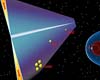
Using the ESA Cluster spacecraft and the NASA Wind and ACE satellites, a team of American and European scientists have discovered the largest jets of particles created between the Earth and the Sun by magnetic reconnection. This result makes the cover of this week's issue of Nature. |
|
|

| The content herein, unless otherwise known to be public domain, are Copyright 1995-2006 - SpaceDaily.AFP and UPI Wire Stories are copyright Agence France-Presse and United Press International. ESA PortalReports are copyright European Space Agency. All NASA sourced material is public domain. Additionalcopyrights may apply in whole or part to other bona fide parties. Advertising does not imply endorsement,agreement or approval of any opinions, statements or information provided by SpaceDaily on any Web page published or hosted by SpaceDaily. Privacy Statement |