|
 |
 |
 |
 |
 |
 |
 |
 |

 |
Toll Of Israel Strategy Could Be War With Lebanon Itself
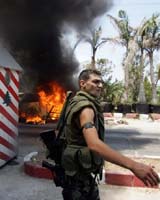
Stamford, Conn. (UPI) Jul 21, 2006 When Hezbollah embarked on its provocative incursion into Israel, most Lebanese (apart from ardent Shiite radicals) saw this incident for what it was: a reckless act aimed at advancing the interests of the Iranian and Syrian regimes, at great risk to both Lebanon and its people. But the mood in Lebanon has drastically changed over the past few days. Very few now blame Hezbollah, or actively agree with calls for its disarmament (even though the majority of the population supported this goal prior to the recent events). And virtually no one would be pleased if the two Israeli soldiers were surrendered under the threat of Israel's continuation of its systematic destruction of Lebanon's infrastructure. Understanding this radical transformation in mind-set can shed some light on the unintended -- yet tragically predictable -- consequences of U.S. policy in the Middle East. What has happened in the span of a few days? In the aftermath of Hezbollah's attacking and kidnapping of the Israeli soldiers across the border, Israel implemented a "shock and awe" strategy that blasted away every piece of infrastructure that the Lebanese painstakingly built over the past fifteen years. As the long-in-place agreement to restrict activities in southern Lebanon and northern Israel to military targets gave way to open warfare, Hezbollah also unleashed its deadly barrages of Katyusha rockets over northern Israel. In a few infernal days, Israeli planes and warships managed to destroy the fruits of fifteen years of labour of ordinary Lebanese citizens determined to restore the country to a semblance of its pre-war level of development. Significantly, only three Hezbollah fighters were killed in the Israeli raids, while more than two hundred Lebanese civilians, including whole families, perished. It is equally sad that Israeli civilians were killed and wounded by Hezbollah rockets. In what can only be viewed as an insult to the intelligence of informed citizens everywhere, U.S. President George W. Bush argued simply that Israel "has the right to defend itself." Luckily for Bush, Israel was able to articulate a more plausible explanation for its strategy: it was ensuring that Hezbollah will not smuggle the Israeli soldiers out of Lebanon, and it was cutting off Hezbollah's arms supply routes. In reality, this explanation is not borne out by the facts on the ground. For example, Israeli jets bombed the highest bridge in the Middle East -- a few miles from my hometown on the main road between Beirut and Damascus -- disabling it and rendering it unusable for months to come. Curiously, the Israelis were not satisfied by disabling the bridge. They came back the next day and completely demolished the remainder of the structure -- as if to simply add tens of million of dollars to the eventual cost of repair. Israel also bombed power generating plants, cellular telephone towers, gas stations, foodstock warehouses and purely commercial targets. I am not a military expert, but none of these seem like relevant targets if the aim is to block Hezbollah from transporting the Israeli soldiers out of the country or to prevent it from receiving arms from Syria and Iran. The more plausible rationale for the 'shock and awe' operation is to make the situation so painful for Lebanese civilians that they 'take responsibility' for the actions of one of their own, the Hezbollah militia. The argument goes as follows: if the cost is made high enough, citizens will pressure their government into doing what it has been struggling to do for months -- disarming Hezbollah. This strategy was beginning to work in the first day of the Israeli operation, as voices in the country began to be raised against Hezbollah and its reckless action. But as the intensity and the perniciousness of the Israeli bombing escalated, even the most moderate civilians in Lebanon experienced an emotional transformation into what can be likened to the revulsion of an innocent person being terrorized into submission by a vastly superior power. In an affront to human dignity and disregard for human life, Israel is inflicting severe pain and suffering on a huge number of civilians to incite them to do its bidding. Hezbollah may be accused of doing the same in Israel (though with a much more limited capacity to inflict pain). But then we would expect a terrorist organisation to commit acts of terrorism. A state committing the same acts, magnified many times over, with the same intentions, must be condemned and ultimately prevented by the world community. Otherwise, we would be sending yet another message to people and nations who feel wronged yet do not have the means to win the fight against their aggressors: your only recourse is to equip yourself with whatever means necessary to deter your aggressors. It would be a return to the law of the jungle that the world can ill afford in this age of nuclear proliferation. By failing to act on behalf of Lebanon and to call Israel to account for its actions, the U.S. is putting the world at greater risk, and it is setting back by decades the cause of peace in the region. To understand the sense of injustice that people in Lebanon feel about their situation, consider this analogy: black rights activists, indignant at police brutality towards fellow blacks, kidnap a white police officer and retreat into their black neighborhood, demanding the release of detained black activists in exchange for the police officer. The state calls in the exclusively white national guardsmen who surround the neighbourhood and start firing mortars into it, destroying businesses and killing whole families. To drive their point home, the national guardsmen cut off the electricity and water supply of the neighbourhood, and announce to the inhabitants that they, the community, will be held responsible for the actions of their radical fringes, and will continue to be pounded by heavy artillery until they rise up against the activists among them. Would blacks in the neighborhood rise against their reckless brothers, or would this response by state authorities take their fury towards their white neighbors to new and irreversibly hostile levels? To put things in perspective, Lebanese civilians are experiencing the same type of revulsion towards Israel that American citizens felt towards Osama bin Laden and al-Qaida after Sept. 11. But blame is also directed at the U.S. government for its political and moral support of Israel in this affair. And I am not talking here about Lebanese Shiite fanatics. I am talking about Jane and John Doe of Lebanon: your average Sunni, Christian, Shiite and Druze who may otherwise hold living in the United States as their greatest aspiration. The Lebanese are feeling tremendous indignation at the injustice they are facing. Let us not allow this indignation to fester and turn into new seeds of hatred. The U.S. had best seize the moment, quickly and decisively, to demonstrate that it understands there is no lasting peace for Israel or Lebanon without some measure of justice and dignity for all parties involved. (Nadim Matta is a management consultant and U.S. citizen of Lebanese origin. During the civil war in Lebanon, he worked for USAID and for Save the Children Federation in Beirut. He can be reached at [email protected].)
Source: United Press International Community Email This Article Comment On This Article Related Links Your World At War
 German Spies Working To Free Israeli Soldiers
 Berlin (UPI) Jul 21, 2006
Germany is getting increasingly involved in the Middle East conflict, with reports the country's intelligence service is using contacts with Hezbollah and Hamas to try and free the kidnapped Israeli soldiers. |
|
|

| The content herein, unless otherwise known to be public domain, are Copyright 1995-2006 - SpaceDaily.AFP and UPI Wire Stories are copyright Agence France-Presse and United Press International. ESA PortalReports are copyright European Space Agency. All NASA sourced material is public domain. Additionalcopyrights may apply in whole or part to other bona fide parties. Advertising does not imply endorsement,agreement or approval of any opinions, statements or information provided by SpaceDaily on any Web page published or hosted by SpaceDaily. Privacy Statement |