|
 |
 |
 |
 |
 |
 |
 |
 |

 |
Titan's Volcano May Release Methane
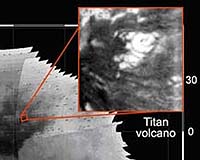
London, UK (SPX) Jun 09, 2005 A team of European and US scientists, using Cassini-Huygens data, have found that Saturn's smoggy moon Titan may have volcanoes that release methane in the atmosphere. These findings may lead scientists to revise the theories that the presence of methane in Titan's atmosphere is mainly due to the presence of a methane-rich hydrocarbon ocean. Infrared images taken by the Visual and Infrared Mapping Spectrometer (VIMS) on board the Cassini orbiter, show a 30-kilometre wide and bright structure. This structure, imaged during the first Titan fly-by on 26 October 2004 from a distance of 1200 kilometres, could be interpreted as a volcanic dome formed by upwelling plumes of icy material rose to the planet's surface. While melting, the icy material contaminated by hydrocarbons would release methane gas. The eruptions of such an ice-volcano, or 'cryo-volcano', would be caused by the heat generated during tidal movements of material inside Titan. Internal tides at Titan are expected as this moon strongly varies its distance from Saturn while it runs along its highly elliptical orbit a round the mother planet. The images of the observed area also show that liquid is not visible on the surface. This conclusion is reinforced by the comparison of surface features imaged by VIMS with similar features imaged by ESA's Huygens probe during its descent and eventual landing onto Titan's soil. "Before Cassini-Huygens, the most widely accepted explanation for the presence of methane in Titan's atmosphere was the presence of a methane-rich hydrocarbon ocean," said Dr. Christophe Sotin, from the University of Nantes (France) and lead author of the results. "The suite of instrument on-board Cassini and the observations at the Huygens landing site reveal that a global ocean is not present. Interpreting this feature as a 'cryo-volcano' provides an alternative explanation for the presence of methane in Titan's atmosphere", he added. An infrared instrument like VIMS is able to peer through Titan's dense haze and provide information about the chemical composition and the topography of the surface. The highest resolution image obtained covers an area 150 square kilometres that includes the bright 30-kilometre circular feature, with two elongated wings extending westward. This structure actually resembles volcanic structures on Earth and Venus, with overlapping layers of material from a series of flows, although the volcanic material is different. In the centre of the area, scientists clearly see a dark feature that can be interpreted as a depression. So, it is easy to imagine it as a volcanic caldera, a bowl-shaped structure formed above chambers of molten material. If the cryo-volcanism hypothesis is true, the black channels seen by Huygens during its descent could have been formed by the large release of methane-rich rains following the eruptions. Scientists have already considered, and ruled out, other interpretations for the 30-kilometre circular structure. In principle, it could be a cloud, but images taken at different times show that the structure does not vary its shape. A second interpretation would suggest that the structure is an accumulation of solid particles transported by gas or liquid, as it happens for sand dunes on Earth. However, a circular shape does not really match with this process, and its possible wind patterns do not match with the expected wind directions on Titan. Radar observations of the same regions to be made later by Cassini will certainly help to confirm these findings. These results see the European contribution of: C. Sotin, lead author, S. LeMouelic and S.Rodriguez(Laboratoire de Planetologie et Geodinamique, Universite de Nantes, France), R. Jaumann, K.Stephan and C.K.Scholz (Institute of Planetary Exploration, DLR, Germany), A. Coradini, V. Formisano and G.Bellucci (Istituto di Fisica dello Spazio Interplanetario, CNR, Rome, Italy), J-P. Bibring and Y. Langevin (Institut d'Astrophysique Spatiale, Universite de Paris-Sud, France), F. Capaccioni and P.Cerroni (Istituto di Astrofisica Spaziale e Fisica Cosmica, CNR, Rome , Italy), M.Combes, P. Drossard and B. Sicardy (Observatoire de Paris, Meudon, France). The other authors are: B.J.Buratti, K.H.Baines, D.L.Matson and R.M.Nelson (JPL, California US), R.H.Brown (University of Arizona, California), R. N. Clark (U.S.Geological Survey, Denver, US), L.A. Soderblom U.S. Geological Survey, Flagstaff, US), D.P Cruikshank (NASA Ames Research Center, California, US), T.B.McCord (University of Washington, US), P.D. Nicholson (Cornell University, US). Community Email This Article Comment On This Article Related Links Cassini VIMS Instrument Cassini-Huygens at JPL Cassini Imaging Team SpaceDaily Search SpaceDaily Subscribe To SpaceDaily Express Explore The Ring World of Saturn and her moons Jupiter and its Moons The million outer planets of a star called Sol News Flash at Mercury
 Titan's Methane Mystery
 Moffett Field CA (SPX) Dec 12, 2005
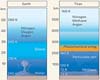
The methane giving an orange hue to Saturn's giant moon Titan likely comes from geologic processes in its interior according to measurements from the Gas Chromatograph Mass Spectrometer (GCMS), a Goddard Space Flight Center instrument aboard the European Space Agency's Huygens Probe. |
|
|

| The content herein, unless otherwise known to be public domain, are Copyright 1995-2006 - SpaceDaily.AFP and UPI Wire Stories are copyright Agence France-Presse and United Press International. ESA PortalReports are copyright European Space Agency. All NASA sourced material is public domain. Additionalcopyrights may apply in whole or part to other bona fide parties. Advertising does not imply endorsement,agreement or approval of any opinions, statements or information provided by SpaceDaily on any Web page published or hosted by SpaceDaily. Privacy Statement |