|
 |
 |
 |
 |
 |
 |
 |
 |

 |
Titan's Strange Surface
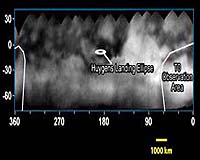
Pasadena - Jul 05, 2004 Cassini spacecraft instruments have peered through the orange smog of Titan and glimpsed the surface below. Images sent back to Earth reveal dark areas and lighter, fuzzy areas. Data from the Visual Infrared Mapping Spectrometer (VIMS) indicate that the dark areas are pure water ice. The bright fuzzy regions have several different types of non-ice materials, and may include organic materials such as hydrocarbons. Dark and light surface regions had been seen by other telescopes, including the Hubble Space Telescope, but the VIMS data does not support the prevailing theories of what the dark and light regions represent. "It had been hypothesized that the darker materials on Titan are hydrocarbons that had fallen out of the atmosphere, and the light areas were water ice that perhaps had been swept clean by methane rain," says science team member Elizabeth Turtle of the University of Arizona, Tucson. "It's a truly strange place, and the VIMS data has turned the theories on their heads. We're still trying to find out what the surface composition of Titan is." The apparent fuzziness of the bright regions may be a photographic artifact, caused by light scattering in Titan's atmosphere. Or it could be a true characteristic of the surface that is the result of unknown processes. Other features on Titan are sharply linear, circular, and concentric, and are suggestive of past geologic activity. One large, dark, circular feature may be an impact crater. Another large dark region is shaped like the letter "H." Images also revealed a single large methane cloud in Titan's South Pole. Pictures of the cloud taken hours apart show that it is changing over time. The cloud particles are much larger than the hazy smog particles that surround the moon. The cloud is about 450 kilometer across, or about the size of Arizona. Right now it is summer in the southern hemisphere of Titan, so the South Pole is constantly illuminated by the sun. The methane cloud could have formed as a result of this surface heating. "We do think we're seeing uplift in the cloud, and that is very similar to cumulus clouds on Earth, says Turtle. "On Titan, methane may play the role that water plays on Earth." Cassini's magnetospheric imaging instrument discovered that a swarm of hydrogen molecules surrounds Titan and extends beyond the top of its atmosphere. This cloud of molecules sweeps along with Titan as it orbits Saturn. The cloud is created as energetic particles from Saturn's radiation belts bombard the top of Titan's atmosphere. The resulting cloud is so big that Saturn and its rings would easily fit inside it. Friday's flyby of Titan brought the spacecraft within 339,000 kilometers (210,600 miles) of the moon. Over the next four years, Cassini will fly by Titan 45 times, getting as close as 950 kilometers (590 miles). Scientists hope these flybys will allow them to create radar maps of Titan's surface. In January 2005, the Huygens probe will descend through Titan's atmosphere and parachute down to the surface. Don Gurnett, principal investigator for the radio and plasma wave instrument, reported that during Cassini's orbital insertion on June 30, the spacecraft was bombarded by tiny dust particles. The instrument detected up to 680 dust hits per second when Cassini crossed the ring plane of Saturn. Roughly 100,000 bits of dust hit the spacecraft in less than five minutes. "The ring plane region was thought to be devoid of particles," says Gurnett. "In fact, there are a huge number of particles, and they hit the spacecraft during both ring plane crossings." Scientists created a simulation of the ring plane crossings, converting the recorded impacts into audible sounds that "resemble hail hitting a tin roof," says Gurnett. The average size of the particles in the ring were about one-thousandth of a millimeter, comparable to particles in cigarette smoke. A few particles were significantly larger, measuring about a tenth of a millimeter. Despite these dust impacts, the spacecraft performed perfectly. The engine burn for entering Saturn's orbit went so well, in fact, that mission managers have decided not to perform an orbital-adjustment maneuver that had been scheduled for today. Community Email This Article Comment On This Article Related Links Cassini at JPL Cassini Image Team SpaceDaily Search SpaceDaily Subscribe To SpaceDaily Express Explore The Ring World of Saturn and her moons Jupiter and its Moons The million outer planets of a star called Sol News Flash at Mercury
 Cassini Images Halo Around Titanic Moon Off Saturn
 Pasadena CA (SPX) Dec 27, 2005
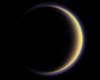
With its thick, distended atmosphere, Titan's orange globe shines softly, encircled by a thin halo of purple light-scattering haze. |
|
|

| The content herein, unless otherwise known to be public domain, are Copyright 1995-2006 - SpaceDaily.AFP and UPI Wire Stories are copyright Agence France-Presse and United Press International. ESA PortalReports are copyright European Space Agency. All NASA sourced material is public domain. Additionalcopyrights may apply in whole or part to other bona fide parties. Advertising does not imply endorsement,agreement or approval of any opinions, statements or information provided by SpaceDaily on any Web page published or hosted by SpaceDaily. Privacy Statement |