|
 |
 |
 |
 |
 |
 |
 |
 |

 |
Titan's Enigmatic Infrared-Bright Spot Is Surface Make-Up
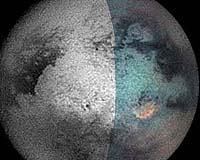
Tucson AZ (SPX) Oct 07, 2005 A 300-mile-wide patch that outshines everything else on Titan at long infrared wavelengths appears not to be a mountain, a cloud or a geologically active hot spot, University of Arizona scientists and Cassini team members say. "We must be looking at a difference in surface composition," said Jason W. Barnes, a postdoctoral researcher at UA's Lunar and Planetary Lab. "That's exciting because this is the first evidence that says not all of the bright areas on Titan are the same. Now we have to figure out what those differences are, what might have caused them." When NASA's Cassini spacecraft flew by Titan on March 31 and again on April 16, its visual and infrared mapping spectrometer saw a feature that was spectacularly bright at 5-micron wavelengths just southeast of the continent-sized region called Xanadu. The bright spot occurs where Cassini's visible-wavelength imaging cameras photographed a bright arc-shaped feature approximately the same size in December 2004 and February 2005. Cassini's radar instrument, operating in the "passive" mode that is sensitive to microwaves emitted from a planetary surface, saw no temperature difference between the bright spot and surrounding region. That rules out the possibility that the 5-micron bright spot is a hot spot, such as a geologically active ice volcano, Barnes said. Cassini microwave radiometry also failed to detect a temperature drop that would show up if some two-mile high mountain rose from Titan's surface, he said. And if the 5-micron bright spot is a cloud, it's a cloud that hasn't moved or changed shape for three years, according to ground-based observations made at the Keck Telescope and with Cassini's visual and infrared mapping spectrometer during five different flybys. "If this is a cloud," Barnes said, "it would have to be a persistent ground fog, like San Francisco on steroids, always foggy, all the time." "The bright spot must be a patch of surface with a composition different from anything we've seen yet. Titan's surface is primarily composed of ice. It could be that something is contaminating the ice here, but what this might be is not clear," Barnes said. "There's a lot left to explore about Titan. It's a very complex, exciting place. It's not obvious how it works. It's going to be a lot of fun over the next couple of years figuring out how Titan works," he said. Barnes and 34 other scientists report the research in the Oct. 7 issue of Science. Authors include UA Lunar and Planetary Laboratory scientists and Cassini team members Robert H. Brown, head of Cassini's visual and infrared mapping spectrometer team; Elizabeth P. Turtle and Alfred S. McEwen of the Cassini imaging team; Ralph D. Lorenz of the Cassini radar team; Caitlin Griffith of the Cassini visual and infrared mapping team; and Jason Perry and Stephanie Fussner, who work with McEwen and Turtle on Cassini imaging. Community Email This Article Comment On This Article Related Links SpaceDaily Search SpaceDaily Subscribe To SpaceDaily Express Explore The Ring World of Saturn and her moons Jupiter and its Moons The million outer planets of a star called Sol News Flash at Mercury
 Titan: Greenhouse And Anti-Greenhouse
 Moffett Field CA (SPX) Nov 04, 2005
Like Earth, Titan has a greenhouse effect. So does Venus, a whopping one, and so does Mars. Venus is the queen of the greenhouse effect. Ninety-nine point nine percent of the energy reaching the surface of Venus is retained by the greenhouse effect. Titan, though, comes in a close second. |
|
|

| The content herein, unless otherwise known to be public domain, are Copyright 1995-2006 - SpaceDaily.AFP and UPI Wire Stories are copyright Agence France-Presse and United Press International. ESA PortalReports are copyright European Space Agency. All NASA sourced material is public domain. Additionalcopyrights may apply in whole or part to other bona fide parties. Advertising does not imply endorsement,agreement or approval of any opinions, statements or information provided by SpaceDaily on any Web page published or hosted by SpaceDaily. Privacy Statement |