|
 |
 |
 |
 |
 |
 |
 |
 |

 |
Titan IV Program Nears End Following Final SRMU Disposal
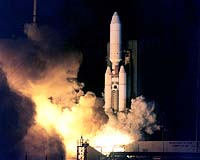
Los Angeles AFB CA (SPX) Sep 28, 2006 Flames kissed the sky as the final two solid rocket motor upgrades, more commonly recognized as the two boosters on a Titan IV rocket, were destroyed recently. As part of the Titan IV closeout, the two SRMUs, spares from the last Titan IV launch in October 2005, were transported from Camp Blanding, Fla., by rail to Utah. They were placed on "Big Red," a large trailer with 128 wheels capable of carrying up to one million pounds and taken to the Hill AFB Test and Training Range. The SRMUs contained solid rocket fuel and each segment weighed approximately 300,000 pounds. Members of the Hill AFB Explosive Ordnance Device team affixed flexible linear charges to the SRMUs, which cannot be reused on the new Delta or Atlas rockets or sold elsewhere. The charges split the fiber casing open and ignited the fuel creating a spectacular explosion which at about 5,000 degrees reduced the SRMUs and surrounding sand to nothing more than small greenish, glassy rock. "You saw a bright flash and some of the propellant came off like a big Roman candle," said Maj. Michael Crowley, Titan Program closeout manager. Six or seven seconds later, onlookers heard the thunder of the explosion, Major Crowley explained. "This is the safest way to handle disposal," he said. "It was perfect. It went without a hitch," he added. Safety was a key concern for officials and the utmost precaution was taken, Major Crowley said. The Utah Test and Training Range and airspace were cleared. To protect the environment, the site was fully cleaned after disposal.? "Two SRMUs with three segments each were disposed of this summer. That is actually the most we've ever disposed of in one year," Major Crowley said. "All six went off extremely smoothly, not even a cut or bruise." The disposal marks near the last activity before the closure of the Titan Program. All that remains is turnover of the final facilities, turn-in of material, and dismantling the test stand. "The test stand is the last real, big challenge," Major Crowley said. The Titan IV was originally created in 1985 as an alternative to the space shuttle for launching heavy payloads. The rocket was used to launch Milstar, Defense Satellite Program and National Reconnaissance Office payloads by the Air Force. Over the course of its use, there were 39 Titan IV launches. The last remaining Titan IVs will be on display at the U.S. Air Force Museum at Wright-Patterson AFB in Fairborn, Ohio, and the Evergreen Aviation Museum in McMinnville, Ore. Community Email This Article Comment On This Article Related Links Rocket Science News at Space-Travel.Com Satellite Constellation - multiple satellite deployments in LEO and Beyond
 Iridium Sat Reports Strong Growth In Crew Calling Subscribers During 2006
 Bethesda MD (SPX) Sep 28, 2006
Iridium Satellite today reported that the number of ships using its maritime Crew Calling service has increased by 54 percent during the first six months of 2006. Iridium executive vice president, Don Thoma, attributes the success to the company's unique value proposition, offering the best combination of cost and convenience for crew members to make ship-to-shore calls at sea. |
|
|

| The content herein, unless otherwise known to be public domain, are Copyright 1995-2006 - SpaceDaily.AFP and UPI Wire Stories are copyright Agence France-Presse and United Press International. ESA PortalReports are copyright European Space Agency. All NASA sourced material is public domain. Additionalcopyrights may apply in whole or part to other bona fide parties. Advertising does not imply endorsement,agreement or approval of any opinions, statements or information provided by SpaceDaily on any Web page published or hosted by SpaceDaily. Privacy Statement |