|
 |
 |
 |
 |
 |
 |
 |
 |

 |
Tissue Engineered Bone Grows Strong
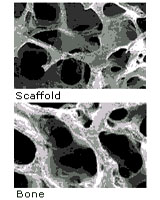
Arlington - Jun 30, 2003 By closely following nature's blueprint, Toronto researchers have developed an innovative way to speed the healing of severe bone breaks, resulting in what may be the thickest tissue-engineered bone ever produced in the laboratory. The new bone grows naturally without the addition of chemical growth stimulants, said Whitaker investigator Molly Shoichet, Ph.D., of the University of Toronto. The innovation is in the design of the synthetic scaffold that provides a framework for the growing tissue. The design mimics the structure of natural bone so faithfully that some experts in the field cannot distinguish between the two when shown micrographs of each side-by-side, Shoichet said. The research was published in the June 15 issue of the Journal of Biomedical Materials Research Part A. "The structure is very open and porous," she said. "There are large interconnections between the pores separated by struts, rather than solid walls." Into this spongy matrix, the researchers drizzle bone marrow cells, which can differentiate into osteoblasts, the strong, mineral-like cells of mature bone. The marrow cells take up residence in the scaffold and begin growing and multiplying. As they mature, the scaffold itself dissolves. "You don't need growth factors to get the cells into the scaffold," Shoichet said. "The cells almost fall through it and get stuck along the way." The scaffold, developed with coinvestigator John Davies of the University of Toronto, is made of poly(lactide-co-glycolide), a polymer used in sutures. The polymer is processed in a unique way to yield the open, sponge-like structure with pores more than 10 times larger than those that result from conventional processing. Animal studies show that the scaffold provides an intricate framework for dense new bone growth while it slowly dissolves. In rabbits, strong new bone completely replaced the scaffold in about eight weeks. For some time, tissue engineers have experimented with scaffolds that promote bone growth. Much of this work has relied on supplementing the cell culture with growth hormones or other stimulating chemicals. Shoichet demonstrates a simpler, more natural way to grow new bone. "To the best of our knowledge, bone growth throughout such a volume has not been reported before in the literature," she said. The University of Toronto has licensed the technology to BoneTec Corp. for commercial development under the trademark name of Osteofoam. Shoichet is a vice president of the company. The Whitaker Foundation has supported Shoichet's laboratory through a 1998 Biomedical Engineering Research Grant for research to encourage the regrowth of damaged nerve cells. Contact: Molly Shoichet, University of Toronto Frank Blanchard, The Whitaker Foundation Community Email This Article Comment On This Article Related Links SpaceDaily Search SpaceDaily Subscribe To SpaceDaily Express Space Medicine Technology and Systems
 Secrets Of A Salty Survivor
 Huntsville AL (SPX) Sep 13, 2004
You can learn a lot from a microbe. Right now, a tiny critter from the Dead Sea is teaching scientists new things about biotechnology, cancer, possible life on other worlds. And that's just for starters: |
|
|

| The content herein, unless otherwise known to be public domain, are Copyright 1995-2006 - SpaceDaily.AFP and UPI Wire Stories are copyright Agence France-Presse and United Press International. ESA PortalReports are copyright European Space Agency. All NASA sourced material is public domain. Additionalcopyrights may apply in whole or part to other bona fide parties. Advertising does not imply endorsement,agreement or approval of any opinions, statements or information provided by SpaceDaily on any Web page published or hosted by SpaceDaily. Privacy Statement |