
 |
 |
 |
 |
 |
 |
 |
 |
 |

 |
Tiny Satellite Constellations to Debuts November
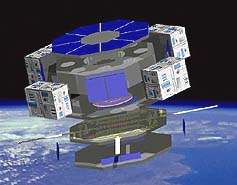
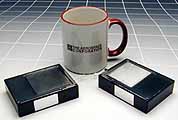
El Segundo - October 11, 1999 - A mission scheduled to be launched in late November from Vandenberg Air Force Base, Calif., will give a preview of how tiny satellites would operate in constellations. The mission will usher in a spaceflight program to validate MEMS -- tiny microelectromechanical systems being developed under sponsorship of DARPA, the Defense Advanced Research Projects Agency. The experiment calls for two tethered picosatellites, each weighing less than one-half-pound and not much larger than a deck of cards, to be released into low Earth orbit by the OPAL satellite. OPAL is the Orbiting Picosat Automated Launcher built by Stanford University students at the school's Space Systems Development Laboratory. Scientists and engineers at The Aerospace Corporation, El Segundo, Calif., conceived the picosat mission, designed the tiny satellites, integrated and tested the components, and delivered the picosats ready for flight. They also are responsible for flight operations. Although the basic mission of picosats is to serve as a platform for testing miniature devices such as MEMS, they also serve as a link to nanosatellites, slightly larger than picosats and envisioned as tiny workhorses of the future. Mother Ship The mission is to be the first-ever to demonstrate the principles of miniature satellites released from a "mother ship" flying in concert and communicating via a local network as nanosatellites would. The experiment, a joint project of DARPA and The Aerospace Corporation, is to be launched aboard a new Air Force booster for small satellites -- the Orbital/Suborbital Program Space Launch Vehicle. Data Hopping The orbiting picosats will perform "data-hopping" communications with a stationary third picosat on the horn of a ground antenna operated by SRI International at Menlo Park, Calif. Commands to the picosats will be issued from the ground station. Tasks, in addition to communicating with each other, will include operating an array of experimental radio frequency MEMS switches designed by Rockwell Science Center of Thousand Oaks, Calif. Communication will be accomplished by chip-based digital cordless telephone technology provided by Rockwell. The radios are derived from the DARPA- sponsored Low-Power Wireless Integrated Microsensors program at UCLA and Rockwell. Powered by lithium thionyl chloride batteries, the diminutive spacecraft will send "data packets" to the ground station to report on the radio frequency switches and the general health and status of the mission. Revolutionary Systems The switches, to be test-operated in space over a mission of several days, are one of several technology programs that promise to revolutionize future communications systems by offering low power, robustness, radiation tolerance and low unit cost via mass production within the silicon microelectronics industry infrastructure. A successful demonstration of the picosat mission will have significant implications for future space-based defense technology, said William "Bill" C. Tang, Ph.D., MEMS program manager at DARPA. Distinguished Engineer Ernest Y. Robinson of The Aerospace Corporation's Center for Microtechnology said the picosat mission -- and another scheduled for early 2000 aboard the Air Force Research Laboratory's MightySat 2.1 spacecraft -- will "set the stage for future, fully functional nanosatellite orbital systems." Robinson and other researchers at the Center for Microtechnology believe nanosatellites of 1 to 10 kilograms can be operational within five to ten years, offering efficient, flexible and low-cost alternatives to contemporary large space systems as well as new paradigms for space missions. For military applications, Robinson said a swarm of miniature satellites could communicate with microsensors on a battlefield and convey important surveillance and tactical information, among other missions.
Nano and MicroSats At SpaceDaily
Email This Article Comment On This Article Related Links Space
 Satellite Launch To Boost DTH In India
 Calcutta, India (SPX) Dec 28, 2005
The successful launch Thursday of India's heaviest satellite from spaceport of Kourou in French Guyana may have boosted the country's space research efforts to yet another level, but it has also lifted the spirits of at least three Direct-To-Home televisions broadcasters, one of which has been waiting for years to launch its services in India. |
|
|

|
|
|
|
|
|
|
|
|
|
|
|
| The content herein, unless otherwise known to be public domain, are Copyright 1995-2006 - SpaceDaily.AFP and UPI Wire Stories are copyright Agence France-Presse and United Press International. ESA PortalReports are copyright European Space Agency. All NASA sourced material is public domain. Additionalcopyrights may apply in whole or part to other bona fide parties. Advertising does not imply endorsement,agreement or approval of any opinions, statements or information provided by SpaceDaily on any Web page published or hosted by SpaceDaily. Privacy Statement |

 El Segundo - October 11, 1999 - The picosat launch will take place from the Spaceport Systems International (SSI) Commercial Spaceport at Vandenberg. It is to be the inaugural launch of the Orbital/Suborbital Program Space Launch Vehicle developed by the Air Force Space and Missile System Center's Test and Evaluation Directorate at Kirtland Air Force Base. It also is to be the first launch from the commercial spaceport.