|
 |
 |
 |
 |
 |
 |
 |
 |

 |
Tiny Enceladus May Hold Ingredients Of Life
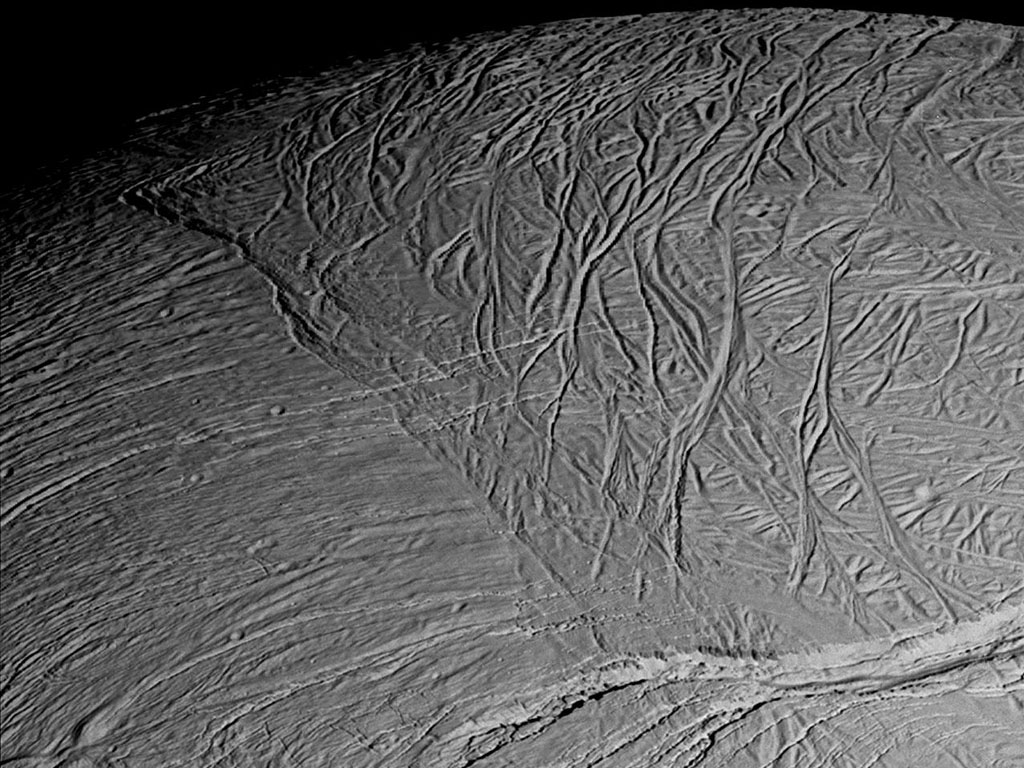
Tucson AZ (SPX) Sep 06, 2005 Saturn's tiny moon Enceladus is "absolutely" a highlight of the Cassini mission and should be targeted in future searches for life, Robert H. Brown of The University of Arizona, leader of the Cassini visual and infrared mapping spectrometer team, said last week. Brown and other Cassini scientists attended a meeting in London last week and are at the 37th annual Division of Planetary Sciences meeting at Cambridge University this week. "Enceladus is without a doubt one of the most spectacular things Cassini has seen," Brown said in a phone interview Thursday. "It's one of the biggest puzzles. It'll be a long time before anyone comes up with a good explanation of how Enceladus does what it does, and for a scientist, that's pure, unmitigated fun. Solving the biggest puzzles is the thrilling part of doing science." Scientists got their first glimpse of Enceladus's geology when Voyager 2 flew by the icy bright satellite in August 1981. They were completely baffled. Voyager photographed areas of young, smooth terrain that told them that the moon must have been geologically active as late as 100 million years ago. But nothing explained how tiny Enceladus -- only 314 miles across -- could get hot enough to melt. It seemingly doesn't have enough interior rocks for radioactive heating, an eccentric enough orbit for tidal heating, or enough ammonia to lower its melting temperature. After Voyager, researchers shelved Enceladus as an unsolvable problem for a while. This year, Cassini turned its more powerful cameras and instruments on Enceladus during Feb. 17, March 9 and July 14 flybys. Results have stunned and delighted. The diminutive moon turns out to have a primarily water vapor atmosphere tinged with nitrogen, carbon dioxide and other simple carbon-based molecules (organics) concentrated at its south pole. Its south pole is a hotspot, hovering at a relatively balmy minus -183 degrees Celsius compared to the expected temperature of -203 degrees Celsius. Enceladus's south pole is a hotbed of geological action. The south pole region is cut by parallel cracks roughly 81 miles long and 25 miles apart. The cracks, dubbed "tiger stripes," vent vapor and fine ice water particles that have crystallized on Enceladus's surface as recently as 1,000 years to 10 years ago. The fine ice material is probably the major source of particles that replenish Saturn's outermost ring, its E ring. "The kind of geophysical activity we see is quite likely being driven by liquid water below the surface," Brown said. Cassini hasn't seen ice geysers or ice volcanoes, but the lack of ammonia, and the sheer volume of water vapor escaping suggests there's pure-water volcanism on Enceladus, he added. "We detected simple organics in the tiger stripes," Brown said. The simple organics include carbon dioxide and hydrogen-and-carbon-containing molecules like methane, ethane and ethylene. "Methane (basically natural gas) has probably been locked up inside Enceladus since the solar system formed and is now bubbling up through the vents." The visual and infrared mapping spectrometer can't detect nitrogen, but Cassini's ion neutral mass spectrometer may have found nitrogen in Enceladus's atmosphere. All other results from these two very different instruments are entirely consistent, which gives Cassini mission scientists confidence in their results, Brown said. "So you've got subsurface liquid water, simple organics and water vapor welling up from below. Over time -- and Enceladus has been around 4.5 billion years, just like Earth and the rest of the solar system -- heating a cocktail of simple organics, water and nitrogen could form some of the most basic building blocks of life," Brown said. "Whether that's happened at Enceladus is not clear, but Enceladus, much like Jupiter's moon Europa and the planet Mars, now has to be a place where we eventually search for life." Community Email This Article Comment On This Article Related Links VIMS Cassini-Huygens at JPL Cassini Imaging Team SpaceDaily Search SpaceDaily Subscribe To SpaceDaily Express Explore The Ring World of Saturn and her moons Jupiter and its Moons The million outer planets of a star called Sol News Flash at Mercury
 Cassini Images Halo Around Titanic Moon Off Saturn
 Pasadena CA (SPX) Dec 27, 2005
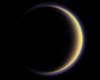
With its thick, distended atmosphere, Titan's orange globe shines softly, encircled by a thin halo of purple light-scattering haze. |
|
|

| The content herein, unless otherwise known to be public domain, are Copyright 1995-2006 - SpaceDaily.AFP and UPI Wire Stories are copyright Agence France-Presse and United Press International. ESA PortalReports are copyright European Space Agency. All NASA sourced material is public domain. Additionalcopyrights may apply in whole or part to other bona fide parties. Advertising does not imply endorsement,agreement or approval of any opinions, statements or information provided by SpaceDaily on any Web page published or hosted by SpaceDaily. Privacy Statement |