|
 |
 |
 |
 |
 |
 |
 |
 |

 |
Time For A Second US-Pakistan Wedding
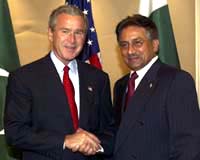
UPI Editor of The National Interest New York (UPI) Sep 19, 2006 Pakistan's President Pervez Musharraf gave a command performance yesterday at a small group discussion hosted in New York by Time Warner and co-sponsored by The Nixon Center, making a forceful case for stronger ties -- a "long-term, broad-based, strategic relationship" between Islamabad and Washington. Over the last 57 years, he said, U.S.-Pakistan relations have gone through three eras; the first (1947-1989) was a joint effort to stem communist expansionism, when Pakistan was the "most allied ally"; the second, in the wake of the Soviet withdrawal from Afghanistan, saw the most allied ally become the "most sanctioned" while Pakistan was left with the detritus of the Afghan war -- 4 million refugees and an unstable western neighbor -- which led to the emergence both of the Taliban and al-Qaida. Since 9/11, a new relationship has emerged, defined by strong government-to-government interaction but characterized by a certain degree of suspicion among both peoples. During his visit, the president clearly wants to tackle some of what he sees as the "misperceptions" about Pakistan that have hampered closer ties -- and, not coincidentally, have created a climate for not only a rapprochement but a growing partnership between the United States and India -- which in turn has strained support among the Pakistani people for closer cooperation with the United States. The perception that Pakistan is part of the problem of international terrorism -- something compounded in recent weeks by what was characterized as inaccurate reporting in the Western media about the arrangements brokered in Waziristan -- comes from a lack of understanding about Pakistan's strategy for coping with the threat posed by al-Qaida and the Taliban. The strategy is to try and wean away as many people as possible from the violent and terrorist organizations -- even those who may hold extreme viewpoints but who could be persuaded not to support al-Qaida and not to support violence in either Pakistan or Afghanistan. He felt that the assumption that religiosity automatically connotes a Taliban supporter to be a mistaken one, and one which could lead to mistakes in implementing an effective response. He stressed at several points that success means understanding "the environment" in which these movements have flourished and that, like it or not, the Taliban has had its roots among the people. The Pakistani strategy combines a judicious use of military force against the "center of gravity" of the Taliban--in its core areas in Afghanistan, with subsidiary operations against other militant groupings, but requires Pakistan, in its own tribal areas, to use other means -- political (working with tribal elders and others), administrative (revitalizing the civilian administration of agents and the like away from the over-militarization of these regions) and via economic reconstruction to provide opportunity. The other negative perception -- that of Pakistan as proliferation risk -- was something he addressed head-on. Pakistan's crash program for developing nuclear weapons was spearheaded out of the presidency during the 1990s, he said; A.Q. Khan's operations did not involve either the government or the military. It was justified because no one was going to stop India from going nuclear either; but now, Pakistan, in order to obtain greater cooperation for its civil nuclear program, would be prepared to accept IAEA safeguards. There is no need for Pakistan's civil nuclear program to be used for military needs, as Pakistan "already has what it needs." Like India and other states in the region, Pakistan faces an energy crisis which affects its ability to sustain and increase economic growth. Nuclear energy is a legitimate part of increasing the energy supply, along with natural gas, hydroelectric power and other sources; Musharraf maintained that with appropriate controls in place, there is no rationale for not increasing cooperation in this area as well. The perception that India is a democracy (and thus a "natural ally" of the United States) in contrast to Pakistan was also a point the Pakistani president wanted to address. He made the argument that the goal of his administration is to lay the foundation for what he called "sustainable democracy", based on a three-tiered system of government that empowers the average person (as well as focusing on bringing more women and minority groups into governing). The media, in his words, have been "unshackled"; there are now 43 independent television channels. Reforms in the legal and educational systems are designed to promote Pakistan's traditional forms of moderate, progressive Islam, although he acknowledged that since 1979, the fighting in Afghanistan as well as the struggles in Kashmir--both of which have helped to fuel extremism--have had an impact on "the fabric of our own society." Finally, he noted the efforts to create a more positive environment for investment in Pakistan, with foreign investment up by 1,200 percent during his tenure. In this author's opinion, there were a number of similarities with themes sounded by Russia's Vladimir Putin -- the importance of building institutions and promoting economic growth as necessary building blocks for long-term democracy. On India, the president noted progress in the bilateral negotiations but stressed that the United States needs to put its weight behind the process. He also pointed out that Pakistan wants strong relations with Washington to proceed without automatic reference to India, appearing to argue against points raised in the United States that the U.S. relationship to Pakistan should be conducted via the prism of the U.S.-India partnership. Instead, he argued for the Pakistan-U.S. relationship to return to the pre-1989 model. Musharraf sees Pakistan as the indispensable nation if one is serious about pursuing closer integration between the countries of the Middle East and Persian Gulf with those of Central Asia, South and Southeast Asia, and China. "We are not an unimportant, insignificant country," he said. Moreover, as the president noted, Washington no longer has the luxury of being able to pursue a "Eurocentric" policy; the fulcrum of world affairs increasingly is shifting to the Middle East and Asia--and Pakistan is well positioned to again be a key ally of the United States--if Washington is prepared to take them up on the full extent of the offer. Nikolas K. Gvosdev is editor of The National Interest. This article is published courtesy of The National Interest.
Source: United Press International Community Email This Article Comment On This Article Related Links Learn about nuclear weapons doctrine and defense at SpaceWar.com News and analysis about the Global War Against Terror at SpaceWar.com News From Across The Stans
 UK Underestimated Taliban
 London (UPI) Sep 19, 2006
The strength of the Taleban in Afghanistan was seriously underestimated by Britain and its Nato allies, British Defense Secretary Des Browne said Tuesday. Amid mounting domestic pressure over the dangers faced by British troops leading the mission in the troubled south of the country, he issued a renewed plea for Nato members to send reinforcements, insisting the battle must and could be won. |
|
|

| The content herein, unless otherwise known to be public domain, are Copyright 1995-2006 - SpaceDaily.AFP and UPI Wire Stories are copyright Agence France-Presse and United Press International. ESA PortalReports are copyright European Space Agency. All NASA sourced material is public domain. Additionalcopyrights may apply in whole or part to other bona fide parties. Advertising does not imply endorsement,agreement or approval of any opinions, statements or information provided by SpaceDaily on any Web page published or hosted by SpaceDaily. Privacy Statement |