|
 |
 |
 |
 |
 |
 |
 |
 |

 |
Thunderbird Linux Cluster Ranks Sixth In Top500 Supercomputing Race
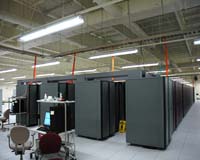
Albuquerque NM (SPX) Nov 16, 2006 Sandia National Laboratories' 8960-processor Thunderbird Linux cluster, developed in collaboration with Dell, Inc. and Cisco, maintained its sixth position in the Top500 Supercomputers by achieving an improved overall performance of 53.0 teraflops, an 18.5 percent increase in efficiency from last year's performance. The Top500 ranking of supercomputers is based on the Linpack benchmark, a yardstick of performance to test processor speed, scalability, and accuracy. "This achievement represents a long-term investment to meet our mission to transform engineering and provide greater processing capacity," says John Zepper, Computing Systems Senior Manager at Sandia. Sandia researchers use Thunderbird to perform a broad range of weapons simulations, including atomistic scale-to-device modeling of radiation effects on semiconductor electronics, assessing weapon-response safety in extreme thermal and impact environments, and quantifying uncertainties in weapon performance. The level of detail being modeled in these assessments was not practical without the new level of scalable capacity that Thunderbird provides. With its 4,480 commodity compute servers linked with an Infiniband message-passing interconnect, Thunderbird is the largest cluster of its type in the world. Sandia is a National Nuclear Security Administration laboratory. The improvement in Thunderbird's performance were propelled by its switch to OpenFabric Enterprise Distribution (OFED) and OpenMPI -- together, a Linux-based open-source software stack qualified by the OpenFabrics Alliance to operate with multi-vendor Infiniband hardware and implement open-source Message Passing Interface (MPI) protocol. The achievement was a joint venture involving Sandia and Cisco. As an active developer in the OFED and OpenMPI projects, Cisco's engineers were on site at Sandia to assist with monitoring, diagnosing, and fine-tuning Thunderbird's performance. The new software-stack environment allows for more memory per node to be available for parallel jobs at runtime, as well as an increase in reliability and scalability of users' jobs. Sandia's extensive use of the new software ironed out bugs and tweaked performance -- improvements that benefit the entire high-performance-computing community. Infiniband is widely regarded as one of the most attractive commodity interconnect technologies, because of its high bandwidth, low latency, and low cost. This is the first time Infiniband, OpenMPI, and OFED have been used in such a massive configuration as Thunderbird. Community Email This Article Comment On This Article Related Links Sandia National Laboratories Powering The World in the 21st Century at Energy-Daily.com Space Technology News - Applications and Research
 Planck Instruments Ready For Integration
 Paris, France (ESA) Nov 17, 2006
Engineers are ready to begin integrating the scientific instruments into ESA's Planck satellite. The pair of instruments will allow the spacecraft to make the most precise map yet of the relic radiation left behind by the formation of the Universe. The integration of Planck's two instruments marks a major milestone for the mission. |
|
|

| The content herein, unless otherwise known to be public domain, are Copyright 1995-2006 - SpaceDaily.AFP and UPI Wire Stories are copyright Agence France-Presse and United Press International. ESA PortalReports are copyright European Space Agency. All NASA sourced material is public domain. Additionalcopyrights may apply in whole or part to other bona fide parties. Advertising does not imply endorsement,agreement or approval of any opinions, statements or information provided by SpaceDaily on any Web page published or hosted by SpaceDaily. Privacy Statement |