|
 |
 |
 |
 |
 |
 |
 |
 |

 |
Through A Telescope Darkly
Pasadena CA (JPL) Apr 16, 2007 Fourteen thousand feet above the vast fetch of the Pacific Ocean, Diana Blaney announces, "Guide Dog is ready. Big Dog is ready." "Roger," says telescope operator Paul Sears. "Guide Dog is on. Big Dog is on." So begins a night of Mars-watching at NASA's Infrared Telescope Facility atop Hawaii's dormant Mauna Kea volcano. Here, astronomers work by night to discover things that can't be seen by day. Big Dog is the software that controls the spectrometer that measures wavelengths of light. Guide Dog takes pictures that document where the telescope is pointed.
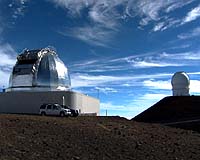
The All-Nighters of Science On this night, cloud cover makes Mars-watching especially challenging. Blaney, a member of the Mars Exploration Rover science team at NASA's Jet Propulsion Laboratory, and Sears, a year-round employee of the University of Hawaii, will spend it trying to measure about 1,000 different wavelengths of infrared light. "All molecules vibrate," says Blaney. "You can kind of think of atoms as a bunch of masses on springs. When sunlight hits them, they start vibrating at a given frequency. What we're doing is measuring that frequency." From a distance, the IRTF resembles a cookie tin topped by a shiny, metallic dome. Heavy metal doors protect the telescope against fluctuations of light or temperature, the sworn enemies of astronomers. Anyone who has gazed into the night sky knows how hard it is to see anything with artificial light or desert thermals invading the field of view.
Making the Invisible Visible In particular, Blaney is searching for minerals widely found in nature in which atoms of sulfur are bound with atoms of oxygen. Sulfur is the stuff that makes matchsticks burn. Oxygen is what humans breathe. Mars has been described as a sulfate planet. On Earth, sulfur is found in deserts, left behind when water evaporates. If humans could see the part of the electromagnetic spectrum known as infrared light, we could look at a mineral like gypsum and see that it contains water molecules. In this way, we could tell a story of environmental change.
Sulfate Planet Spacecraft measuring infrared light at Mars have found minerals with water and sulfur at the poles and in Valles Marineris, the solar system's largest canyon. Stream channels and rock layers bear evidence of liquid water in the past. Scientists have lots of different ideas about how it got there. Perhaps it was transported by volcanic gases, acid rain, flowing streams, glaciers, lakes, mud flows, or even oceans.
Ideal Spot for Mars-Watching Measured from the ocean floor, Mauna Kea is the tallest mountain on Earth, rising 10,203 meters (33,476 feet). The volcano's summit punches into the lower reaches of the stratosphere. There's not much oxygen, and when the sun sets, the temperature drops to about 35 degrees F. (2 degrees C). Given a choice between a down jacket and a heater, an astronomer will choose the down jacket. Heat causes distortions, like mirages on a desert highway.
Martian Soils and Weathering "One of the things we're trying to do," says Blaney, "is figure out how rocks made of black lava turn into the richly colored, weathered materials we see on Mars today. You can kind of compare the process of weathering on Mars to rusting a nail. That rusty material is the iron oxide that makes the surface red."
Role of Water Given the presence of water in the past, scientists wonder if Mars could have supported life. They also wonder if Mars has enough water ice to sustain human exploration. "There have been times up there on Mauna Kea," says Blaney, "when the sky has been so dark, I could see Halley's Comet with my own eyes or see the Milky Way in great detail. The stars up there are just different. It's like being in a different world." Community Email This Article Comment On This Article Related Links NASA Infrared Telescope Facility Mars News and Information at MarsDaily.com Mars News and Information at MarsDaily.com Lunar Dreams and more
 Mars Project To Simulate Radiation Exposure
 University Park, PA (SPX) Apr 13, 2007
Monitoring radiation from solar flares to ensuring that fellow crew members on the surface receive ample warning is only one of the tasks for Irene Schneider Puente, graduate student in geosciences at Penn State, as a member of the Crew 61, a two-week simulation of Martian exploration. |
|
|

| The content herein, unless otherwise known to be public domain, are Copyright 1995-2006 - SpaceDaily.AFP and UPI Wire Stories are copyright Agence France-Presse and United Press International. ESA PortalReports are copyright European Space Agency. All NASA sourced material is public domain. Additionalcopyrights may apply in whole or part to other bona fide parties. Advertising does not imply endorsement,agreement or approval of any opinions, statements or information provided by SpaceDaily on any Web page published or hosted by SpaceDaily. Privacy Statement |