|
 |
 |
 |
 |
 |
 |
 |
 |

 |
Three Sols Of Driving Gain Opportunity 138 Meters
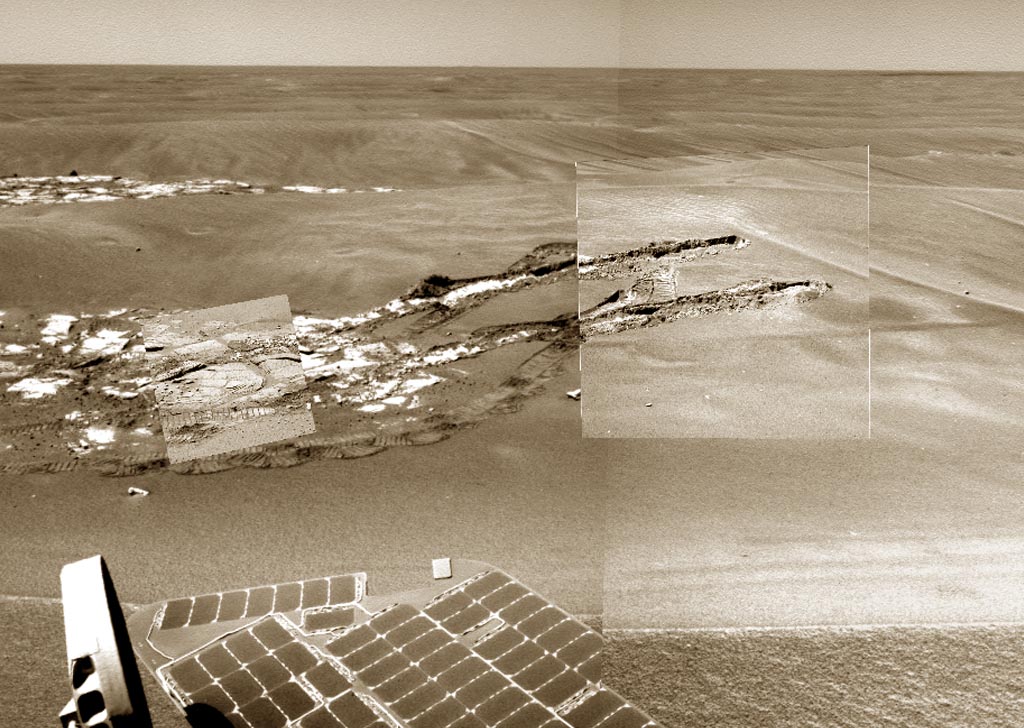
Pasadena CA (SPX) Jun 26, 2006 NASA's Opportunity Mars rover remains healthy some 29 months - and 26 months beyond its designed operational lifetime - after bouncing to a stop on the red planet's surface. JPL mission controllers report the rover has started receiving a new flight software load. It also advanced 138.1 meters (453 feet) toward Victoria Crater in the Meridiani Planum region three sols, or Martian days, of driving and observing outcrop targets. As of sol 855 (June 20) Opportunity was 780 meters (just under half a mile) from Victoria and about 300 meters (984 feet) from a smaller crater controllers have dubbed Beagle. Controllers are uploading new flight software to both Opportunity and Spirit. The upload process is expected to take several weeks before the new software is installed and used. To expedite this process, the team is gradually increasing the duration of Opportunity's high-gain antenna uplink sessions. No files of the new flight software were uplinked via UHF this week, but beginning with sol 864 (June 29), Opportunity will begin receiving flight software files via its daily UHF-band communication window as well as via the X-band high-gain antenna. Sol-by-sol summaries: Sol 852 (June 17): Controllers loaded files for the new flight software via a 20-minute window of communication via the high-gain antenna. Targeted remote sensing with the panoramic camera included an assessment of the clarity of the atmosphere (a term called tau) and imaging of targets called Holberg and Blixen. The miniature thermal emission spectrometer was used for observations of Holberg, Blixen, sky and ground. Sol 853: A flight software upload used a 20-minute high-gain antenna window. The rover drove 42.1 meters (138 feet). Untargeted remote sensing included post-drive imaging by the navigation camera and the panoramic camera, an assessment of tau by the panoramic camera, a check for clouds with the navigation camera, and sky and ground observations with the miniature thermal emission spectrometer. Sol 854: Another flight software upload was accomplished during a 20-minute high-gain antenna communication window. The panoramic camera checked tau. The navigation camera looked back in the direction toward where sol 853's drive began. Sol 855: During a 30-minute high-gain antenna session, more of the new flight software was transmitted. Opportunity drove 39.4 meters (129 feet). The navigation camera and panoramic camera made observations from the new location. The panoramic camera checked tau. The miniature thermal emission spectrometer completed a sky and ground observation. Sol 856: During a one-hour window, another flight software upload was accomplished. Untargeted remote sensing included a panoramic camera observation of the ground's brightness, a panoramic camera assessment of tau, and a miniature thermal emission spectrometer observation of sky and ground. Sol 857: More flight software files were uploaded during a 30-minute high-gain antenna window. The rover drove 56.6 meters (186 feet). Opportunity also conducted a panoramic camera assessment of tau, a panoramic camera calibration, and a miniature thermal emission spectrometer observation of sky and ground. Sol 858 (June 23): A two-hour high-gain antenna session allowed for the upload of more flight software updates. The navigation camera looked back in the direction toward where sol 857's drive began. The panoramic camera checked tau and made a calibration observation. The miniature thermal emission spectrometer observed sky and ground. As of the end of its drive on sol 855 (June 20), Opportunity's odometry totaled 8,190.89 meters, or 5.09 miles. Community Email This Article Comment On This Article Related Links Mars Rovers at JPL Mars Rovers at Cornell Mars News and Information at MarsDaily.com Lunar Dreams and more
 Spirit Turns On Heaters To Continue Working
 Pasadena CA (SPX) Jun 26, 2006
For the first time in its 29-month mission on Mars, NASA's Spirit rover turned on its battery heaters. The rover took the action automatically at 8:15 a.m. local solar time on Mars on Sol 865 (June 9). |
|
|

| The content herein, unless otherwise known to be public domain, are Copyright 1995-2006 - SpaceDaily.AFP and UPI Wire Stories are copyright Agence France-Presse and United Press International. ESA PortalReports are copyright European Space Agency. All NASA sourced material is public domain. Additionalcopyrights may apply in whole or part to other bona fide parties. Advertising does not imply endorsement,agreement or approval of any opinions, statements or information provided by SpaceDaily on any Web page published or hosted by SpaceDaily. Privacy Statement |