|
 |
 |
 |
 |
 |
 |
 |
 |

 |
Three Gorges Dam Second Phase Filling Begins
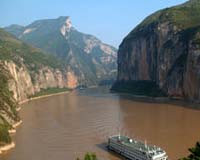
Yichang, China (XNA) Sep 21, 2006 The second phase of raising the water level of the Three Gorges Reservoir began at 10:00 p.m. Wednesday. One of the 13 power-producing generators was shut down, reducing electricity generation to 5.65 million kw, down from the normal 6.86 million kw, according to Li Yong'an, general manager of the China Yangtze River Three Gorges Project Development Corporation. By midnight, the water level in the Three Gorges Reservoir will have risen by 0.6 meters, said Li. He said that when the level reaches 156 meters in mid-October, this would be a milestone in the construction of the Three Gorges Project. Earlier in the day, Chongqing municipality, upstream from the reservoir, launched a massive clean-up campaign to prevent waste from fouling the waters. The timing of the second phase had been approved by the State Flood Control and Drought Relief Headquarters, said Cao Guangjing, deputy general manager of the China Yangtze River Three Gorges Project Development Corporation. The State Flood Control and Drought Relief Headquarters has limited the raising of the water level to a maximum five meters per day and the volume of water discharged downstream to 8,000-10,000 cu m per second so that drought fighting efforts and water usage in downstream areas are not affected. The second phase is one of the most important stages in the Three Gorges Project on the middle reaches of China's longest river, the Yangtze. When the water level reaches 156 meters, the project will increase power production by 7.85 billion kw/hours annually, while water storage will rise by 11 billion cubic meters, improving shipping conditions upstream. The reservoir currently holds 14 billion cu m of water. The water level will rise from the current 135 meters to 148 meters by Oct. 1 and then to 156 meters by mid-October after a break of two days so engineers can monitor the effects on the dam, which was completed in May. The first rise from the natural flow of the Yangtze to 135 meters began on June 1, 2003, when the reservoir was formed. Meanwhile, Chongqing, the largest industrial city in the Three Gorges area, began a clean-up campaign with a budget of 4.6 million yuan (575,000 U.S. dollars). The areas of nine counties and districts in the municipality will be inundated when the water level rises to 156 meters. Six hundred workers, with 208 boats and 58 motor vehicles, have been mobilized to clear the affected areas and the Yangtze's 20 dried-up lesser tributaries of tree branches, solid waste and farm debris, said Tang Jiali, deputy director of Chongqing Municipal Environmental Hygiene Bureau. "If this rubbish is not cleared, it will be washed down into the reservoir, polluting the environment and endangering shipping," said Tang. About 1.16 million people have been relocated since construction on the project began in 1993. The dam spans 2,309 meters and is 185 meters high. It houses 26 power generators on both banks, and a five-tier, dual-track ship lock. With a budget of 203.9 billion yuan (25.5 billion U.S. dollars),the project will have a reservoir with a capacity of 39.3 billion cubic meters and produce 84.7 billion kw/h of electricity annually, when it is completed in 2009. Workers have completed the dam, installation of 14 generating units on the northern bank and most of the ship lock system, whichhas been put into service. Thirteen generators are producing electricity. The installation of 12 more generating units on the southern bank of the Yangtze is underway. Traffic in the dam area has had to be restricted to one direction, alternating every 24 hours, since Sept. 15 when work began on a year-long project to raise the beds of the two topmost tiers of the ship lock from 131 to 139 meters. This will ensure safe navigation when the water level behind the dam rises to 156 and finally to 175 meters. Most of the people in Hubei Province and neighboring Chongqing City who have been displaced have moved to live on higher ground and a small number have chosen to settle elsewhere in China. Of the total, 244,500 people from 13 districts and counties were resettled at a cost of 10.27 billion yuan because of the water rising to 156 meters. Chen Xuecan, 43, a handicapped farmer from Chenjiawan Village in Xingshan County, central China's Hubei Province, used to have ahome below the 156-meter level. With a family of four, Chen spent 120,000 yuan on a flat in an eight-storey complex built on higher ground. The relocation compensation fee provided by the state covered 90,000 yuan of the purchase price. He moved into the new flat in April. "We have a new home which is a lot better than our old earth-and-wood one," said Chen, gleefully. He added he was receiving a monthly subsistence allowance of 80 yuan and his wife has found a temporary job with a local museum not far away from their new home. By April, 126 billion yuan (15.75 billion U.S. dollars) had been spent on construction of the Three Gorges project. A total of 130 billion kw/h of electricity has been generated since July 2003, earning 25 billion yuan (3.125 billion U.S. dollars) in revenue.
Source: Xinhua News Agency Community Email This Article Comment On This Article Related Links Water, Water Everywhere and Not A Drop To Drink... Water News - Science, Technology and Politics
 The Point Of Icicles
 Tucson AZ (SPX) Sep 21, 2006
Contemplating some of nature's cool creations is always fun. Now a team of scientists from The University of Arizona in Tucson has figured out the physics of how drips of icy water can swell into the skinny spikes known as icicles. |
|
|

| The content herein, unless otherwise known to be public domain, are Copyright 1995-2006 - SpaceDaily.AFP and UPI Wire Stories are copyright Agence France-Presse and United Press International. ESA PortalReports are copyright European Space Agency. All NASA sourced material is public domain. Additionalcopyrights may apply in whole or part to other bona fide parties. Advertising does not imply endorsement,agreement or approval of any opinions, statements or information provided by SpaceDaily on any Web page published or hosted by SpaceDaily. Privacy Statement |