|
 |
 |
 |
 |
 |
 |
 |
 |

 |
Three ESA Satellites Reveal Etna's Complexity
Paris (ESA) Nov 04, 2002 As detected by ESA satellite sensors, the recent eruptions of the Mount Etna volcano in Sicily are throwing huge amounts of ash and trace gases into the atmosphere. Instruments on three different ESA spacecraft have acquired imagery of the eruptions that shed new light on the event and its impact on the Earth's environment. Working with data from the Global Ozone Monitoring Experiment (GOME) sensor onboard ESA's ERS-2 spacecraft, scientists at the German aerospace centre (DLR) report that levels of sulphur dioxide from the eruptions on Sunday and Monday are at least 20 times higher than normal. This latest activity from Etna, the second in a little over a year, marks the beginning of another period of activity of Europe's largest volcano, says Werner Thomas, an atmospheric scientist with DLR's Remote Sensing Technology Institute. "As in July and August 2001 eruptions of Etna, dense ash clouds and gaseous emissions were again detected by several space-borne sensors," he said. The normal background level of sulphur dioxide is typically below 0.5 Dobson Units (DU), a measure of atmospheric gas concentrations from ground level to the top of the atmosphere, about 70 km in altitude. "In the plume, we measured atmospheric content of sulphur dioxide of about 10 DU, at least 20 times higher than normal," Thomas said. Sulphur dioxide in the troposphere, the lowest part of the atmosphere where most weather changes occur, is known to be responsible for the so-called "acid rain" phenomenon. Stratospheric sulphur dioxide, from about 11 km to 50 km above the Earth's surface, causes the formation of sulphate aerosol particles that may have a serious impact on the global climate. Etna is one of the most prominent sources of natural sulphur dioxide worldwide. The ERS' GOME instrument is dedicated for remote sensing of the atmosphere and can detect a variety of atmospheric trace gases, including sulphur dioxide. The first GOME data after the beginning of the eruptions was recorded and analysed on 29 October around 10:15 UTC. As seen in the accompanying chart, enhanced levels of sulphur dioxide are evident in the southeast of Sicily, indicating that the tropospheric sulphur dioxide was carried away from the volcano by the winds in that direction. The Italian government declared a state of emergency yesterday in Sicily in the wake a series of earthquakes, measuring between 3.6 and 4.3 on the Richter scale, that forced the evacuation of approximately 1000 homes, according to reports from BBC and Italian newspapers. Meanwhile, three streams of lava from the eruption flowed down the south, northeast and northwest slopes of the mountains, the media reports stated.
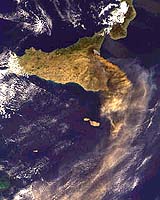
Ash to affect global environment As seen in the image acquired Monday by the Medium Resolution Imaging Spectrometer (MERIS) onboard ESA's Envisat satellite, the eruptions spewed significant amounts of ash, along with sulphur dioxide, into the atmosphere The plume from the volcano can be seen in the image stretching south and west from Sicily to the north African coast. The larger volcanic ash particles are expected to settle out in a short period of time, but the sulphuric acid aerosols produced by the sulphur dioxide will persist for several years. These aerosols will impact the Earth's energy budget, both regionally and on a global scale. Aerosols containing black graphite and carbon particles are dark, thus absorbing sunlight. As these atmospheric particles reduce the amount of sunlight reaching the planet's surface, they increase the amount of solar energy absorbed in the atmosphere, thus simultaneously cooling the surface and warming the atmosphere. The capability of the MERIS instrument to observe the spatial distribution of these aerosol plumes can be exploited to measure the amounts of airborne particles and to examine the role of these aerosols as cloud condensation nuclei and their impact on the hydrologic cycle through changes in cloud cover, cloud properties and precipitation.
Today's images from Proba Since its launch last year, Proba's high-performing computer system and technologically advanced instruments have enabled it to demonstrate and evaluate onboard operational autonomy, new spacecraft technology both hardware and software, and to test Earth observation and space environment instruments in space. The imagery captured today by Proba demonstrate the capabilities of CHRIS, the Compact High Resolution Imaging Spectrometer, which is providing important information on the Earth and its environment, and will be a valuable tool in remote sensing during the extended mission. The instrument acquired the accompanying Etna images in four standard bands, although the instrument is capable of image acquisition in up to 19 different bands. Community Email This Article Comment On This Article Related Links GOME homepage MERIS -- The story in pictures GOME at DLR ERS Envisat results Proba SpaceDaily Search SpaceDaily Subscribe To SpaceDaily Express Dirt, rocks and all the stuff we stand on firmly
 Japan To More Than Double 'Research' Whale Hunts
 Ulsan, South Korea (AFP) Jun 20, 2005
Japan said Monday it will more than double its catch of minke whales and extend its hunt to whales considered endangered, defying international pressure to give up its "research" whaling. |
|
|

| The content herein, unless otherwise known to be public domain, are Copyright 1995-2006 - SpaceDaily.AFP and UPI Wire Stories are copyright Agence France-Presse and United Press International. ESA PortalReports are copyright European Space Agency. All NASA sourced material is public domain. Additionalcopyrights may apply in whole or part to other bona fide parties. Advertising does not imply endorsement,agreement or approval of any opinions, statements or information provided by SpaceDaily on any Web page published or hosted by SpaceDaily. Privacy Statement |