|
 |
 |
 |
 |
 |
 |
 |
 |

 |
Three Bitten As Australia Drought Brings Out Snakes
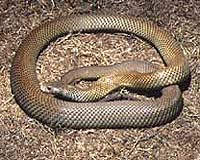
Sydney (AFP) Jan 25, 2007 At least five people including a child have been bitten by deadly snakes this week as a relentless drought draws thousands of slithering menaces out of the Australian bush, officials said Thursday. Three people have died of snake bites since the beginning of the year in Australia, home to all 10 of the most deadly snake species, but the latest victims all survived. A man in his 40s was bitten on the leg by a Brown Snake, the world's second deadliest, in his garden in the city of Melbourne late Wednesday. He was in a stable condition in hospital. That attack came after a 12-year-old boy was bitten on the leg by an unidentified snake near Melbourne earlier Wednesday, said Phil Cullen of the Metropolitan Ambulance Service. On Monday, a 60-year-old man was bitten twice on his wrist as he weeded his garden in the same area of Victoria state, while two men were bitten in their gardens in the eastern state of New South Wales. "It's a lot cooler than it was last week but certainly a lot of snakes are still active," Cullen told the Australian Associated Press. More people could be bitten as increasing numbers of snakes move into residential and business areas in search of moisture as a long-running drought devastates bushland, officials have warned. The spate of attacks came two weeks after a 16-year old boy died after being bitten by an Eastern Brown Snake in suburban Sydney. "Across Australia we're seeing far more snake bites than we have had for many years," Professor George Braitberg, co-director of the Austin Hospital's toxicology service in Victoria, said recently. Bites from the Brown Snake make up 80 percent of the 500 to 3,000 snake bites reported in Australia each year, reptile experts say.
earlier related report But just days after fending off death, 41-year-old Eric Nerhus said the attack had not put him off diving and that he was planning to return to the sea as soon as he has recovered. Nerhus was collecting abalone in the ocean south of Sydney when he suddenly found himself halfway inside the "dark cave" of the three-meter (10-foot) fish's mouth as its razor sharp teeth crunched on his lead-lined weight vest. "I was a bit shocked because I wasn't sure what had happened to me," Nerhus said in his first account of the ordeal in an interview broadcast late Wednesday by Australia's Nine Network television. "I went straight into its mouth, front onwards. My shoulders, my head and one arm went straight down its throat and I could feel teeth crunching up and down on my weight vest. "You can imagine concentrating on these abalone and the next minute being in a dark cave, squashing me like a vice," he said from his hospital bed in the city of Wollongong, adding that he spent two minutes in the shark's mouth.The father of two said he realised his only chance of survival was to hit back at the shark by stabbing at its eye with his abalone chisel as it began shaking him from side to side about eight meters below the surface. The shark -- which had knocked Nerhus' oxygen regulator out of his mouth, crushed his goggles and left him bleeding profusely -- paused and opened its mouth. Then the diver gouged it in the eye with the chisel clutched in his one free hand. Nerhus managed to wriggle free and began a tortuous, spiralling ascent through the blood-clouded water to the surface, as the shark followed menacingly at his feet, making him fear it would rip his legs off. "It was just circling around my flippers, round and round in tight circles," he said. "The big round black eye, five inches wide, was staring straight into my face with just not one hint of fear, of any boat, or any human, or any other animal in the sea," Nerhus said. The lucky diver was pulled out of the bloody water onto a boat by his teenage son."Just before I got out of the water it was just coming up under my legs again, so I'm sure it would've probably bit my legs off on the next one and Mark would've lost me, I'd say," he said. Nerhus said it was the indignity of being mistaken for a shark snack that made him fight for his life. "I realise it obviously mistook me at first for its natural prey, which would have been possibly a seal," he said. "I couldn't think of a worse way to go than to end up as fish food. And that's why I fought back too, because I was determined I didn't want to go like that. It's a very undignified way to go," the lucky diver added. Shark experts said Nerhus had a one in a million chance of survival after being attacked by one of the ocean's greatest predators. The great white probably mistook Nerhus, clad in a shimmering black wetsuit, for a seal and it may have spat him out because he tasted bad as he would have been bony and lacking in fat, they said. Fellow divers said Nerhus was almost certainly saved by his heavy weight jacket and reinforced goggles that absorbed most of the force of the shark's crushing jaws.But despite the lucky escape, Nerhus was ready to head back to the sea.His teenage children are against it, and his wife Tracey says she would attempt to stop him but would leave the decision to him.
Source: Agence France-Presse Community Email This Article Comment On This Article Related Links Darwin Today At TerraDaily.com Darwin Today At TerraDaily.com
 Scientists Discover New Species Of Distinctive Cloud-Forest Rodent
 Chicago IL (SPX) Jan 26, 2007
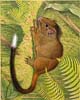
A strikingly unusual animal was recently discovered in the cloud-forests of Peru. The large rodent is about the size of a squirrel and looks a bit like one, except its closest relatives are spiny rats. The nocturnal, climbing rodent is beautiful yet strange looking, with long dense fur, a broad blocky head, and thickly furred tail. A blackish crest of fur on the crown, nape and shoulders add to its distinctive appearance. |
|
|

| The content herein, unless otherwise known to be public domain, are Copyright 1995-2006 - SpaceDaily.AFP and UPI Wire Stories are copyright Agence France-Presse and United Press International. ESA PortalReports are copyright European Space Agency. All NASA sourced material is public domain. Additionalcopyrights may apply in whole or part to other bona fide parties. Advertising does not imply endorsement,agreement or approval of any opinions, statements or information provided by SpaceDaily on any Web page published or hosted by SpaceDaily. Privacy Statement |