|
 |
 |
 |
 |
 |
 |
 |
 |

 |
Threatening Conditions For Rovers In Giant Martian Dust Storm
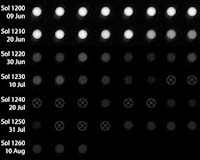
Pasadean CA (SPX) Aug 30, 2007 The mighty Mars rovers Spirit and Opportunity continue to persevere in brutal conditions, as revealed in images of the sun they are sending home. The images show how opaque the Martian atmosphere has been in the face of a raging, two-month dust storm. To understand the gravity of the storm, engineers and astronomers monitor the situation by examining the images of the sun and measuring the amount of dust or the opacity of the atmosphere. Emily Lakdawalla of the Planetary Society assembled the mosaic of images, which were taken daily by the panoramic cameras (Pancams) on both rovers, Spirit and Opportunity. The images were calibrated by students in Cornell's MarsLab image-processing facility and made available through collaboration with Jim Bell, Cornell professor of astronomy and the principal investigator on the rovers' Pancam imaging team. "Emily's mosaics are quite remarkable. They show a rover's-eye view of the storm getting worse, and this little light bulb we call the sun getting dimmer and dimmer and dimmer as the dust clouds built up," said Bell. Since June, a massive dust storm has engulfed much of the Martian surface. The storm has put the rovers in danger, as they depend upon solar power to run during the day and to survive the harsh, cold Martian nights. As dust clouds block the sunlight and dust settles on the solar panels, the rovers' energy is depleted. Only wind can remove the dust, Bell said. For the rover Spirit, the Jet Propulsion Laboratory (JPL) in Pasadena, Calif., reports that even though the Martian sky above Gusev Crater is clearing, solar power levels remained fairly low and constant dust now appears to be accumulating on the solar panels. Between sol -- a Martian day -- 1283 (Aug. 12) and sol 1286 (Aug. 16) , the atmosphere cleared by about 35 percent, leading to daily energy levels of about 300 watt-hours (the amount of energy needed to light a 100-watt bulb for three hours). Typical levels before the dust storms were around 700 to 900 watt-hours for the rovers. On the other side of Mars, Opportunity, now waiting to enter Victoria Crater from the rim, is currently experiencing its lowest power levels to date. The sky was so dark in mid-July that less than 200 watt-hours of daily energy was available, according to JPL. But skies are slowly clearing, offering hope that the rover will be ready for a descent into the crater soon. Opportunity benefited from wind blowing some dust off solar panels on Aug. 22. Under gradually clearing skies, Opportunity's solar panels were producing about 300 watt hours daily by Aug. 24. Community Email This Article Comment On This Article Related Links Mars News and Information at MarsDaily.com Lunar Dreams and more
 Rovers Begin New Observations On Changing Martian Atmosphere
 Pasadena CA (SPX) Aug 30, 2007
Mars rover scientists have launched a new long-term study on the Martian atmosphere with the Alpha Particle X-ray Spectrometer, an instrument that was originally developed at the University of Chicago. |
|
|

| The content herein, unless otherwise known to be public domain, are Copyright 1995-2007 - SpaceDaily.AFP and UPI Wire Stories are copyright Agence France-Presse and United Press International. ESA Portal Reports are copyright European Space Agency. All NASA sourced material is public domain. Additional copyrights may apply in whole or part to other bona fide parties. Advertising does not imply endorsement,agreement or approval of any opinions, statements or information provided by SpaceDaily on any Web page published or hosted by SpaceDaily. Privacy Statement |