|
 |
 |
 |
 |
 |
 |
 |
 |

 |
Thousands Stranded By Flooding From Tropical Storm John
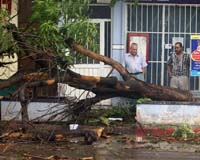
Cabo San Lucas, Mexico (AFP) Sep 03, 2006 Military helicopters flew in emergency aid after floods triggered by Tropical Storm John left 10,000 people stranded on Mexico's Baja California peninsula, officials said Sunday. People in 15 towns in the mountainous region of Baja California Sur state were cut off as flood waters reached up to 1.5 meters (50 inches) after John's heavy rains caused the Iguagil dam in Comondu to overflow its banks. No deaths were reported as the storm made its way up the heavily-touristic peninsula. Three members of one family, counted as disappeared when the current carried their house away Saturday, were found safe and sound on a hillside, protected by the waters, local authorities said. At 2:00 pm (2100 GMT) John remained just barely strong enough to be classified a small tropical storm, said the US National Hurricane Center in Miami, with sustained winds having dropped to 65 kilometers per hour (40 miles per hour). It was located over the mountainous middle of the Baja California peninsula about 50 kilometers (30 miles) northwest of Santa Rosalia. The National Hurricane Center said John was moving northward over the peninsula at 11 kilometers per hour (seven mph) and was expected to further weaken into a tropical depression as it headed toward the southwestern United States, which could expect rain from the storm over the next few days. The center warned that northwestern Mexico could get up to 15 centimeters (six inches) of rainfall, and up to 25 centimeters (10 inches) in isolated areas, possibly causing dangerous flash floods and mud slides in the mountains. While the international airport of Loreto remained closed, La Paz's airport was open, though no flights were taking off. Mexican President Vicente Fox, visiting the region to survey the damages and rescue operations, flew into the airport at Los Cabos, which was also in operation. He was planning to meet with local political leaders and businessmen and visit one of the region's emergency shelters. John hit shore on the peninsula's southern tip Saturday as a Category 2 hurricane after tracking Mexico's Pacific coastline from the south, washing its famous resorts with heavy winds and rains. Some 15,000 people, many of them foreigners, were evacuated from threatened areas in the peninsula, including Los Cabos, a favorite destination for US and other international tourists. Rivers overflowed and trees were downed around the southern end of the peninsula by the storm. But electricity was restored in most of La Paz and Los Cabos by Sunday, and traffic flowed on the roads though slowly. Telecommunication was also restored in most of the area. Earlier John briefly attained Category 4 strength on the five-level Saffir-Simpson hurricane intensity scale. It dumped heavy rain and triggered mudslides in Sinaloa, Nayarit, Jalisco and Guerrero states, though there were no reports of serious damage in those regions.
John Weakens To Tropical Storm Over Baja California Tropical Storm John crawled slowly across the resort-dotted peninsula on the Pacific, triggering some flooding and mudslides. "We are getting off scot-free. I think in a week we will be as if nothing happened," said Jose Gajon, the director general of civil protection in the state of Baja California South. Flooding and downed trees have closed many roads to traffic, he said. The three airports in the region that had been closed Friday in preparation for the storm but "maybe by tomorrow (Sunday) already they will be open," he said. Several areas in the south of the peninsula had suffered power outages, including the state capital La Paz, but by the afternoon most service had been restored. At the peninsula's tip, in the tourist mecca of Cabo San Lucas, Joel Cota, the head of the city's public safety office, said that the storm had left two people in the El Coro area of the resort dead but he did not explain the circumstances of their deaths. But Gajon later denied that information. "There is no dead," he said. The state civil protection official added that a man who had been reported missing after being swept from a vehicle by floodwaters had shown up "bruised, hurt but stable." Late Saturday, John was moving toward the northwest at about 13 kilometers (eight miles) an hour, the Miami-based US National Hurricane Center (NHC) reported. Sustained winds had slowed to nearly 110 kilometers (70 miles) an hour. "Further weakening is likely as John interacts with Baja California," the center said in an advisory. Heavy rains could produce "life-threatening flash floods and mudslides over mountainous terrain," it warned. The Mexican government has dicontinued all hurricane warnings and tropical storm watches, the NHC said. Forecasters said John would continue to weaken as it edged across land, and was expected to leave the peninsula by Sunday. Authorities said the storm crashed ashore as a Category 2 hurricane at around 0200 GMT Saturday in Cabo Pulmo, an area known for its sleek fishing yachts, million-dollar condos and well-manicured oceanfront golf courses. The eye of the hurricane, which initially had been forecast to cross over the posh seaside resort of Cabo San Lucas, passed 45 kilometers (28 miles) to the west. A total of 15,000 people, many of them foreigners, were evacuated from threatened areas. But the majority of the 10,000 tourists, most of them Americans, who were registered Thursday in hotels along a 42-kilometer (26-mile) stretch of coastline known as Los Cabos opted to stick out the storm. John -- which briefly attained Category 4 strength on the five-level Saffir-Simpson hurricane intensity scale -- dumped heavy rain and sparked mudslides in Sinaloa, Nayarit, Jalisco and Guerrero states, though there were no reports of serious damage in those regions.
Source: Agence France-Presse Community Email This Article Comment On This Article Related Links Bring Order To A World Of Disasters A world of storm and tempest Bringing Order To A World Of Disasters When the Earth Quakes A world of storm and tempest
 High-Flying Balloons Begin Tracking Emerging Hurricanes
 Washington DC (SPX) Sep 03, 2006
In a unique collaboration, U.S. and French researchers are launching large, specialized balloons into the stratosphere to drop nearly 300 instrument packages over wide swaths of Africa and the Atlantic Ocean. |
|
|

| The content herein, unless otherwise known to be public domain, are Copyright 1995-2006 - SpaceDaily.AFP and UPI Wire Stories are copyright Agence France-Presse and United Press International. ESA PortalReports are copyright European Space Agency. All NASA sourced material is public domain. Additionalcopyrights may apply in whole or part to other bona fide parties. Advertising does not imply endorsement,agreement or approval of any opinions, statements or information provided by SpaceDaily on any Web page published or hosted by SpaceDaily. Privacy Statement |