|
 |
 |
 |
 |
 |
 |
 |
 |

 |
This Year Set To See Historic Number Of Hurricanes
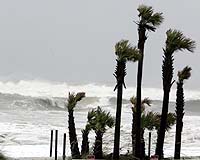
Paris (AFP) Aug 07, 2005 2005 is set to be one of the worst years on record for hurricanes, scientists say, amid spectacular new evidence about the power of these storms and fears that global warming is intensifying them. Less than halfway through the six-month tropical storm season, experts are already warning that the brooding western Atlantic may serve up as many as 21 severe storms and hurricanes this year. If so, that would be more than twice the average annual tally since records began in 1851. "The 2005 hurricane season could rival historically significant years such as 1887, which had 19 named storms; 1933, which had 21 named storms; and 1995, which had 19 named storms," says Barry Keim, assistant professor of geography and anthropology at Louisiana State University, and a climatologist for the state. Since the start of the season on June 1, there have already been eight "named storms" -- the term for a tropical depression that is named once it develops winds of at least 62 kilometers (39 miles) per hour. When the wind speed reaches at least 118 kph (74 mph), the named storm is upgraded to the status of a hurricane. Two of this year's hurricanes, Dennis and Emily, registering four on a maximum scale of five, ripped across the Caribbean and into Florida and Mexico respectively, killing at least 72 people. On August 3, the US National Oceanographic and Atmospheric Administration (NOAA) said it expected an additional 11 to 14 more named storms by the time the season officially ends on November 30. But could this be a conservative estimate? One eagerly-awaited forecast will be released this week by scientists at Britain's Benfield Hazard Research Centre (http://tropicalstormrisk.com), who have devised a new and so far impressively accurate model for predicting potential late-season hurricanes. "I expect (our) forecast will call for exceptionally high hurricane activity, possibly exceeding the forecasts issued by NOAA... with storm activity at sea reaching record-breaking levels," lead scientist Professor Mark Saunders told AFP. Hurricanes are the biggest natural disaster in the United States, accounting for eight out of the 10 costliest catastrophes to hit the country. The annual average damage bill for the continental US between 1950 and 2004 is 5.6 billion dollars, ranging from zero in 10 of those years to more than 44 billion dollars, in the 1992 season, when Hurricane Andrew struck, according to Saunders' figures. But late-season hurricanes are notorious. The summer warming of atmosphere and ocean can brew storms that are more frequent, longer-lasting and more powerful than early-season events. In 2004 -- itself viewed as an exceptional year -- five hurricanes and four tropical storms pounded the Caribbean, Gulf of Mexico and southeastern US states in August and September, inflicting hundreds of deaths and property damage in the billions of dollars. Hurricanes, whose east Asian equivalent is the typhoon, develop from clusters of thunderstorms over tropical waters that are warmer than 27.2 C. In light winds and the right sea conditions, these storms build into a whirling, self-nourishing cyclone, fuelled by the energy that comes from evaporation rising from the warm ocean surface. New research suggests that just a very small increase in sea temperature may dramatically "pump up" these phenomena. Over the past 30 years, the destructive power of North Atlantic storms has more than doubled, with big increases in the duration of the storms as well as in wind power, it says. Yet during this time, the surface of tropical oceans has warmed by just 0.5 C (0.9 F). The study, by Massachusetts Institute of Technology (MIT) scientist Kerry Emanuel, backs predictions by some climatologists that global warming will make storms more damaging. But Emanuel found no evidence to support theories that warmer temperatures will also make tropical storms more frequent. The number of tropical cyclones around the world has been holding steady at around 90 a year, although regional totals undergo periodic swings. Another study on hurricanes has revealed that monster waves, as portrayed in the movie "The Perfect Storm," may not be the freaks once thought. Pressure sensors placed on the floor of the northeastern Gulf of Mexico as Hurricane Ivan raged overhead on September 15 last year showed that one wave was 27.7 metres (91 feet) from crest to trough. The wave, as high as a 10-storey building, was the largest ever measured in US waters, although it never made landfall. The sensors may have missed some waves as high as 40 metres (132 feet), according to the study, which appears in the latest issue of the American journal Science. Community Email This Article Comment On This Article Related Links SpaceDaily Search SpaceDaily Subscribe To SpaceDaily Express Bringing Order To A World Of Disasters When the Earth Quakes A world of storm and tempest
 New Orleans Colleges To Reopen This Week
 New Orleans, Louisiana (AFP) Jan 05, 2006
Thousands of students and faculty are returning to New Orleans' eight colleges and universities this week for the first time since hurricane Katrina flooded the city four months ago. |
|
|

| The content herein, unless otherwise known to be public domain, are Copyright 1995-2006 - SpaceDaily.AFP and UPI Wire Stories are copyright Agence France-Presse and United Press International. ESA PortalReports are copyright European Space Agency. All NASA sourced material is public domain. Additionalcopyrights may apply in whole or part to other bona fide parties. Advertising does not imply endorsement,agreement or approval of any opinions, statements or information provided by SpaceDaily on any Web page published or hosted by SpaceDaily. Privacy Statement |