|
 |
 |
 |
 |
 |
 |
 |
 |

 |
The Year Of Shenzhou
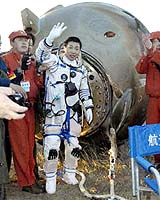
Sydney, Australia (SPX) Oct 05, 2004 It's roughly one year since Yang Liwei became China's first astronaut. The ascendancy of China to the elite club of human spaceflight nations has produced a curious mix of effects, both within China itself and around the world. The flight of Shenzhou 5 was clearly a successful mission, with Yang returning to Earth alive and well after his one-day trip. China's own media coverage of the mission was reasonably good, with the exception of a last-minute decision to avoid a live broadcast of the launch. China had plenty of reason to celebrate, and there is certainly pride in the mission within the nation. But any major effects of China's achievement are somewhat difficult to find in a complex, media-saturated world. Shenzhou received coverage in most major international media sources, who clearly recognised the newsworthiness of the event. But the mission wasn't given as much airtime as it could have been, partially due to China's own tight handling of international media access, but also due to events beyond their control. In a stroke of surprisingly bad luck, New York's legendary Staten Island Ferry crashed as the mission was underway, distracting the US media. International coverage was also tempered by a growing trend towards sensationalist, tabloid news values in the mass media, and a lack of interest in scientific or technical stories. The space activities of any nation receive only modest coverage in the general media, unless a probe has landed on another planet or astronauts have died. Most people were treated to brief clips of Yang waving triumphantly as he emerged from his capsule, before the flight of Shenzhou was shuffled off news agendas. Outside of the scientific and aerospace media, there has been very little coverage of Shenzhou since October 2003. China has not launched another Shenzhou in the meantime, and probably won't get any more international press until it does. But there was little in the way of detailed analysis or commentary on the first mission. It flew. It made headlines. Then news coverage and general attention moved on to other things. This will certainly disappoint some authorities within China, who would probably have hoped that journalists would treat Shenzhou as an indicator of China's growing technological and industrial strength. But news coverage has changed in recent years, largely due to the ascendancy of 24-hour cable news channels. Today's news emphasises the fast reporting of spot events over the monitoring of long-term trends. While China is only the third nation to launch its own crew-carrying spacecraft, the media has grown accustomed to spaceflight in general and categorised it as a regular activity. Without the creation of more visuals, activities or media events, there will be no B-roll (video) to feed into broadcasts. China did permit a group of correspondents to visit the Jiuquan launch site for Shenzhou several weeks ago, but the restrictions placed on this visit make the subsequent write-ups look like satirical comedy. Journalists found themselves writing mundane notes on visiting a local swimming pool and greenhouse, along with a few platitudes from local workers. The tour produced essentially no news or information that hasn't already been widely disseminated. If this is all China is prepared to reveal to the media, it's a wonder that this tour was ever permitted. This will not encourage further visits by international correspondents, who will find it hard to justify their expenses if they cannot generate useful reportage. Irrespective of any deficiencies in China's treatment of the media and vice versa, spaceflight of any sort no longer generates the awe and fear that were common at the birth of the space age. Over the course of several decades, governments, the general public and the world in general have become accustomed to having their territory overflown by foreign spacecraft, and long-range missiles pointed at our major cities. "Sputnik shock" was a product of its time, when the USA was unsure of the strengths of its Cold War foes, and even doubted its own economic and technological prowess. The "iron curtain" trick of selectively filtering information passing outside of a nation's territory also no longer applies. China's space launches have not generated hysteria over "missile gaps" or other strategic scares with the rest of the world. Granted, China is certainly well-armed, but the world has possessed fairly reliable estimates of China's military capabilities for years. At least China has been spared some of the more obnoxious rumours and urban legends that have plagued spaceflight in other nations. Nobody in the mainstream media has questioned the success of the mission, or raised "phantom yuhanguan" stories about failed attempts to launch Chinese astronauts before Yang Liwei. Yang did have to deny reports that he observed the Great Wall of China from orbit, but this is fairly harmless. So, it's easy to conclude that the world acknowledged the flight of Yang Liwei, and gave it as much coverage as the media will give to anything else. But Shenzhou has hardly rocked perceptions of China, its military and industrial base, or the overall course of spaceflight. The three space missions of Space Ship One, the world's first privately developed sub-orbital spacecraft, outstripped media coverage of Shenzhou 5 by a considerable degree. But the team behind Space Ship One provided ample opportunities for media access to their mission, and have broken new ground by putting what was formerly the exclusive domain of major governments into the private sector. China would do well to notice this, and manage its media coverage and public relations with more skill in the future. It would seem that the generally subdued international response to Shenzhou has probably influenced the course of the program. China had previously indicated that the Shenzhou 6 mission, China's second manned spaceflight, would lift off in 2004, probably a year after its predecessor. But in recent months, China has suggested that the flight won't reach the pad until 2005, probably two years after Shenzhou 5. What has caused this surprisingly large delay in the progress of the program? Some suggestions have been made that extra technical work needs to be carried out before the next mission can be launched, and to a certain degree, that's true. Shenzhou 6 is slated to carry two astronauts in orbit for a week, which will stretch its logistics much further than Shenzhou 5. But making room for extra food and oxygen should be fairly straightforward, especially when Shenzhou has now been demonstrated to be a functional spacecraft. All of its major technical bugs were ironed out years ago. It has long been suspected that economic constraints have plagued the Shenzhou program since its inception, which is one reason for its surprisingly relaxed launch schedule during its test phase. But a continuation of the program's previous levels of funding would suggest that Shenzhou 6 should be able to launch within roughly a year, just as every previous mission has done. The unit cost of Shenzhou should also decrease over time, as its design becomes frozen and production becomes more routine. What's happening to Shenzhou? Technical factors and funding seem to be poor excuses for a sudden drop in the planned launch rate. The most likely explanation is that Shenzhou has lost some of its appeal to its political ringmasters. China's senior leadership is still probably haunted by the memory of early Soviet triumphs in space, and expected that a Chinese manned launch could also cause the world to shudder. Clearly, this hasn't happened. Shenzhou also has great potential to boost morale inside China, at a time when the nation is experiencing problems caused by rapid social and economic changes. But reports I have received from visitors to China suggest that many people are unaware that the flight took place, or if they know, they are indifferent to the event. Again, poor handling of media and public relations must surely take some of the blame. Recently, China has also seen a consolidation of its leadership. Jiang Zemin has now yielded control of the military, and Hu Jintao has further consolidated his power base by taking on this role. The Shenzhou program is technically under the wing of the Chinese military, and this change in power could influence its overall course. Is Hu a space fan? He attended the launch of Shenzhou 5, but it remains to be seen if he will boost support for future missions. If attitudes to space remain unchanged at the top, the situation looks fairly uninspiring in the short term. Shenzhou will not be cancelled, but it would seem that China's human spaceflight program will not be pursued at the same rate as its international counterparts. There will be more missions in the future, gradually increasing in their degree of difficulty, but lengthy intervals will probably pass between each milestone. After China's two-man long-duration flight, logical "next steps" will be extravehicular activity, along with rendezvous and docking. At the moment, we stand roughly halfway between China's first and second manned space missions. In a relatively short space of time, our perceptions of the course of the Shenzhou program have changed considerably. But spaceflight is proving to be highly volatile all over the world, as political controversies and funding shortfalls for government programs confront a modest but ambitious series of projects in the private sector. International relationships are also somewhat unpredictable. By the time Shenzhou 6 blasts into orbit, circumstances could have changed again. We're watching with anticipation. Dr Morris Jones can be contacted at [email protected] CommunityEmail This Article Comment On This Article Related Links SpaceDaily Search SpaceDaily Subscribe To SpaceDaily Express The Chinese Space Program - News, Policy and Technology China News from SinoDaily.com
 Taikonauts On Moon A Far Off Dream For China Yet
 Beijing (XNA) Jan 05, 2006
A one-year lunar fly-by mission may start in April 2007 in China, but a manned flight to the Earth's neighbour may be a long way away, a chief lunar exploration scientist said last night. |
|
|

| The content herein, unless otherwise known to be public domain, are Copyright 1995-2006 - SpaceDaily.AFP and UPI Wire Stories are copyright Agence France-Presse and United Press International. ESA PortalReports are copyright European Space Agency. All NASA sourced material is public domain. Additionalcopyrights may apply in whole or part to other bona fide parties. Advertising does not imply endorsement,agreement or approval of any opinions, statements or information provided by SpaceDaily on any Web page published or hosted by SpaceDaily. Privacy Statement |