
 |
 |
 |
 |
 |
 |
 |
 |
 |

 |
The Woes Of The Great Russian Army Continue Part Two
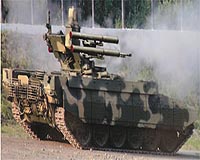
Moscow (UPI) Sep 15, 2008 The five-day conflict between the Russian army and Georgia last month exposed serious Russian weaknesses in the field of radio-electronic warfare. It turns out that Russian electronic countermeasures systems are unable to jam and suppress enemy surface-to-air missiles and reconnaissance systems, radars and UHV communications and troop-control networks. This is rather disturbing, especially as the Georgian army lacked modern systems. As a result, the 58th Army sustained unnecessary casualties and also lost more combat equipment than it should have. The Russian tank force has been suffering from major problems for a long time. The North Caucasian Military District, for instance, still operates T-72 Main Battle Tanks without night sights. But not even the more sophisticated T-80-U and T-90 have such sights, either. Moreover, their explosive-reactive armor was not filled with explosives and therefore could not deflect high-explosive anti-tank weapons. It is common knowledge that tanks are extremely vulnerable in mountainous and urban areas and during redeployment because their crews lack all-round visibility, making it difficult to spot enemy soldiers with rocket launchers or shaped-charges hiding in caves and ravines and behind rocks and bushes. The Dzerzhinsky Ural Railroad Car Works -- Uralvagonzavod -- which has developed all post-Soviet and Russian main battle tanks except the T-80, unveiled its Tank Support Combat Vehicle more than 20 years ago. The TSCV featured nine weapons systems, including guided anti-tank missiles, large-caliber machine-guns, surface-to-air missiles and 30mm and 40mm automatic rocket launchers, and was intended to be used against Mujahedin forces in Afghanistan. Most importantly, the TSCV had effective target-acquisition systems for detecting and killing enemy soldiers long before they could fire the first shot. Although the TSCV has passed all state tests with flying colors and also has been displayed at numerous exhibitions, it has not served with the Russian army to date. Unlike most advanced foreign armies, including the Israeli army, Russian tanks are not supported by attack helicopters. There is no regular radio communication between Russian tank, motorized-rifle, helicopter, attack-plane and tactical-bomber units either. Although experts have been discussing the creation of an integrated combat-control system for many years, such a system remains on the drawing board. The Russian army and its commanders have not yet realized that all units and weapons accomplishing a joint objective must become part of an integrated combat-control system. Russian officers and soldiers have to compensate for the current lag in combat-support systems with their selfless heroism and bravery. But this costs the country and its armed forces dearly. It is high time we learned modern fighting skills. The system for awarding state defense contracts must also be modified accordingly. Unfortunately, the Russian army is unlikely to receive new weapons and combat-support systems after the South Ossetian conflict. Although Russia once again has paid a high price for victory, its generals and politicians often prefer empty talk to candid and sober-minded assessments. (Nikita Petrov is a Russian military analyst. This article is reprinted by permission of RIA Novosti. The opinions expressed in this article are the author's and do not necessarily represent those of RIA Novosti.) (United Press International's "Outside View" commentaries are written by outside contributors who specialize in a variety of important issues. The views expressed do not necessarily reflect those of United Press International. In the interests of creating an open forum, original submissions are invited.) Community Email This Article Comment On This Article Share This Article With Planet Earth
Related Links Learn about the Superpowers of the 21st Century at SpaceWar.com Learn about nuclear weapons doctrine and defense at SpaceWar.com
 Hungary agrees to NATO accession of Albania, Croatia
 Budapest (AFP) Sept 15, 2008
The Hungarian parliament voted unanimously in favour of the ratification of the NATO accession protocols of Albania and Croatia in Budapest on Monday. |
|
|

| The content herein, unless otherwise known to be public domain, are Copyright 1995-2007 - SpaceDaily.AFP and UPI Wire Stories are copyright Agence France-Presse and United Press International. ESA Portal Reports are copyright European Space Agency. All NASA sourced material is public domain. Additional copyrights may apply in whole or part to other bona fide parties. Advertising does not imply endorsement,agreement or approval of any opinions, statements or information provided by SpaceDaily on any Web page published or hosted by SpaceDaily. Privacy Statement |
 del.icio.us
 Digg
Digg Reddit
 YahooMyWeb
 Google
 Facebook