
 |
 |
 |
 |
 |
 |
 |
 |
 |

 |
The Sun Is Setting On Phoenix
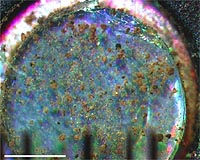
Moffett Field CA (SPX) Oct 14, 2008 As fall approaches Mars' northern plains, NASA's Phoenix Lander continues to dig into the red planet's soil and deliver samples to its onboard science instruments for analysis. Over the past two weeks, Phoenix's nearly 2.4-meter-long (8 foot) arm moved a rock named "Headless" about 0.4 meters (16 inches) and snapped an image of the rock with its camera. Then the robotic arm scraped the soil underneath the rock and delivered a few teaspoonfuls of soil onto the lander's optical and atomic-force microscopes. These microscopes are part of Phoenix's Microscopy, Electrochemistry and Conductivity Analyzer. Scientists are conducting preliminary analysis of this soil sample, nicknamed "Captain Hessian." The soil piqued their interest because it may contain a high concentration of salts, said Phoenix mission scientist Diana Blaney of NASA's Jet Propulsion Laboratory, Pasadena, Calif. As water evaporates in arctic and arid environments on Earth, it leaves behind salt, which can be found under or around rocks, Blaney said. "That's why we wanted to look under Headless, to see if there's a higher concentration of salts there." These salts could indicate that liquid water was once present on Mars, possibly providing a habitat for life. Phoenix scientists also want to analyze a hard, icy layer beneath the Martian soil surface. Excavating to that icy layer underneath a rock might give scientists clues about processes affecting the ice. So the robotic arm has dug into a trench called "La Mancha" in part to see how deep the Martian ice table is. The Phoenix team also plans to dig a trench laterally across some of the existing trenches to reveal a cross section, or profile, of the soil's icy layer. "We hope to learn more about how the ice depth is controlled by physical processes," said Phoenix co-investigator Mike Mellon of the University of Colorado, Boulder. "By looking at how ice depth varies, we can pin down how it got there." The Phoenix lander, originally planned for a three-month mission on Mars, is now in its fifth month. The lander's weather instruments have detected water-ice haze clouds in the northern martian sky, and temperatures are getting colder as the daylight hours wane. Phoenix faces an increasing drop in solar energy as the sun dips longer below the martian horizon. Mission engineers and scientists expect this power decline to curtail activities in the coming weeks. As darkness deepens, Phoenix will become primarily a weather station. The lander will likely cease all activity by the end of the year. Community Email This Article Comment On This Article Share This Article With Planet Earth
Related Links Phoenix at LPL Phoenix at NASA Mars News and Information at MarsDaily.com Lunar Dreams and more
 Phoenix Lander Digs And Analyzes Soil As Darkness Gathers
 Pasadena CA (SPX) Oct 10, 2008
As fall approaches Mars' northern plains, NASA's Phoenix Lander is busy digging into the Red Planet's soil and scooping it into its onboard science laboratories for analysis. |
|
|

| The content herein, unless otherwise known to be public domain, are Copyright 1995-2007 - SpaceDaily.AFP and UPI Wire Stories are copyright Agence France-Presse and United Press International. ESA Portal Reports are copyright European Space Agency. All NASA sourced material is public domain. Additional copyrights may apply in whole or part to other bona fide parties. Advertising does not imply endorsement,agreement or approval of any opinions, statements or information provided by SpaceDaily on any Web page published or hosted by SpaceDaily. Privacy Statement |
 del.icio.us
 Digg
Digg Reddit
 YahooMyWeb
 Google
 Facebook