|
 |
 |
 |
 |
 |
 |
 |
 |

 |
The Strange 'Mercy' Of Hurricane Katrina
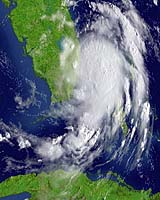
Washington (UPI) Aug 29, 2005 The so far mercifully low casualties inflicted upon the United States by the "perfect storm" of Hurricane Katrina bear testimony to the superb efficiency of the high-tech, space based early warning weather system that serves the U.S. East Coast and Southeast. The extremely low casualties suffered in the Category 5 hurricane's path, despite the material havoc and billions of dollars of damage inflicted, stand in striking contrast to the horrific death toll of around 250,000 from the tidal waves caused by an enormously powerful earth quake deep beneath the Indian Ocean in December. After that catastrophe, there was rapid realization that if the kind of real-time warning infrastructure that already existed to warn of tsunamis, or tidal waves, in the Pacific, had existed for the nations circling the Indian Ocean from India to Indonesia, the death toll would have been far, far lower. In the case of the warnings that preceded Hurricane Katrina, they were all thanks to space-based weather reconnaissance satellites, a service now globally taken for granted but still inconceivable half a century ago except in the minds of a few visionaries like Arthur C. Clarke. For Katrina was the kind of storm that seemed heaven -- or hell -- ordained to take Florida and Louisiana by total surprise and wreak total havoc. At first it appeared to be a tropical storm and it was moving slowly, then it unexpectedly picked up speed. As late as Wednesday evening, no more than a small hurricane was anticipated. Then a series of apparently random and improbable events, like a text book fulfillment of the famous "Butterfly Effect" in mathematical "Chaos Theory", gave it extra power and duration as it swept over Florida with sufficient strength remaining to draw new energy from the favorable weather and tidal conditions in the Gulf of Mexico, especially the loop current of hot tropical seawater south of Louisiana. Thanks to satellite weather reconnaissance, all these developments were monitored in real time and ample precautions could be taken. In the days before the first 1960s weather satellites were launched into orbit, however, it would have been a very different story and thousands of people would have died. The famous case of the hurricane that slammed into Long Island and New England in September 1938 killing 700 people and injuring 1,700 more was the textbook example of that. Today there would have been at least 24 hours, perhaps 48 hours warning and almost all of those lives would have been saved. Vulnerable and isolated beach properties would have been evacuated. Towns in the path of the storm would have been warned to flee or hunker down in storm cellars and almost all traffic would have ceased on the roads. Fishing boats and tour ships would long since have fled to port, as happened on the east coast of Florida on Wednesday night and Thursday morning. But orbiting surveillance satellites did not yet exist, nor did the intercontinental-range ballistic missiles needed to lift them into orbit, or the television technology to serve them, or radar, or jet aircraft either. But even today, the most advanced and prepared technological societies on the planet can still fall victim to catastrophes if the forces impelling them are powerful enough, or if random factors produce unprecedented results. Thailand has been one of the fastest developing industrial societies in the world over the past 40 years. But the boom in tourism for its idyllic beaches only added to the tragedy when the tidal waves hit last December. No sufficient precautions were taken because no catastrophe of comparable magnitude had occurred within modern times: There seemed to be no reason to even prepare for it. And if Katrina had fulfilled her full threat and hit with its full force the evacuated coastal city of New Orleans, more than 20 feet in many areas below sea-level, despite all the warnings that were given and the energetic precautions that were taken, the death toll would inevitably have been significant. The economic costs could also have been vastly worse. For the Port of Southern Louisiana is the fifth largest one in the world behind only Singapore, Rotterdam, Shanghai and Hong Kong. It handles more cargo per year than New York/New Jersey and it stretches for 50 miles along the Mississippi River from St. James to St. Charles Parish. And the levees that protect it from the ocean and the "Mighty Mississip" are not designed for a Category 5 monster like Katrina. There have been only three other storms of comparable intensity to it in recorded history. By the time Katrina hit the Louisiana-Mississippi border around noon Monday, it had decreased to nasty but manageable Category 2 storm with winds of "only" 105 miles per hour. Early reports stated 20 buildings had collapsed around New Orleans. It might easily have been far worse. The relatively low costs and casualties inflicted by Katrina are a tribute to the U.S. National Weather Service and National Hurricane Center, still incomaparably the best in the world. But they are also a reminder that we remain even at our most technologically imposing, mere gnats riding on the back of a gigantic Nature that could shrug us off at any time. Community Email This Article Comment On This Article Related Links SpaceDaily Search SpaceDaily Subscribe To SpaceDaily Express Bringing Order To A World Of Disasters When the Earth Quakes A world of storm and tempest
 New Orleans Colleges To Reopen This Week
 New Orleans, Louisiana (AFP) Jan 05, 2006
Thousands of students and faculty are returning to New Orleans' eight colleges and universities this week for the first time since hurricane Katrina flooded the city four months ago. |
|
|

| The content herein, unless otherwise known to be public domain, are Copyright 1995-2006 - SpaceDaily.AFP and UPI Wire Stories are copyright Agence France-Presse and United Press International. ESA PortalReports are copyright European Space Agency. All NASA sourced material is public domain. Additionalcopyrights may apply in whole or part to other bona fide parties. Advertising does not imply endorsement,agreement or approval of any opinions, statements or information provided by SpaceDaily on any Web page published or hosted by SpaceDaily. Privacy Statement |