|
 |
 |
 |
 |
 |
 |
 |
 |

 |
The Spark Of A New Era
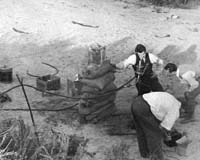
Pasadena CA (SPX) Oct 27, 2006 On July 4th of 2005, the hopes and dreams of the people of the Jet Propulsion Laboratory rode on the precision of a single five-pound rocket motor. Within one 90-minute span, the diminutive thruster had to fire accurately three times to position the working end of NASA's Deep Impact mission in the path of an onrushing comet. While the comet/spacecraft encounter was unique, it was by no means the first time a five-pound rocket motor carried the aspirations of the Jet Propulsion Lab. The very first time, JPL was not even called JPL. Seventy years ago this Halloween, at 9 a.m., a truck from the California Institute of Technology turned on to a road owned by the Pasadena Water Department and after heading down a small hill came to a stop. Its tired occupants - they had spent the night before preparing and had only three hours sleep - clambered out and began the laborious job of carrying their cumbersome test equipment another 400 yards into the dirt and scruffy brush of Pasadena's Arroyo Seco. They were there in an isolated, dry, scrub strewn gulch three miles north of the Rose Bowl to scientifically measure the thrust developed by one of the world's first liquid-fueled rocket motors. They were there to accurately calculate the efficiency of the motor. They were there because, there, they most likely would not kill anyone - except perhaps themselves. The 'they' were Frank Malina, Jack Parsons, Ed Forman, A.O. Smith, William Bollay, Carlos Wood and William Rockefeller. Malina was a graduate student at nearby Caltech. He had read Jules Verne as a child and considered propellers to be an unnecessary limitation to the potential of aircraft. His associate Parsons was a freethinking explosives expert who dabbled in pagan rituals and liked to keep volatile rocket fuels in his home. And Forman was an area mechanic who, like his friend Parsons, liked to see things go boom. Forman and Parsons met Malina through Caltech professor Theodore von Karman. Although both Parsons and Forman's education ended at the high school level, their enthusiasm for the new field of rocketry won over von Karman. But the methodical professor realized the young duo's 'kick the tire and light the fire' attitude had to be tempered. To achieve breakthroughs in rocket propulsion, von Karman appreciated, would require a healthy respect for the scientific method. He pointed them in the direction of Malina, who was also quickly won over by their passion. In February 1936, Malina requested the two assist him in his doctoral thesis on rocket propulsion. Nine months of hard work later, Malina, Parsons and Forman were standing in the dusty gully in the Arroyo Seco with Smith, Bollay, Wood and Rockefeller - all inquisitive, aeronautically-minded Caltech graduate students willing to break a sweat. By one in the afternoon the now sweaty septet had had their fill of the lugging and assembling of heavy cylinders, gauges and hoses. Before them stood a nearly five-foot-tall rocket motor made of duralumin, surrounded by a water jacket to keep the combustion chamber cool. It was pointed skyward and, when firing, the plan was it would push down on a diamond tipped arm that would scratch a clock-driven glass drum, providing the experimenters with an accurate assessment of the motor's thrust. All this was attached by a series of rubber tubes to a m�lange of valves, flow meters, pressure regulators, pressurized bottles of fuel and oxidizer, and surrounded by sandbags. Nine months of work led to this moment. Most in attendance huddled behind a wall of sandbags. A few took refuge behind a nearby trash dump. All waited anxiously. A lit fuse quickly covered the distance between sandbag and rocket. It entered the rocket chamber and then - nothing. After confirming it was relatively safe to approach, the team gathered by the rocket engine and attempted some on-scene analysis. Soon after, two more attempts led to the same humbling result. Prior to the fourth and final attempt of the day the team made a modification to the fuse. The fuse was lit. When its flame entered the combustion chamber the regulators for gaseous oxygen and methyl alcohol were opened. Ignition. A foot-long plume of fire rose from the engine's nickel-plated nozzle only to be quickly snuffed out when the oxygen hose broke loose. Our intrepid rocket pioneers ran for the hills as the hose snaked across the ground spouting flame. When the coast was clear they compared notes. They agreed the motor had only fired for all of three seconds. But they also agreed that the most important thing was that it had fired. One month after their initial success, the team more than quadrupled their initial firing time; and by January of the following year the rocket motor was putting out between 5 and 8 pounds of thrust for up to 44 seconds. Rocket propulsion, and more importantly, the science of rocket propulsion, had come to Pasadena. Today, space probes designed, built and managed within earshot of that first Arroyo rocket firing have reached every planet in our solar system and peered well beyond its boundaries. Each probe carries on it the logo of the Jet Propulsion Laboratory. But more importantly, each probe carries with it the legacy of scientific and engineering excellence that began some 70 years ago in an isolated, scrub-strewn gulch in the Arroyo. Community Email This Article Comment On This Article Related Links Rocket Science News at Space-Travel.Com Space Tourism, Space Transport and Space Exploration News
 ISRO Moots Manned Mission To Space
 Delhi (PTI) Oct 27, 2006
A "registration of intent" to send an Indian astronaut into space on a home-made space capsule using an Indian launch vehicle from Sriharikota in Andhra Pradesh was made before Prime Minister Manmohan Singh in New Delhi on October 17. Indian Space Research Organisation (ISRO) Chairman G. Madhavan Nair made a brief slide presentation on the possibility of sending an Indian astronaut into space. |
|
|

| The content herein, unless otherwise known to be public domain, are Copyright 1995-2006 - SpaceDaily.AFP and UPI Wire Stories are copyright Agence France-Presse and United Press International. ESA PortalReports are copyright European Space Agency. All NASA sourced material is public domain. Additionalcopyrights may apply in whole or part to other bona fide parties. Advertising does not imply endorsement,agreement or approval of any opinions, statements or information provided by SpaceDaily on any Web page published or hosted by SpaceDaily. Privacy Statement |