|
 |
 |
 |
 |
 |
 |
 |
 |

 |
The Sources Of Solar Hazards In Interplanetary Space
Denver CO (SPX) Jun 03, 2004 Life on Earth is nurtured by heat and light from the Sun. Yet life on Earth also is inconvenienced, sometimes potentially threatened, when the Sun sends out huge blasts of energy and high-speed particles. On Earth, our atmosphere and magnetic field help protect us. But in deep outer space, and on the surface of the Moon and Mars, astronauts are vulnerable to solar eruptions. Predicting such eruptions and how they affect interplanetary space would help mitigate their effects, but currently is impossible. On Monday at the 204th meeting of the American Astronomical Society in Denver, Colorado, Smithsonian astrophysicist Jun Lin (Harvard- Smithsonian Center for Astrophysics) and colleagues announced that they have gained a new understanding of how to identify and describe the sources of solar radiation hazards, which are composed of solar energetic particles. Over time, that knowledge may lead to better predictions of such hazards: a capability that will be needed when astronauts begin fulfilling the vision of human exploration beyond Earth. "Our current ability to forecast solar energetic particle events is more primitive than our ability to forecast thunderstorms before the invention of satellites," said Lin. "Eventually, we plan to monitor the Sun for signs of high-energy particle emission just as we monitor the Earth for storm fronts. Ultimately, the goal is to predict such hazards just like meteorologists predict rainstorms."
The Threat Of Space Storms The production of hazardous high-energy particles is known to be associated with large solar storms, which consist of catastrophic eruptions near the solar surface called flares and ejections of gases and magnetism called coronal mass ejections. Both flares and coronal mass ejections are believed to produce hazardous high-energy particles that scatter off waves, bathing interplanetary space in those particles. The Earth's atmosphere and magnetosphere protect people on the ground, and even astronauts in low-Earth-orbit are reasonably protected by the Earth's magnetosphere, although they occasionally seek shelter in protected modules of the International Space Station. However, astronauts traveling to the Moon or Mars leave such protections behind. Therefore, prompt storm warnings, well-shielded spacecraft, and lunar and martian bunkers will be critical to the success of human space exploration. "That's where our work comes in," said Leonard Strachan (CfA). "Meteorologists use radar to look for hook echoes signaling an approaching tornado. We are working to determine what signs from the Sun signal the production of energetic particle hazards."
Two Storm Sources Particle hazards have two different sources, much like tornadoes may be spawned either by a storm front or by a hurricane. The first emissions lasting less than an hour come from strong solar flares near the Sun's surface that feed on the Sun's evolving magnetic field. Longer duration production by shock waves is generated by coronal mass ejections (CMEs) -- dramatic solar explosions that propel huge amounts of gas away from the Sun at tremendous speeds. Although it is generally known that both flares and coronal mass ejections produce solar energetic particle hazards, the exact sites of the particle production are not known for solar flares; and before now, it has not been possible to determine both where and when a coronal mass ejection generates the shock wave that is needed to produce the energetic particles. Over the past 8 years, CfA scientists have been using observations from the Solar and Heliospheric Observatory (SOHO) to better understand the sources of both types of energetic particle production. The Smithsonian- developed Ultraviolet Coronagraph Spectrometer (UVCS) instrument on SOHO observes CMEs above the solar surface, in the region of their peak acceleration into the solar system.
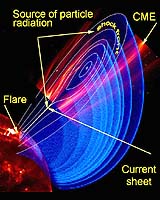
First Step Toward Predictions Substantial progress has been made in identifying and describing the sites that produce energetic particles for both the initial flare-related production, and for the longer-duration coronal mass ejection production of the hazards. For the flare-related portion, a theoretical model developed by Jun Lin (CfA) and Terry Forbes (University of New Hampshire) has led to new ideas about the precise source region of the energetic particles. Instead of blasting outward from the flare itself, Lin and Forbes propose that many of these particles arise in a thin electrified "sheet" of gas that stretches from the flare site to the base of the coronal mass ejection. This current sheet acts much as an Earth-bound particle accelerator, pushing atomic particles to almost the speed of light. "The electrified current sheets predicted by the model have been seen by UVCS," said Lin. "It was remarkable that right where the model predicted a sheet would be, UVCS saw an extremely narrow region where the gas temperature jumped up from less than a million degrees Celsius to more than 6 million. This intense heating is one of the hallmarks of the current sheet model." For the CME-related shock portion, UVCS observations have made the first-ever determinations of the detailed properties of these shocks -- i.e., when and where they form, as well as their temperatures, speeds, and chemical compositions. Knowing these detailed properties is crucial for being able to predict the strength of the energetic particle production that will result from a particular event. Prior to SOHO, observations of CMEs have seen bubbles and tongues of ejected gas, but not evidence of the shock wave itself. "We know that interplanetary shocks heat up the tenuous gas as they plow through the solar corona," said John Raymond (CfA). "The ultraviolet observations let us see both pre-existing cool gas get pushed aside by the shock, as well as the much hotter, 50 million degree C gas that is produced directly by the shock. Using these observations, we determine the existence, location, and strength of the shock." Also, observing the formation of the shock at a particular place in the solar atmosphere gives the scientists an extra piece of information: the intensity of the magnetic field. Although measurements of the magnetic field intensity on the surface of the Sun are routine, there have been no known methods of measuring this key quantity high up in the corona. In order to put these measurements into a real-time prediction system for the radiation hazards to astronauts, the observed CME shock properties have to be input into a computer model. These models are under development at a number of institutions around the world, but in order to have real-time predictive capability, they require that scientists input the initial properties of the shocks. That data can come only from observations of shock formation in the corona. The ongoing SOHO observations are continuing to test the feasibility of using these observations for real-time space storm prediction, but a true monitoring system has yet to be built. Community Email This Article Comment On This Article Related Links American Astronomical Society SpaceDaily Search SpaceDaily Subscribe To SpaceDaily Express Space Technology News - Applications and Research
 TeleRay Mobile Sat TV Antenna For Japan Auto Market
 Las Vegas CA (SPX) Jan 5, 2006
RaySat has introduced TeleRay, the world's smallest satellite TV vehicle antenna, into the domestic Japanese automotive market. |
|
|

| The content herein, unless otherwise known to be public domain, are Copyright 1995-2006 - SpaceDaily.AFP and UPI Wire Stories are copyright Agence France-Presse and United Press International. ESA PortalReports are copyright European Space Agency. All NASA sourced material is public domain. Additionalcopyrights may apply in whole or part to other bona fide parties. Advertising does not imply endorsement,agreement or approval of any opinions, statements or information provided by SpaceDaily on any Web page published or hosted by SpaceDaily. Privacy Statement |