|
 |
 |
 |
 |
 |
 |
 |
 |

 |
The Secret Lives Of Sea Slugs
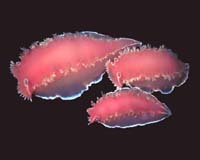
Woods Hole MA (SPX) May 09, 2006 It turns out that the sea slug isn't really that sluggish after all. So says the first broad field study of this charismatic orange creature's behavior in the wild, which was just published in the April 2006 issue of The Biological Bulletin. The new research is significant because the sea slug known as Tritonia diomedea, a nudibranch mollusc species found in the shallow northeast Pacific, is important in laboratory studies of the how the brain controls behavior, a field known as neuroethology. Biologists Russell Wyeth and Dennis Willows, of University of Washington's Friday Harbor Laboratories, launched the study to help provide missing information on this important research animal. "Tritonia is one of the testing grounds for a lot of ideas for how nervous systems work," says Wyeth. "Field work with this organism is helpful because it gives you a good idea of how to set things up in the lab." Observations of the slug's natural behaviors and the sensory cues that trigger them also add exciting new context for scientists studying them under experimental conditions and provide information that cannot be obtained in laboratories. The study sheds light on the sea slug's navigation, feeding, mating, and egg-laying behavior, and confirms that many of this creature's behaviors in the wild are similar to published descriptions of laboratory behavior. The navigational observations are among the study's most exciting findings, not only because they are new to science, but also because they suggest that sea slugs don't just inch randomly around the sea. In fact, they respond to odors and other sensory cues by initiating beneficial navigational behaviors, including escaping from predators by swimming up into water currents that hurl them (un-sluggishly) end over end downstream and away from harm, as well as crawling aggressively (for slugs) upstream to breed and feed. The observations also correlated with earlier studies suggesting that sea slugs flatten out their bodies to reduce drag when they encounter strong water currents, a behavior that helps them avoid being swept away. At field sites near Vargas Island, British Columbia, and in southern Puget Sound, Wyeth, Willows, and their colleagues used SCUBA and time-lapse videos made with surveillance cameras like those used to catch shoplifters to observe the slugs' secret lives, then described certain behaviors and their relationships to sensory cues. The goal of neuroethologists who study sea slugs in the laboratory is to link specific behaviors to their underlying neural controls. Information on behaviors and sensory cues that influence them is essential to the study of sensory systems, central processing, and motor systems, the basic neural elements that control behavior in all animals. The sea slug has become a favored research model in this research arena over the past 40 years. "It's nature's gift to neurobiologists," says Wyeth. "It has a relatively small number of large, color-coded nerve cells that always appear in the same place in a relatively simple nervous system that controls behaviors that are easy to study under conditions of neurophysiological experimentation." The observations that sea slugs navigate with respect to water flow and direction based on odor and other cues will inspire further studies of this behavior and aid scientists studying the nerve cells involved in navigation, an important problem every animal faces. "Once you know what a behavior is, you have a starting point to see how the brain is actually controlling it," Wyeth says. Community Email This Article Comment On This Article Related Links Marine Biological Laboratory Darwin Today At TerraDaily.com
 Hundreds Protest Reintroduction Of Bears In Pyrenees
 Paris (AFP) May 08, 2006
Hundreds of people gathered in southwest France on Saturday to protest the reintroduction of bears into the Pyrenees mountains, as a French court considered whether to suspend the disputed scheme. |
|
|

| The content herein, unless otherwise known to be public domain, are Copyright 1995-2006 - SpaceDaily.AFP and UPI Wire Stories are copyright Agence France-Presse and United Press International. ESA PortalReports are copyright European Space Agency. All NASA sourced material is public domain. Additionalcopyrights may apply in whole or part to other bona fide parties. Advertising does not imply endorsement,agreement or approval of any opinions, statements or information provided by SpaceDaily on any Web page published or hosted by SpaceDaily. Privacy Statement |