|
 |
 |
 |
 |
 |
 |
 |
 |

 |
The Secret Life Of Acid Dust
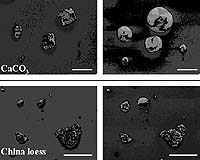
San Francisco CA (SPX) Dec 15, 2004 Dry dust reacts with air pollutants to form dewy particles whose sunlight-reflecting and cloud-altering properties are unaccounted for in atmospheric models. "Calcite-containing dust particles blow into the air and encounter gaseous nitric acid in polluted air from factories to form an entirely new particle of calcium nitrate," said Alexander Laskin, a senior research scientist at the Department of Energy's Pacific Northwest National Laboratory in Richland, Washington. "These nitrates have optical and chemical properties that are absolutely different from those of originally dry dust particles, and climate models need to be updated to reflect this chemistry." Calcite dust is ubiquitous in arid areas such as Israel, where this past winter Laskin and colleagues Vicki Grassian, chemistry professor at the University of Iowa, and Yinon Rudich, professor of environmental sciences and energy research at the Weizmann Institute of Science, collected particles for analysis. Laskin presented their findings Tuesday at the American Geophysical Union fall meeting. Working from a mountaintop, the team collected dust that had blown in from the northern shores of Egypt, Sinai and southern Israel. The particles had mingled with air containing pollutants that originated from Cairo. They analyzed nearly 2,000 individual micron-sized particles and observed the physical and chemical changes with an array of techniques at the W.R. Wiley Environmental Molecular Sciences Laboratory at PNNL. A key change in the properties of the newly formed nitrate particles is that they begin to absorb water and retain the moisture. These wet particles can scatter and absorb sunlight - presenting climate modelers, who need to know where the energy is going, a new wild card to deal with. Companion studies of dust samples from the Sahara and the Saudi coast and loess from China show that the higher the calcium in the mineral, the more reactive they are in with nitric acid. And once the particle is changed, it stays that way. "When dust storms kick up these particles and they enter polluted areas, the particles change," Laskin said. "To what extent this is happening globally, as more of the world becomes industrialized, we don't know. But now we have the laboratory and field evidence that shows it is definitely happening. The story is much more complicated than anybody thought." Community Email This Article Comment On This Article Related Links PNNL University of Iowa Weizmann Institute of Science SpaceDaily Search SpaceDaily Subscribe To SpaceDaily Express Earth Observation News - Suppiliers, Technology and Application
 New Legislation Initiated To Support Commercial Remote Sensing Industry
 New York NY (SPX) Jan 11, 2006
The importance of remotely sensed data and technologies to support natural disasters has prompted attention and action in Washington. New initiatives and legislation authorizing appropriations to the remote sensing industry will be discussed at Strategic Research Institute's U.S. Commercial Remote Sensing Industry conference, scheduled for February 9-10, 2006 in Washington D.C. |
|
|

| The content herein, unless otherwise known to be public domain, are Copyright 1995-2006 - SpaceDaily.AFP and UPI Wire Stories are copyright Agence France-Presse and United Press International. ESA PortalReports are copyright European Space Agency. All NASA sourced material is public domain. Additionalcopyrights may apply in whole or part to other bona fide parties. Advertising does not imply endorsement,agreement or approval of any opinions, statements or information provided by SpaceDaily on any Web page published or hosted by SpaceDaily. Privacy Statement |