|
 |
 |
 |
 |
 |
 |
 |
 |

 |
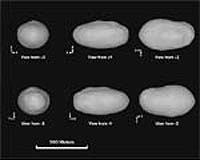
The Rough Shape Of Asteroid "ITOKAWA" Revealed
Tokyo - Apr 27, 2004 A recent radar observation clarified the rough shape of an asteroid called "ITOKAWA", where the MUSES-C (Hayabusa) is heading for. A research group led by Dr. Steve Ostro of the NASA Jet Propulsion Laboratory carried out observations by transmitting radio waves to ITOKAWA from the radiotelescope at the Arecibo Observatory in Puerto Rico. The radiotelescope is famous for having the largest diameter of 305 meters. Their research is to observe time of wave reflection and frequency gaps over a long time to study the shape and revolution of a faraway asteroid. Hayabusa will carry out detailed observations for months after its scheduled arrival at ITOKAWA in the summer of 2005. The onboard high-performance camera will capture more precise images of the surface of ITOKAWA, which looks like a potato in the image data retrieved by the Arecibo Observatory�f s radiotelescope. In addition, Hayabusa is expected to provide more detailed information on the origin of the solar system through observations by spectroscopy of several wave ranges including infrared rays and X-rays, and hopefully by bringing back a fragment of ITOKAWA. Hayabusa will conduct an "Earth Swing-by" in May 2004 to project itself into the orbit of ITOKAWA. HAYABUSA's mission: to bring back samples from an asteroid and investigate the mysteries of the birth of the solar system. HAYABUSA (MUSES-C) has been developed to investigate asteroids. Asteroids are celestial bodies that are smaller than planets but are part of the solar system. HAYABUSA was launched on May 9th, 2003, and has been flying steadily towards an asteroid named "Itokawa," after the late Dr. Hideo Itokawa, the father of Japan's space development program. HAYABUSA is traveling through space using an ion engine. It will orbit the asteroid, land on it, and bring back a sample from its surface. Until now, the only extra-terrestrial celestial body from which we have gathered samples is the Moon. But since the matter that comprises large bodies such as the planets and the Moon has changed over time due to thermal processes, these bodies cannot provide us with a pristine record of the solar system. Asteroids, on the other hand, are believed to be small enough to have preserved the state of the early solar system and are sometimes referred to as celestial fossils. A soil sample from an asteroid can give us clues about the raw materials that made up planets and asteroids in their formative years, and about the state of the inside of a solar nebula around the time of the birth of the planets. However small the sample amount may be, its scientific significance is tremendous. HAYABUSA's mission will play an important role in future space-probe journeys. HAYABUSA employs a new technology - the ion engine. This engine first ionizes the propellant gas, Xenon, then electrically accelerates and emits the ions, to propel itself forward. As it is a highly efficient engine, it is expected to be an important technological tool for our future exploration of the Moon and the planets. HAYABUSA will demonstrate this technology. Another innovation that HAYABUSA will demonstrate is the Autonomous Navigation System, which enables the probe to approach a far-away asteroid without human guidance. The system works by measuring the distance to the asteroid with the Optical Navigation Camera, and using Light Detection and Ranging. HAYABUSA will not only gather samples but also observe the asteroid with various scientific devices and measures. For that purpose, it is equipped with a Telescope Wide-View Cameras and Light Detection and Ranging, as well as with a Near Infrared Spectrometer. It will also employ a hopping robot, which can move around on the asteroid's surface. When HAYABUSA returns to Earth, a re-entry capsule bearing a surface sample from the asteroid will separate from it and plunge into the Earth's atmosphere. This is also a very important experiment in space engineering. Community Email This Article Comment On This Article Related Links MUSES-C Homepage Asteroid Radar Science at JPL SpaceDaily Search SpaceDaily Subscribe To SpaceDaily Express Asteroid and Comet Mission News, Science and Technology
 NASA'S Spitzer Finds Possible Comet Dust Around Dead Star
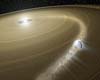 Pasadena CA (SPX) Jan 12, 2006
NASA's Spitzer Space Telescope has spotted what may be comet dust sprinkled around the white dwarf star G29-38, which died approximately 500 million years ago.
--------------------------------------------------------- It's new. And it's downright terrific! Celestron's CPC Schmidt-Cassegrain telescope is the scope you've been waiting for! It offers new alignment technology, advanced engineering, and bold new design at a new, low price! In fact, Celestron's Professional Computerized (CPC) scope with revolutionary SkyAlign Alignment Technology redefines everything that amateur astronomers are looking for. It offers quick and simple alignment, GPS technology, unsurpassed optical quality, ease of use, advanced ergonomics, enhanced computerization and, most important, affordability. Want to view M-31 tonight? One button takes you there!
Shop for telescopes online at Telescopes.com! today!
|
|
|

| The content herein, unless otherwise known to be public domain, are Copyright 1995-2006 - SpaceDaily.AFP and UPI Wire Stories are copyright Agence France-Presse and United Press International. ESA PortalReports are copyright European Space Agency. All NASA sourced material is public domain. Additionalcopyrights may apply in whole or part to other bona fide parties. Advertising does not imply endorsement,agreement or approval of any opinions, statements or information provided by SpaceDaily on any Web page published or hosted by SpaceDaily. Privacy Statement |