
 |
 |
 |
 |
 |
 |
 |
 |
 |

 |
The Rosetta Stone For Understanding Evolution
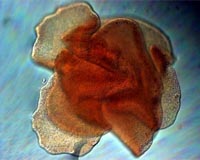
New Haven CT (SPX) Sep 12, 2008 Yale molecular and evolutionary biologists in collaboration with Department of Energy scientists produced the full genome sequence of Trichoplax, one of nature's most primitive multicellular organisms, providing a new insight into the evolution of all higher animals. The findings reported in the online edition of the journal Nature show that while Trichoplax has one of the smallest nuclear genomes found in a multi-cellular creature, it contains signature sequences for gene regulation found in more complex animals and humans. Further, it defines Trichoplax as a branching point of animal evolution. "Trichoplax placozoans are animals that have only four body cell types and no structured organs. They represent descendents of the oldest multi-celled animal, perhaps older even than sponges," said author Stephen Dellaporta, professor of molecular, cellular and developmental biology at Yale. This study shows that compared with the nuclear genome of humans that contains 3 billion base pairs, Trichoplax has only 98 million. Earlier sequencing work showed that the mitochondrial genome of Trichoplax is over twice the size of those found in most animals with genes, introns and spacer sequences like the most primitive organisms. However, size is not all that matters. DNA sequences that organisms share in common represents what was in their genomes at the time of their divergence. Unlike other model systems for studying evolution, including fruit flies and worms, even the arrangement of genes is conserved between the Trichoplax and human genomes. "Trichoplax shares over 80 percent of its genes with humans," said Dellaporta. "We are exited to find that Trichoplax contains shared pathways and defined regulatory sequences that link these most primitive ancestors to higher animal species. The Trichoplax genome will serve as a type of "Rosetta Stone" for understanding the origins of animal-specific pathways." Community Email This Article Comment On This Article Share This Article With Planet Earth
Related Links Yale University Darwin Today At TerraDaily.com
 What Came First: Viruses Or Cells
 University Park PA (SPX) Sep 11, 2008
Scientists at Penn State have developed a new computational method that they say will help them to understand how life began on Earth. The team's method has the potential to trace the evolutionary histories of proteins all the way back to either cells or viruses, thus settling the debate once and for all over which of these life forms came first. |
|
|

| The content herein, unless otherwise known to be public domain, are Copyright 1995-2007 - SpaceDaily.AFP and UPI Wire Stories are copyright Agence France-Presse and United Press International. ESA Portal Reports are copyright European Space Agency. All NASA sourced material is public domain. Additional copyrights may apply in whole or part to other bona fide parties. Advertising does not imply endorsement,agreement or approval of any opinions, statements or information provided by SpaceDaily on any Web page published or hosted by SpaceDaily. Privacy Statement |
 del.icio.us
 Digg
Digg Reddit
 YahooMyWeb
 Google
 Facebook