|
 |
 |
 |
 |
 |
 |
 |
 |

 |
The Resurgent Sun
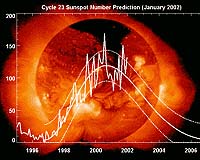
Huntsville - Jan 21, 2002 Evidence is mounting that some solar cycles are doubled-peaked. The ongoing solar maximum may itself be a double -- and the second peak has arrived. Every 11 years solar activity reaches a fever pitch: Solar flares erupt near sunspots on a daily basis. Coronal mass ejections, billion-ton clouds of magnetized gas, fly away from the Sun and buffet the planets. Even the Sun's awesome magnetic field -- as large as the solar system itself -- grows unstable and flips. It's a turbulent time called Solar Max. The most recent (and ongoing) Solar Max crested in mid-2000. Sunspot counts were higher than they had been in 10 years, and solar activity was intense. One remarkable eruption on July 14, 2000 -- the so-called "Bastille Day Event" -- sparked brilliant auroras as far south as Texas, caused electrical brown-outs, and temporarily disabled some satellites. After that, sunspot counts slowly declined and the Sun was relatively quiet for month-long stretches. Solar Max was subsiding. But now, as 2002 unfolds, it's back. The Sun is again peppered with spots, and eruptions are frequent. Says David Hathaway, a solar physicist at the NASA Marshall Space Flight Center: "The current solar cycle appears to be double-peaked," and the second peak has arrived. Scientists track solar cycles by counting sunspots -- cool planet-sized areas on the Sun where intense magnetic loops poke through the star's visible surface. Hathaway is an expert forecaster of sunspot numbers. "Sunspot counts peaked in 2000 some months earlier than we expected," he recalls. The subsequent dip toward solar minimum seemed premature to Hathaway, and indeed it was. Before long, sunspot counts reversed course and began to climb toward a second maximum that now appears to be only a few percent smaller than the first. Solar Max eleven years ago was much the same. A first peak arrived in mid-1989 followed by a smaller maximum in early 1991. In fact, if the ongoing cycle proves to be a double, it will be the third such double-peaked cycle in a row. During solar maximum, magnetic fields above the Sun's surface become impressively tangled, particularly near sunspots. Twisted magnetic fields -- stretched like taut rubber bands -- can snap back and explode, powering solar flares and coronal mass ejections. Sunspots are the most visible sign of those complex magnetic fields -- but not the only one. Another sign is solar radio emissions, which come from hot gas trapped in magnetic loops. "The radio Sun is even brighter now than it was in 2000," says Hathaway. By the radio standard, this second peak is larger than the first. Hathaway notes a widespread misconception that solar activity varies every 11 years "like a pure sinusoid." In fact, he says, solar activity is chaotic; there is more than one period. Earth-directed solar explosions, for instance, tend to happen every 27 days -- the time it takes for sunspots to rotate once around the Sun. There is also an occasional 155-day cycle of solar flares. No one knows what causes it. And the double peaks of recent solar maxima are separated by approximately 18 months. The source of all this variability is the turbulent Sun itself. The outermost third of our star -- the "convective zone" -- is boiling like hot water on a stove. California-sized bubbles rise 200,000 km from the base of the zone to the Sun's surface where they turn over and "pop," releasing heat (generated by nuclear reactions in the core) to space. Below the convective zone lies the "radiative zone" -- a calmer region where photons, not mass motions, transport the Sun's energy outward. Says Hathaway: "The Sun's magnetic field is generated at the boundary between these two layers where strong electric currents flow." Magnetic fields are produced by electric currents -- that is, charges in motion. The Sun itself is a conducting fluid. Our star is so hot that the atoms within it are mostly ionized; their nuclei are separated from their electrons. As a result, relative motions between neighboring layers of ionized gas carry currents and spawn magnetic fields. "The rotational velocity of the Sun changes suddenly near the convective-radiative boundary," says Hathaway. "The velocity shear is what drives the so-called solar magnetic dynamo." Last year, scientists using a technique called helioseismology, which can probe conditions within the Sun much like seismic waves reveal the interior structure of our planet, announced that currents of gas at the base of the convective zone speed and slacken every 16 months. "That's about the same as the time between the double peaks of recent solar maxima," notes Hathaway. Perhaps the two are connected. "It's hard to be sure," he cautions, because the detailed inner workings of stellar magnetic dynamos remain a mystery. "Helioseismology of the Sun, which can probe beneath its visible surface, is still a young field. We need more time to understand completely how the internal rhythms of our star affect the solar cycle." Whatever the cause, a resurgent Sun is welcome news for many sky watchers. Solar eruptions can trigger one of the most beautiful spectacles on our planet: Northern Lights. If the Sun continues to storm, the skies could be alight, off and on, for many months to come. Community Email This Article Comment On This Article Related Links SpaceDaily Search SpaceDaily Subscribe To SpaceDaily Express Solar Science News at SpaceDaily
 Huge Solar Flare Spotted
 Greenbelt MD (SPX) Sep 09, 2005
Scientists are currently tracking a very large flare that occurred on the Sun around 1:40 pm EDT (17:40 UT). The current estimate of the size of the explosion is X-17; that would place the flare as the fifth largest ever observed. |
|
|

| The content herein, unless otherwise known to be public domain, are Copyright 1995-2006 - SpaceDaily.AFP and UPI Wire Stories are copyright Agence France-Presse and United Press International. ESA PortalReports are copyright European Space Agency. All NASA sourced material is public domain. Additionalcopyrights may apply in whole or part to other bona fide parties. Advertising does not imply endorsement,agreement or approval of any opinions, statements or information provided by SpaceDaily on any Web page published or hosted by SpaceDaily. Privacy Statement |