|
 |
 |
 |
 |
 |
 |
 |
 |

 |
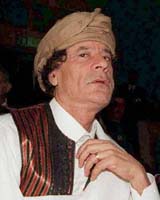
The Other Libyan Model
UPI Outside View Commentator Washington (UPI) Jul 06, 2006 On May 15 the U.S. State Department announced its intention to remove Libya from the U.S. list of states sponsors of terrorism and upgrade the diplomatic relationship between the two countries to the level of embassies. On May 31 the United States and Libya signed and exchanged the official documents establishing embassies in their respective capitals. Finally, last Friday, after the required 45 days period of notifying Congress which commenced on May 15, Libya was officially removed from the U.S. State Department's terrorism list. Since the end of 2003, when Moammar Gadhafi pre-surrendered publicly and gave up all materials and documents associated with his nominal WMD programs and committed himself to full cooperation with the U.S. and U.K. in the "war on terrorism," the main thrust behind the Bush administrations reengagement policy with Libya has been the basic notion that accepting Libya back into the international order and rewarding it publicly with removal from the terrorism list and establishing full diplomatic relations, will serve as a model for other countries in the world, namely Iran and North Korea, to follow suit. That view has been dismissed as na�ve by many. The argument is that both Iran and North Korea don't fall in the same category. Libya's despotic regime is one of the feeblest in the world and thus one of the easiest to extract these kinds of concessions from with minimum price. After almost three years, we have been proven right. No other country, Iran, North Korea, not even Syria, have followed, nor even appear in the slightest to be considering, this so-called "Libya Model." Worst still, Gadhafi and other Libyan officials themselves have been whining publicly and privately that they have been disappointed by how they have been treated by the United States. They say that the U.S. has been too slow to re-establish full diplomatic links with Libya since 2003, when they thought they have reached an agreement. With this, it's almost idiotic to still assume that any other country will still consider this "model" as remotely attractive, especially since the Libyans themselves seem to be saying it has not been worth it. There is another, more obvious, "Libya Model" however for many throughout the Arab and Muslim world, one which seems to be intentionally ignored by the Bush administration as it tries to spin its Libya policy as a success. Support for democratization and respect for Human Rights in the Arab world, a corner stone of a new American Middle East policy, as articulated by the president and other senior U.S. officials for the past few years, is now evidently dead. The public embrace of Gadhafi's Libya, the Arab world's most vile, soon may be hereditary, dictatorship, with a rap-sheet that comes very close to that of Saddam Hussein's family Inc. in Iraq in earlier times, is a very loud and clear message to Arab dictatorships and the marginalized democratic groups throughout the region that the U.S. can easily and cheaply be bought off without so much as even a superficial step towards any sort of democratic reform. This deepens the credibility crises of the U.S. in that part of the world and leaves most Arabs with the inescapable conclusion that political change and reform in the Arab world can only be obtained despite the U.S. not with its help. In short, the only alternative left in the region now after the failure of both the Iraq and Libya models is the Hizbullah, the Muslim Brotherhood and Hamas Models in Lebanon, Egypt and Palestine. The U.S. should, and still can, turn Libya to a convincing model for the president's public pledges to support democratic reform in the region. President Bush should exert public pressure on Libya's dictator to reform his farcical political system with one that should at least resemble Libya's exemplary constitution of 1952 which Gadhafi abolished upon taking power through a military coup in 1969. At minimum, this will restore some credibility to the U.S. and demonstrate to the other despots in the region and beyond that putting a halt to their domestic terrorism practices against their own people, who view these "leaders" as Washington's puppets, is just as important to us as stopping their international terrorism support or handing over the scrap metal that they dreamed of using one day to develop WMDs. It's about time that our policy in the region should be geared towards strengthening our links with its people and not continue to rely on autocratic rulers whose legacy will not be any better than that of the shah of Iran. Hafed Al-Ghwell is a Libyan American who lives and works in Washington DC. He can be reached at [email protected] or through his personal blog at http://www.hafed.com. United Press International's "Outside View" commentaries are written by outside contributors who specialize in a variety of important issues. The views expressed do not necessarily reflect those of United Press International. In the interests of creating an open forum, original submissions are invited.
Source: United Press International Community Email This Article Comment On This Article Related Links Learn about nuclear weapons doctrine and defense at SpaceWar.com Learn about nuclear weapons doctrine and defense at SpaceWar.com Learn about missile defense at SpaceWar.com All about missiles at SpaceWar.com Learn about the Superpowers of the 21st Century at SpaceWar.com
 Calling The Bluff On North Korea
 Washington (UPI) Jul 06, 2006
North Korea may have gambled -- and lost -- while playing a game of nuclear/missile chicken with the United States. The reclusive communist state, the only remaining Stalinist regime on the planet, can hardly feed its population. |
|
|

| The content herein, unless otherwise known to be public domain, are Copyright 1995-2006 - SpaceDaily.AFP and UPI Wire Stories are copyright Agence France-Presse and United Press International. ESA PortalReports are copyright European Space Agency. All NASA sourced material is public domain. Additionalcopyrights may apply in whole or part to other bona fide parties. Advertising does not imply endorsement,agreement or approval of any opinions, statements or information provided by SpaceDaily on any Web page published or hosted by SpaceDaily. Privacy Statement |