|
 |
 |
 |
 |
 |
 |
 |
 |

 |
The Oldest Explosion In The Universe
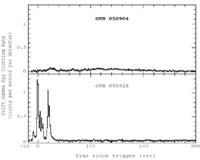
Palermo, Italy (SPX) Mar 16, 2006 Astronomers have detected the most distant - and therefore oldest - gamma-ray burst ever. The burst, called GRB 050904, was observed last September and is thought to have come from an explosion that happened around 12.8 billion years ago, when the universe was just 7% of its current age. The explosion released an intense flash of gamma rays that has been measured by three independent teams of astronomers from the US, Italy and Japan. The results - reported in three papers in this week's Nature - could help shed more light on the dynamics of the early universe. Gamma-ray bursts are violent explosions that give off intense flashes of gamma rays that can last from a few milliseconds to about a hundred seconds. The initial burst of gamma rays is followed by an "afterglow" of longer wavelength radiation that can last for weeks or even years. Many astronomers believe that gamma-ray bursts happen when a massive star undergoes a supernova explosion at the end of its life and collapses to form a black hole. GRB 050904, which lasted just 80 seconds, was detected on 4 September 2005 by NASA's Swift satellite, which contains a gamma-ray monitor that was able to determine the position of the burst. Giancarlo Cusumano of the National Institute for Astrophysics in Palermo in Italy and colleagues describe how, within seconds, the satellite turned around to direct its built-in X-ray telescope at the region of sky where the burst had occurred (Nature 440164). This then allowed astronomers at other optical and infrared telescopes around the world to search and measure the burst's afterglow. A second team led by Nobuyuki Kawai at the Tokyo Institute of Technology in Japan reports on how it measured the afterglow of GRB 050904 at optical wavelengths (Nature 440 184). In the final paper, a group led by Daniel Reichart of the University of North Carolina in the US describes how it measured the afterglow at longer, near-infrared wavelengths (Nature 440 181). In astronomy, distance, time and the wavelength at which observations are made are all linked. Light travels at a finite speed and so takes a certain time to reach us. Distant objects are therefore seen as they were in the far-off past. Cosmologists generally use the "redshift", z, to define distance, or how far away in the past an object actually is. With a redshift of about 6.3, GRB 050904 is the most distant stellar explosion ever observed and occurred when the universe was only about 900 million years old. The current age of the universe is thought to be 13.7 billion years. The researchers believe that other distant gamma-ray bursts could now be detected. Such bursts could be used to study how the first generation of stars in the early universe formed. Community Email This Article Comment On This Article Related Links Tokyo Institute of Technology Stellar Chemistry, The Universe And All Within It
 River Of Stars Flows Through Milky Way
 Pasadena CA (SPX) Mar 15, 2006
Astronomers have discovered a narrow stream of stars extending at least 45 degrees across the northern sky. The stream is about 76,000 light-years distant from Earth and forms a giant arc over the disk of the Milky Way galaxy. |
|
|

| The content herein, unless otherwise known to be public domain, are Copyright 1995-2006 - SpaceDaily.AFP and UPI Wire Stories are copyright Agence France-Presse and United Press International. ESA PortalReports are copyright European Space Agency. All NASA sourced material is public domain. Additionalcopyrights may apply in whole or part to other bona fide parties. Advertising does not imply endorsement,agreement or approval of any opinions, statements or information provided by SpaceDaily on any Web page published or hosted by SpaceDaily. Privacy Statement |