|
 |
 |
 |
 |
 |
 |
 |
 |

 |
The Mystery of the Fins
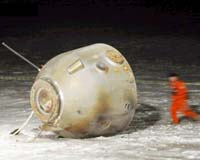
Sydney - Feb 12, 2003 As we await the launch of China's first astronaut, expected in October this year, it's time to review some of the remaining mysteries of the Chinese Shenzhou human spaceflight program. It would seem that Shenzhou 4, which blasted off towards the end of 2002 and landed in early 2003, was a generally successful flight. We saw it take off, watched video footage beamed back from orbit, and then saw the descent capsule resting on a snow-covered plain. Any problems with the flight, assuming they exist, are probably minor. The tinkering with Shenzhou's basic design has come to an end, and it works. But one mystery with the program has apparently not been discussed extensively by Chinese officials: The fins on the side of the Long March 2F. In some photographs of the vehicle, slim trapezoidal fins can be seen attached to the side of the boosters clustered around the vehicle's first stage. In other photographs, these fins are nowhere to be seen. Why? The mystery begins with the very first photographs ever glimpsed of the Long March 2F. These were leaked onto the Internet in 1999 amid circumstances that have never been properly explained. The controversial images depicted a rocket that's essentially the same as every official photograph of the 2F, but also set an interesting precedent. The vehicle was finless. Go forward to official photography of the Shenzhou 1 launch, which happened just weeks after the first images were leaked. Fins could be seen in images of the vehicle on the pad before launch, and are also apparently visible in photographs of the rocket during its launch. Images release for Shenzhou 2 tell a slightly different story. Photography of the launch shows fins, but at least one image that is supposed to show the Shenzhou 2 launch vehicle being rolled out to the launchpad depicts a finless rocket. Shenzhou 3 followed a similar pattern. Some images released by the Chinese show a finless rocket during its rollout. The photography of Shenzhou 3 during its launch is relatively unclear, but it would seem that the vehicle has suddenly sprouted fins! Shenzhou 4 featured fins in images of its launch, but I have yet to see any rollout images for the vehicle. What's going on? Are we seeing photographs of different rockets, some with fins, some without? Have the Chinese simply used stock photography of an earlier finless version of the Long March 2F, without any attention to continuity? The answer to this mystery has come from the veteran space analyst Chen Lan. The Long March 2F has its fins added only when it is actually on the launchpad! This form of construction is somewhat unique. Most rockets simply don't undergo such a modification at such a late stage in their rollout. But there are practical reasons for doing this. The fins make the Long March 2F considerably wider, which could make it more difficult to transport the rocket through hangar doors. Adding them after transport, when there is no chance of them colliding with another object, must make logistics easier. The fins are not especially complex items. They do not require power, data integration or fuelling. So installing them would not require much in the way of special handling. It's a much-celebrated fact that the dimensions of some rockets were dictated by their heritage as ballistic missiles. The vehicles had to conform to specific widths to allow them to be transported on rail lines and other forms of transport. Shenzhou's fins are another reminder that the journey to space starts long before a vehicle leaves the launchpad. Dr Morris Jones is a Sydney-based journalist. Email morrisjonesNOSPAMhotmail.com. Replace NOSPAM with @ to send email. CommunityEmail This Article Comment On This Article Related Links SpaceDaily Search SpaceDaily Subscribe To SpaceDaily Express The Chinese Space Program - News, Policy and Technology China News from SinoDaily.com
 Taikonauts On Moon A Far Off Dream For China Yet
 Beijing (XNA) Jan 05, 2006
A one-year lunar fly-by mission may start in April 2007 in China, but a manned flight to the Earth's neighbour may be a long way away, a chief lunar exploration scientist said last night. |
|
|

| The content herein, unless otherwise known to be public domain, are Copyright 1995-2006 - SpaceDaily.AFP and UPI Wire Stories are copyright Agence France-Presse and United Press International. ESA PortalReports are copyright European Space Agency. All NASA sourced material is public domain. Additionalcopyrights may apply in whole or part to other bona fide parties. Advertising does not imply endorsement,agreement or approval of any opinions, statements or information provided by SpaceDaily on any Web page published or hosted by SpaceDaily. Privacy Statement |