|
 |
 |
 |
 |
 |
 |
 |
 |

 |
The Mothman Adventures
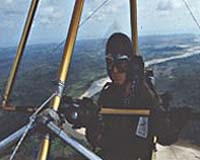
London, England (SPX) Nov 22, 2005 Until aliens are found, astrobiologists have to content themselves with studying weird life on Earth. Studies of organisms living in harsh or unusual environments here can suggest the possibilities for life elsewhere in the universe. Astrobiologists therefore have fascinating adventures in some of the world's most exotic places. Charles Cockell, professor and chair of microbiology at the Open University in the UK, has been to the ends of the Earth studying different organisms. Before his career as an astrobiologist began, he went on an expedition to fly around the forests of Indonesia like a giant bug. In a recent interview with Astrobiology Magazine, Cockell described how he outwitted moths and the military, only to be brought down by a rogue tree. "I'm fascinated where the connections lie between Earth and space exploration. You study extreme environments on Earth as a path to space exploration, and you send satellites into space to monitor environments on Earth. This connection between natural sciences and space exploration has gone on for a long time, and I've always sought ways to bring those two things together. I managed to combine exploration with aeronautics in one of my earlier expeditions. It all started when I wanted to go to Mongolia to collect moths for the Natural History Museum in London. Mongolia was Communist then, so it was difficult for a westerner to get into the country. When I called up the Mongolian Embassy in London and said I wanted to organize an expedition, they just slammed the phone down on me. We tried to get into Mongolia for four years, and eventually the foreign ministry in the UK gave me 20 minutes with the Mongolian science minister to try to convince him. That worked, and we went to Mongolia in 1990, arriving the day after the first free elections. It was the first western scientific expedition to enter post-communist Mongolia. We drove through the Gobi Desert collecting moths until we got to the south, and we drove up across the north of Mongolia into the forests. We were trying to catch moths in the trees, and to do this you get very powerful lamps, put them out against a white sheet, and the moths are supposed to fly down and land on the sheet. But we soon realized the moths from the top of the trees didn't want to come down. They would fly halfway down, take one look at us, and go back up again. When we were sitting around the campfire that evening I said, "Wouldn't it be fantastic if you could solve this problem by getting in an aircraft and flying up to the moths over the treetops." Hence the idea was born for the Moth Machine: a moth-catching ultralight glider. When I got back to London, I immediately began to plan a moth-catching expedition to Indonesia. I took lessons to get my ultralight pilot's license. We designed a moth-catching ultralight: a fiberglass pod that you sit in, with a V-shaped wing above you. You hold onto this bar, and you're essentially rolling yourself underneath this wing, shifting your weight to navigate while flying. There are a number of ways in which you need to modify this basic design to catch moths over trees. First of all, you need some ultraviolet (UV) lights to attract moths, otherwise they're flying all over the tree canopy and you can't localize them. You need to be able to swoop the canopy with your UV lights to attract all the moths to one place. So we built UV lights on the front nose of the Moth Machine. You also need to be able to determine your height over the forest. Moths are active at dusk or in the dead of night, which leads to a small problem in terms of crashing into trees. To avoid this, you take two one-million-candle-power lamps and stick them on the front of the ultralight, pointing them downward so you can see where the trees are. But the other problem is that sometimes you get these rogue trees that will grow quite high, and stick above the canopy of the rainforest. If you're not careful, you'll fly straight into these trees. So you also need a rogue tree light. This is a lamp on the front of the ultralight that scans back and forth to keep an eye out for any tall trees. We also wore infrared night vision goggles to help us see. And then of course you need to catch the moths. You could just stick a butterfly net on the bottom of the ultralight, but then the moths will hit the net at cruising speed, which is about 40 miles an hour, and that will destroy their wings. So we attached something called the Reduced Airflow Moth Collection Device. It's like a lobster trap, with an inverted funnel and a net on the back. Because it's narrow at the front and wide at the back, as the air goes into the funnel it slows down and expands into the space. The net at the back is pleated, and the moths hit the back of the net and get stuck in the pleats, and that protects them until you land. So we built this thing, packaged it all up, and sent it over to Indonesia in the summer of 1993. But the Indonesian government wouldn't let us take it out of customs because they thought we were using it to prospect for oil. So we had to pay the Indonesian military a hefty bribe to get our Moth Machine out of customs. We couldn't find a trailer to haul it around, so we had to build one. Then we drove up to the rainforests of Sumatra, trailing our Moth Machine behind our truck. We camped out in a hut in the middle of the rain forest, and there was a tiny village nearby with a school, and we commandeered the drive of the school as our runway. We did some test runs around the village to make sure the wings were still functioning. The villagers had never seen anything like this, and they called it "Besar Ayam," which is Indonesian for "Big Chicken." We flew the Moth Machine over the rainforests for about 2 or 3 weeks, and caught moths on the ground as well. In total, we collected about 8,000 moths from Sumatra. About half way through the expedition I was bringing the Moth Machine in to land at the edge of the rainforest. I think it must have clipped a tree, but I'm not really sure what occurred because it happened so quickly. The next thing I knew, I was sitting on the ground surrounded by the wreckage of the Moth Machine. I was quite lucky, because I was completely uninjured. I wasn't even knocked unconscious. According to the village locals, the Moth Machine somersaulted three times before it hit the ground nose first. It was completely destroyed. The locals thought this was the funniest thing that had happened in a long time, and they decided to throw a big party. So we all got together, and the local children came over and performed a salute over the mashed-up Moth Machine. Now we needed to find a way to salvage our expedition. The Indonesians had been training people to ride elephants, because they're concerned about poaching, and they would ride around the rainforests on elephant back keeping track of the other elephants. So we had this idea that we could rent a herd of elephants and go moth-catching on elephant back. We telexed the Times in London, who was one of our sponsors, and said, "Destroyed the Moth Machine, but we're switching to moth-collection by Jumbo." So that's how we finished out our expedition, going into the forest on the backs of elephants with butterfly nets and lamps to collect moths. Three years later I was in Antarctica at the U.S. McMurdo station giving a lecture about the Moth Machine experience. Some naval airmen were watching the lecture, and they got really enthusiastic, and we came up with an idea for a moth-catching helicopter. We drew a diagram of an Apache helicopter gunship with a moth-catching device underneath, but unsurprisingly it never got built. So that was the end of my moth-catching experience with aircraft." Community Email This Article Comment On This Article Related Links Open University SpaceDaily Search SpaceDaily Subscribe To SpaceDaily Express Darwin Today At TerraDaily.com
 UC Davis Expert Writes Key Report On Controversial UK Badger Killings
 Davis CA (SPX) Dec 15, 2005
UC Davis scientist Rosie Woodroffe is co-author of two reports released today in Great Britain that say the controversial practice of killing wild badgers to prevent tuberculosis in cattle can actually make matters worse. |
|
|

| The content herein, unless otherwise known to be public domain, are Copyright 1995-2006 - SpaceDaily.AFP and UPI Wire Stories are copyright Agence France-Presse and United Press International. ESA PortalReports are copyright European Space Agency. All NASA sourced material is public domain. Additionalcopyrights may apply in whole or part to other bona fide parties. Advertising does not imply endorsement,agreement or approval of any opinions, statements or information provided by SpaceDaily on any Web page published or hosted by SpaceDaily. Privacy Statement |