|
 |
 |
 |
 |
 |
 |
 |
 |

 |
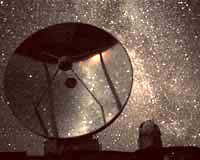
The Milky Way Above La Silla
Garching, Germany (SPX) Sep 30, 2004 Anybody who visits a high-altitude astronomical observatory at this time of the year will be impressed by the beauty of the Milky Way band that stretches across the sky. Compared to the poor views from cities and other human conglomerations, the dark and bright nebulae come into view together with an astonishing palette of clear stellar colours. This view above the ESO La Silla Observatory in the southernmost part of the Atacama desert was obtained some evenings ago by ESO Software Engineer Nico Housen. Normally stationed at the Paranal Observatory, he seized the opportunity of a visit to ESO's other observatory site to produce this amazing vista of the early evening scenery. To the left is the decommisioned 15-metre dish of the Swedish- ESO Submillimetre Telescope (SEST), and on the right in the background is the dome of the ESO 3.6-metre telescope, at the highest point of the mountain. The southern Milky Way is seen along the right border of the SEST and above the 3.6 metre telescope. There is an upside-down reflection of the sky and the horizon behind the photographer in the highly polished antenna dish of the SEST. Besides the reflection of the horizon (the darker part in the top of the dish) and the Milky Way (which runs as a thin cloud from the bottom of the dish up to the horizon) there is also a yellow area of light to the right. This is the reflection of the city lights of the city of La Serena, about 100 km away and too faint to disturb observations of celestial objects high above La Silla. The 3.6-m telescope began operations in 1976 and was ESO's largest telescope until the advent of the VLT at Paranal. Never endowed with a fancy name like the VLT Unit telescopes, the "3.6-m" houses several state-of-the-art astronomical instruments, including the ultra-precise HARPS facility that is used to hunt for exoplanets, cf. ESO PR 22/04. The SEST was for a long time the only instrument of its kind in the southern hemisphere. With it, ESO gained invaluable experience in ground-based non-optical observations, paving the way for the ALMA project. The Atacama Large Millimetre Array (ALMA) is one of the largest ground-based astronomy projects of the next decade after the ESO VLT. Its construction started last year and will be completed by 2011. When ready, it will be the largest and most sensitive astronomical observatory of its kind, comprisiing some sixty-four 12-m antennas located on a 10-km wide plateau at a 5000-m elevation in the Atacama Desert. More information on ALMA can be found on ESO PR 29/03 or on the ESO ALMA web page.ESO PR Photo 27/04 may be reproduced if Nico Housen and the European Southern Observatory are mentioned as source. CommunityEmail This Article Comment On This Article Related Links SpaceDaily Search SpaceDaily Subscribe To SpaceDaily Express Nuclear Space Technology at Space-Travel.com
 Carina Nebula Dust Pillars Harbor Embedded Stars
 Boulder CO (SPX) May 31, 2005
Astronomers using NASA's Spitzer Space Telescope have imaged a giant molecular cloud being shredded by howling stellar winds and searing radiation, exposing a group of towering dust pillars harboring infant stars, according to a University of Colorado at Boulder researcher. |
|
|

| The content herein, unless otherwise known to be public domain, are Copyright 1995-2006 - SpaceDaily.AFP and UPI Wire Stories are copyright Agence France-Presse and United Press International. ESA PortalReports are copyright European Space Agency. All NASA sourced material is public domain. Additionalcopyrights may apply in whole or part to other bona fide parties. Advertising does not imply endorsement,agreement or approval of any opinions, statements or information provided by SpaceDaily on any Web page published or hosted by SpaceDaily. Privacy Statement |