|
 |
 |
 |
 |
 |
 |
 |
 |

 |
The Last Cry Of Matter
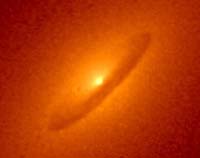
Paris - Dec 01, 2003 'Black holes' are truly black. When an object gets within a certain distance from a black hole, it will get swallowed forever with no chance to escape. That includes light, which means that black holes do not shine. How do astronomers detect black holes if they are unable to see them? Well, to be precise, astronomers do not detect black holes. But they do detect the phenomena that can only be explained by the existence nearby of objects that match the description of black holes! The strong gravitational attraction of a black hole affects the motion of nearby objects. When astronomers see a star circling around something, but they cannot see what that something is, they may suspect it is a black hole, or a neutron star -- the ultra-dense 'corpse' of a star. Astronomers can even infer the mass of a black hole by measuring the mass of the star and its speed. The same kind of calculation can be done whith supermassive black holes that lurk at the centre of many galaxies, including our own galaxy, the Milky Way. In the Milky Way, observations have revealed the existence of stars and gas moving very fast near the centre, a behaviour that can only be explained if a mass of several million times that of the Sun is at the centre of the galaxy. Such mass has to be concentrated within a radius of only 10 light-days -- roughly 40 times times the distance from the Sun to Pluto -- and is most likely to be a black hole. In fact, at the very centre of our galaxy, radio and X-ray telescopes have detected a powerful source called 'Sagittarius A', identified as the candidate to be this massive black hole. This idea has recently received strong support, with the measurement for the first time of the orbit of a star that approaches this mysterious object to within 17 light-hours -- only three times the distance between the Sun and Pluto -- while travelling at speeds of than 5000 kilometres per second!
Shining to death To explain the incredible amount of energy they must release, astronomers also need black holes: just before disappearing into a black hole, the matter being swallowed heats up and emits great amounts of energy -- its 'last cry'. So quasars are believed to be caused by black holes with masses of one million to several billion times the mass of the Sun. The 'last cry' of matter about to be swallowed is best detected with x-ray and gamma-ray telescopes, because the energy released is given off in the form of hard x-rays. In fact, ESA's orbiting observatories XMM-Newton and Integral have already shown their skills in studying black holes in several discoveries. For example, XMM Newton has recently discovered a small black hole whirling in our galaxy, in the Ara constellation of the southern sky. Integral has detected what could be the first significant hard x-ray emission from the black hole in the centre of our galaxy. Community Email This Article Comment On This Article Related Links Integral overview XMM-Newton overview SpaceDaily Search SpaceDaily Subscribe To SpaceDaily Express Black Hole Science and News
 MIT: SpInning Black Hole Leaves Dent In Space-Time
 Boston MA (SPX) Jan 12, 2006
MIT scientists and colleagues have found a black hole that has chiseled a remarkably stable indentation in the fabric of space and time, like a dimple in one's favorite spot on the sofa. |
|
|

| The content herein, unless otherwise known to be public domain, are Copyright 1995-2006 - SpaceDaily.AFP and UPI Wire Stories are copyright Agence France-Presse and United Press International. ESA PortalReports are copyright European Space Agency. All NASA sourced material is public domain. Additionalcopyrights may apply in whole or part to other bona fide parties. Advertising does not imply endorsement,agreement or approval of any opinions, statements or information provided by SpaceDaily on any Web page published or hosted by SpaceDaily. Privacy Statement |