|
 |
 |
 |
 |
 |
 |
 |
 |

 |
The Invasion of the Deep-Sea Microbes
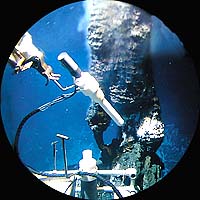
Moffett Field - Nov 6, 2001 On the deep sea floor, along the margins of diverging plates of ocean crust, communities of microscopic organisms live around hot volcanic vents. These seafloor hydrothermal systems have probably existed on Earth since the oceans first formed, more than four billion years ago. The microscopic life around the vents may also have an ancient heritage -- genetic comparisons suggest that modern vent microbes are close kin to the earliest forms of life on Earth. These regions are therefore of special interest to astrobiologists, who study the geology, chemistry, and biology of hydrothermal vents to better understand how Earth's early biosphere emerged. A team of scientists is presently using the deep sea submersible "Alvin" to further study these important communities. Alvin has a depth range of 4500 meters (2.8 miles), and therefore gives scientists access to the deep, high-pressure regions where these vents exist. Arizona State University professors John Holloway and Peggy O'Day have teamed with microbiologist Craig Cary from the University of Delaware for this new study. They hope to learn more about how the biology of hydrothermal vent communities may be affected by differences in vent chemistry and mineralogy. The team is exploring deep-sea vents located at a latitude of nine degrees North of the equator, along a large seafloor mountain chain called the East Pacific Rise. Where hot water exits the seafloor, tube-like structures called "chimneys" form. The chimneys expel dark clouds of sulfide minerals, giving them the nickname "black smokers." The expelled sulfur cools upon contact with seawater, and adds to the size of the chimney structures over time - some have reached heights in excess of 60 meters (about 200 feet). Previous studies of seafloor vent fields have revealed the existence of a wide variety of chimney types, each showing large differences in chemistry. As the chimneys grow over time, their physical, chemical and mineralogical properties change and create new habitats for life. But scientists still know very little about how microbial organisms respond to these environmental changes. Using a newly designed sampling system, the scientists will collect some of the smaller chimney structures. The team will also sample vent waters to determine any chemical differences, and monitor how heat-loving microbes -- known as thermophiles -- colonize actively forming vent surfaces. By studying the succession of microbial species that colonize chimneys, the team hopes to improve our understanding of how such processes may have driven patterns of diversification in early vent environments. Studies of vent chemistry will also provide basic information about how deep sea vent processes may have affected the overall geochemical balance of the Earth's oceans and atmosphere during our planet's history. The scientists plan to use the collected information to design a new experimental laboratory at ASU. This laboratory will simulate the broad range of pressure and temperature conditions observed in natural vent systems, and enable scientists to study how microbiology varies under these conditions. Community Email This Article Comment On This Article Related Links NASA Astrobiology Institute SpaceDaily Search SpaceDaily Subscribe To SpaceDaily Express Dirt, rocks and all the stuff we stand on firmly
 Magnetic Reconnection Region Larger Than 2.5 Million Km Found In The Solar Wind
 Paris (ESA) Jan 12, 2006
Using the ESA Cluster spacecraft and the NASA Wind and ACE satellites, a team of American and European scientists have discovered the largest jets of particles created between the Earth and the Sun by magnetic reconnection. This result makes the cover of this week's issue of Nature. |
|
|

|
|
|
|
|
|
|
|
|
|
|
|
| The content herein, unless otherwise known to be public domain, are Copyright 1995-2006 - SpaceDaily.AFP and UPI Wire Stories are copyright Agence France-Presse and United Press International. ESA PortalReports are copyright European Space Agency. All NASA sourced material is public domain. Additionalcopyrights may apply in whole or part to other bona fide parties. Advertising does not imply endorsement,agreement or approval of any opinions, statements or information provided by SpaceDaily on any Web page published or hosted by SpaceDaily. Privacy Statement |