|
 |
 |
 |
 |
 |
 |
 |
 |

 |
The Inconstant Sun
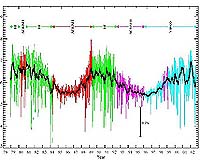
Huntsville - Jan 20, 2003 Our Sun may seem an enduring, unwavering beacon in the sky, but in truth it has a "heartbeat" of sorts--a pulsation between dimmer and brighter phases so slow that it only "beats" 9 times each century! It's understandable that you might not have noticed. The pulsing is not only slow, it's also subtle. The total energy coming from the Sun only varies by about 0.1% over each 11-year cycle. For a long time scientists didn't notice it either, which is why the Sun's intensity is called, ironically, the "solar constant." The intensity of the Sun varies along with the 11-year sunspot cycle. When sunspots are numerous the solar constant is high (about 1367 W/m2); when sunspots are scarce the value is low (about 1365 W/m2). Eleven years isn't the only "beat," however. The solar constant can fluctuate by ~0.1% over days and weeks as sunspots grow and dissipate. The solar constant also drifts by 0.2% to 0.6% over many centuries, according to scientists who study tree rings. These small changes can affect Earth in a big way. For example, between 1645 and 1715 (a period astronomers call the "Maunder Minimum") the sunspot cycle stopped; the face of the Sun was nearly blank for 70 years. At the same time Europe was hit by an extraordinary cold spell: the Thames River in London froze, glaciers advanced in the Alps, and northern sea ice increased. An earlier centuries-long surge in solar activity (inferred from studies of tree rings) had the opposite effect: Vikings were able to settle the thawed-out coast of Greenland in the 980s, and even grow enough wheat there to export the surplus to Scandinavia. Researchers still aren't sure how small changes in the Sun's output nudge Earth's climate in one direction or another. To find the answer, they need to monitor our climate and keep a finger on the Sun's "pulse" for many decades running. "Consistency in this data record is crucial," says Alexandre Joukoff, a scientist at the Royal Meteorological Institute of Belgium who studies the solar constant. "Gaps or flaws in the record undermine our ability to use statistics to draw strong conclusions about phenomena such as Earth's climate." Getting consistent measurements from the ground is tricky, explains Joukoff, because Earth's changing seasons and weather cause sunlight hitting the ground to wax and wane. On average, clouds and the atmosphere absorb or reflect 51 percent of the incoming sunlight, and this can vary widely between overcast and cloudless days. The best place to measure the solar constant is high above the clouds--in space. But there's a problem there, too: The typical design-life of most satellites is only 5 to 10 years; after that, fuel runs out and the satellite goes cold and quiet. They're not around long enough to measure the solar constant for decades-long stretches. When new satellites are launched to replace dying ones, it's hard to know if a reading of, say, "10 units" from the new satellite truly equals "10 units" measured by the old one, making the consistency of the data record uncertain. Furthermore, satellite sensors degrade as they age--a result of sustained exposure to solar ultraviolet radiation. From this patchwork of aging satellites and sensors, scientists somehow need to assemble a continuous, consistent record of the Sun's intensity over 30 ... 40 ... 50 or more years! "SOLCON is what makes that possible," says Joukoff. SOLCON, short for "Solar Constant radiometer," is a high-precision solar-intensity sensor that Joukoff and colleagues keep at the Royal Meteorological Institute of Belgium. By sheltering the sensor from UV radiation and rarely using it, they spare this "gold standard" instrument from most of the effects of aging, making it a dependable touchstone over the years. Every few years they fly SOLCON on a short mission into space to spot-check the agreement of Sun-watching satellites in orbit at the time. In fact, SOLCON is in orbit now. It's one of the 80+ experiments onboard the space shuttle Columbia (STS-107), which left Earth on January 16th for a 16-day research mission. Researchers will use the sensor in the days ahead to spot-check two satellites: the Solar and Heliospheric Observatory (SOHO) and ACRIM-3. Adjusted to match SOLCON, the separate records from these satellites and others can then be stitched together into a continuous history of our Sun's cycles of brightness--a kind of long-term "EKG" readout for our pulsing star. "This kind of data is invaluable because it helps us understand the past as well as the future," notes Paal Brekke, the deputy project scientist for SOHO. "Methods for estimating the Sun's intensity hundreds of years ago, such as measuring the cosmic ray-generated carbon-14 embedded in the rings of old trees, can be improved by comparing those clues today with a reliable satellite record. In principle, SOLCON is like an old-fashioned two-pan balance--but for heat instead of mass. It consists of two identical chambers and a device between them that detects any heat moving from one chamber to the other. One chamber is opened to incoming sunlight via a very precise aperture. The other "reference" chamber is kept closed and heated only electrically. To measure intensity of incoming sunlight, the device adjusts the current to an electric heater in the sun-exposed chamber until no heat flows between the chambers--that is, until the "scales" are balanced. The amount of current required to achieve a balance is a measure of the energy in the sunlight. Most solar intensity sensors in orbit operate in this way. Eventually, even SOLCON will need to be replaced. One candidate for its successor is the Total Irradiance Monitor (TIM) built by the Laboratory for Atmospheric and Space Physics in Colorado. TIM is very similar to SOLCON, except that it uses four chambers instead of two for better internal cross-checking of instrument aging. The date has not yet been set, but when the day comes, the successor will fly a single mission--probably a shuttle research mission like STS-107--in tandem with the old instrument in order to assess the new sensor's accuracy. After that, SOLCON will finally be retired. The Sun, of course, will keep on going--but if all goes as planned, we won't miss a beat. Community Email This Article Comment On This Article Related Links SpaceDaily Search SpaceDaily Subscribe To SpaceDaily Express Dirt, rocks and all the stuff we stand on firmly
 Magnetic Reconnection Region Larger Than 2.5 Million Km Found In The Solar Wind
 Paris (ESA) Jan 12, 2006
Using the ESA Cluster spacecraft and the NASA Wind and ACE satellites, a team of American and European scientists have discovered the largest jets of particles created between the Earth and the Sun by magnetic reconnection. This result makes the cover of this week's issue of Nature. |
|
|

| The content herein, unless otherwise known to be public domain, are Copyright 1995-2006 - SpaceDaily.AFP and UPI Wire Stories are copyright Agence France-Presse and United Press International. ESA PortalReports are copyright European Space Agency. All NASA sourced material is public domain. Additionalcopyrights may apply in whole or part to other bona fide parties. Advertising does not imply endorsement,agreement or approval of any opinions, statements or information provided by SpaceDaily on any Web page published or hosted by SpaceDaily. Privacy Statement |