|
 |
 |
 |
 |
 |
 |
 |
 |

 |
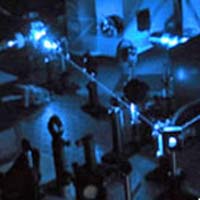
The Impossible Is Possible: Laser Light From Silicon
Providence RI (SPX) Nov 22, 2005 Since the creation of the first working laser � a ruby model made in 1960 � scientists have fashioned these light sources from substances ranging from neon to sapphire. Silicon, however, was not considered a candidate. Its structure would not allow for the proper line-up of electrons needed to get this semiconductor to emit light. Now a trio of Brown University researchers, led by engineering and physics professor Jimmy Xu, has made the impossible possible. The team has created the first directly pumped silicon laser. They did it by changing the atomic structure of silicon itself. This was accomplished by drilling billions of holes in a small bit of silicon using a nanoscale template. The result: weak but true laser light. Results are published in an advanced online edition of Nature Materials. The feat is an apt one for Xu, whose Laboratory of Emerging Technologies is alternately known as the Laboratory of "Impossible" Technologies. "There is fun in defying conventional wisdom," said Xu, the Charles C. Tillinghast Jr. '32 University Professor, "and this work definitely goes against conventional wisdom � including my own." Right now, the possible is not yet practical. In order to make his silicon laser commercially viable, Xu said, it must be engineered to be more powerful and to operate at room temperature. (Right now, it works at 200�C below zero.) But a material with the electronic properties of silicon and the optic properties of a laser would find uses in both the electronics and communications industries, helping to make faster, more powerful computers or fiber optic networks. Xu said that when lasers were invented, they were considered a solution looking for a problem. Now lasers are used to power CD players and barcode scanners and cut everything from slabs of steel to delicate eye tissue during corrective surgery. "Every new discovery in science eventually finds an application," Xu said. "It will just take years of work to develop the technology." Light emission from silicon was considered unattainable because of silicon's crystal structure. Electrons necessary for laser action are generated too far away from their "mates." Bridging the distance would require just the right "matchmaker" phonon, arriving at precisely the right place and time, to make the atomic connection. In the past, scientists have chemically altered silicon or smashed it into dust-like particles to generate light emission. But more light was naturally lost than created. So Xu and his team tried a new way to tackle the problem. They changed silicon's structure by removing atoms. This was accomplished by drilling holes in the material. To get the job done, the team created a template, or "mask," of anodized aluminum. About a millimeter square, the mask features billions of tiny holes, all uniformly sized and exactly ordered. Placed over a bit of silicon then bombarded with an ion beam, the mask served as a sort of stencil, punching out precise holes and removing atoms in the process. The silicon atoms then subtly rearranged themselves near the holes to allow for light emission. The new silicon was tested repeatedly over the course of a year to ensure it met the classical criteria of a laser, such as threshold behavior, optical gain, spectral line-width narrowing, and self-collimated and focused light emission. Xu credits Sylvain Cloutier, a Ph.D. student and the Nature article's first author, with the success of the experiment. "The whole thing started with my hunch that silicon could be altered this way and might surprise us with new behavior," Xu said. "But Sylvain took the idea and ran. He conducted the first tests and set up the measurements. And he was skillful and careful enough to catch the first faint bit of laser light from the nanostructured silicon." "I felt thrilled and really curious when I first observed the light emission," Cloutier said, "but I also knew there would be a lot of work ahead before demonstrating laser action." Postdoctoral research fellow Pavel Kossyrev independently verified the process and the results. Community Email This Article Comment On This Article Related Links Brown University Defense Advanced Research Projects Agency Office of Naval Research John Simon Guggenheim Memorial Foundation SpaceDaily Search SpaceDaily Subscribe To SpaceDaily Express Space Technology News - Applications and Research
 LIGO Up And Running, But Gravity Waves Remain Elusive
 Washington DC (SPX) Jan 10, 2006
Scientists working on the Laser Interferometer Gravitational-Wave Observatory said Monday the facility has reached its target detection sensitivity, but the goal of finding the elusive phenomena known as gravity waves remains as elusive as ever. |
|
|

| The content herein, unless otherwise known to be public domain, are Copyright 1995-2006 - SpaceDaily.AFP and UPI Wire Stories are copyright Agence France-Presse and United Press International. ESA PortalReports are copyright European Space Agency. All NASA sourced material is public domain. Additionalcopyrights may apply in whole or part to other bona fide parties. Advertising does not imply endorsement,agreement or approval of any opinions, statements or information provided by SpaceDaily on any Web page published or hosted by SpaceDaily. Privacy Statement |