|
 |
 |
 |
 |
 |
 |
 |
 |

 |
The Ice Man Cometh!
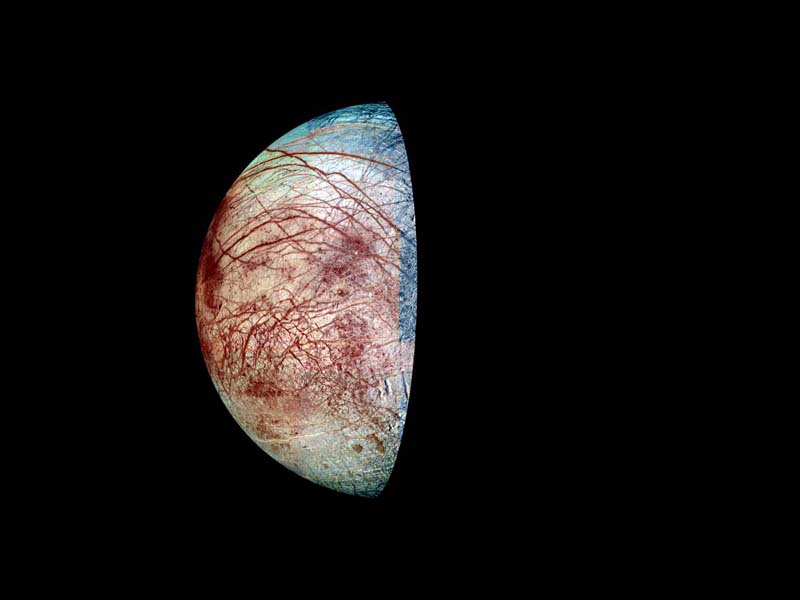
Sydney - July 20, 2001 Dr Charles Elachi is the recently appointed head of NASA's Jet Propulsion Laboratory in Pasadena, California. A softly spoken diplomat of hi-tech, he travels the world drumming up support for some of the wildest ideas in the history of exploration. JPL doesn't do jet work any more - they haven't since the early 50s, but the name has stuck. These days they design and run robotic interplanetary missions. You might have noticed that all the astounding pictures of the rings of Saturn and the clouds of Jupiter are credited "JPL/NASA". There's a reason for this. They took the pictures. Elachi was in Australia a couple of weeks back, gently insisting that Canberra should have a long hard look at the sky, and maybe let his outfit upgrade the Deep Space Network tracking station a few kilometres from Parliament House. He didn't get any argument from the local boys - hell, NASA is paying for it. Well, it had to be done. NASA's got a lot on its plate right now and they need a few new antennae. Mars shots are running at two a year. The Casinni probe is getting close to Saturn, and its intriguing, cloud-shrouded moon Titan. Galileo still spins around Jupiter, sending back incredible images despite being well past its use-by date. Voyagers One and Two, even the Pioneers from the early 70s, they all keep sending back interesting numbers from the back of beyond. Deep Space #1 thru #4, the Deep Impact comet shot - it's getting busy out there. On top of which, every new probe sends back hundreds of times more data ten times faster than its predecessor. We have to keep our ears open, and Australia has NASA's only ear south of the equator and this side of the date line. The information traffic jam will only get worse. Crikey, there are asteroids, comets, moons and no end of solar and planetary work. Space is indeed huge, and there's a lot to look at. So where do you go? How do you get there and how do you pay for it? What's important and what isn't? Elachi's job is to set priorities, but in the same way that a five-year-old sets priorities in a lolly shop. "Hey! I want it all!" Just as a "for instance", there's much heated argument going on about launching a Pluto probe before the planet moves so far from the sun that its atmosphere freezes out. After 2020 it spends over a century in the darkest outer reaches, where fly-past instruments won't be able to take its chemical pulse. There's talk of� there's talk of everything. Elachi's job is to cut the talk back to a reasonable discussion about the things that can actually be done. How important is the atmosphere of Pluto, anyway? Is it more important than, say, the origins of the moons of Neptune? Are they the same problem? I met the guy twice. I asked him about the nuclear heat he'd need to burn through the Europan ice, and the kind of flak he'd cop sending that much megatonnage into the Florida skies. (His answer? "Safety is paramount of course, but if you're scared of exploring, well, just shut the door and stay home�") But as a card-carrying space nut, I had to ask him what his In-tray looked like first thing in the morning. There wouldn't be another like it in the solar system. As it turns out, it's full of proposals from people who want to take pictures of the north pole of Mercury, the south pole of the moon, and everywhere in between and beyond. This doesn't bother him. "I've got the best job in the world," is how he put it. Yeah, this world or any other. A radar imaging man by trade, Elachi was literally instrumental in obtaining the stunning topographical vision we now have of the surface of Venus, buried as it is under a boiling sulphuric atmosphere 100 times denser than ours. He designed the gear (not alone, but it he was one of the first guys to punch the ceiling when it worked), and he got the pictures. The Magellan probe was a brilliant success. And while he never expects to get further from the earth than a trans-Pacific 747 can take him, he remains a realist with a wild imagination. This is his gig. Boy's Own space exploration. Elachi flies a desk and not an ion-drive sports capsule to be sure, but he has travel plans, no question about that. But he also has to deal with thousands of other people who have divergent itineraries. People who fly their own desks at very high speeds and have the data to prove it. They all want to go somewhere, and Elachi's job is to cut a practical shortlist from a myriad tantalising projects and forward it to NASA's head office, and, by inevitable extension, to the US Congress for funding. "We don't send wild concepts to NASA unless we think we can actually do the job," he says. "You see, when it comes down to it, if we get the money, it lands back on our desks and we have to make the thing work." It's all too true - sometimes it doesn't work. JPL have lost two Mars probes in the last five years. Just because you want to drill through the ice of Europa and see if anyone's home, you still have to convince a sceptical Congressman from Iowa that it's (a) feasible, and (b) worth doing in any case. What about the farmers? The missile guys? Urban decay? In Congressional budget hearings, the wish list is endless. Elachi's bottom line is good science, but he also knows that some projects are sexier than others. "Pathfinder amazed us," he recalls, speaking of the little remote-controlled car that rolled all of three or four metres over the Martian desert back in '97. "The public response to that mission astounded us. It was utterly unexpected that millions of people would hit our web site just to look at the rocks Pathfinder stumbled across. "But people were fascinated. And yes, it is fascinating. Still, it was nice to know that so many people shared our opinion. Oh, and we did some good science out there." But the sexiest search of all is the search for life. We all love aliens, whether we're monster movie fans or exobiologists. It's as true for Elachi as it is for the tragic Trekkie or the seven-year-old watching Dr. Who re-runs. I asked him the question he probably asks himself every day. Charles, if you could go anywhere, right now, where would it be? One eyebrow went up, he laughed, and said this� "Everywhere, but you can't. Still, there are three projects that fascinate me. The ice of Europa may cover an ocean, an ocean that may be warm enough to harbour life. We need to find out what's there. A discovery of that nature would be truly dramatic. "I'd also like to see a Mars rover than can explore over hundreds of kilometres, drill into the soil and return samples for analysis. This is well into the design and testing process and will actually happen before too long. "And ultimately I wish for the ability to look at nearby stars for earth-like planets. We are close to having that capability. We're looking at maybe ten or fifteen years. "For decades it has been said that we will never be able to do this, but now we are very close, and there are interferometry experiments about to fly which will get us closer still." 9 AM, Pasadena, August 2008. A man picks up a sheet of paper. "Confirmed. We have oxygen, water, traces of ozone, nitrogen - 150.000,000 kms from a G-type star 20 light years away�" Imagine having THAT in your in-tray on Monday morning! It's the memo Charles Elachi dreams of. Community Email This Article Comment On This Article Related Links SpaceDaily Search SpaceDaily Subscribe To SpaceDaily Express Space
 Satellite Launch To Boost DTH In India
 Calcutta, India (SPX) Dec 28, 2005
The successful launch Thursday of India's heaviest satellite from spaceport of Kourou in French Guyana may have boosted the country's space research efforts to yet another level, but it has also lifted the spirits of at least three Direct-To-Home televisions broadcasters, one of which has been waiting for years to launch its services in India. |
|
|

|
|
|
|
|
|
|
|
|
|
|
|
| The content herein, unless otherwise known to be public domain, are Copyright 1995-2006 - SpaceDaily.AFP and UPI Wire Stories are copyright Agence France-Presse and United Press International. ESA PortalReports are copyright European Space Agency. All NASA sourced material is public domain. Additionalcopyrights may apply in whole or part to other bona fide parties. Advertising does not imply endorsement,agreement or approval of any opinions, statements or information provided by SpaceDaily on any Web page published or hosted by SpaceDaily. Privacy Statement |